Kirjojen hintavertailu – 12 903 725 kirjaa ja 27 kauppaa

Kirjailija

Denis Lawton

Kirjat ja teokset yhdessä paikassa: 13 kirjaa, julkaisuja vuosilta 1998–2016, suosituimpiin kuuluu Class, Culture and the Curriculum. Vertaile teosten hintoja ja tarkista saatavuus suomalaisista kirjakaupoista.

13 kirjaa

Kirjojen julkaisuvuodet: 1998–2016.
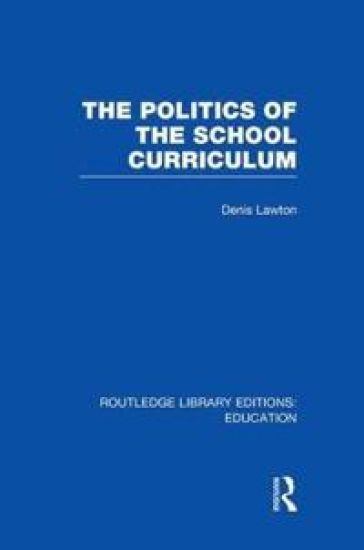
The Politics of the School Curriculum
If the curriculum can be defined as a ‘selection from the culture of society’, the central question then becomes ‘who selects’. This volume answers this question, reviewing various aspects of the curriculum and its planning. For many years the control of the curriculum was uncontroversial. In the 1970s this situation changed: teachers were increasingly criticised for having too much power; the Department of Education was suspected of wanting more control and local education authorities felt they should be more involved in curriculum planning. In reviewing some of the reasons for these conflicting pressures, two central themes emerge: first, the change from a partnership model of control to a complex system of accountability; and second the fact that these and many other changes which occur tend to be brought about as a result of secret decisions and central manipulation rather than through open negotiation. Among the areas covered are the changing position of teachers and the Department of Education, the influence of examinations on the curriculum, and some political aspects of curriculum evaluation and the different models used.
Class, Culture and the Curriculum
It is often argued that education is concerned with the transmission of middle-class values and that this explains the relative educational failure of the working class. Consequently, distinctive culture needs a different kind of education. This volume examines this claim and the wider question of culture in British society. It analyses cultural differences from a social historical viewpoint and considers the views of those applying the sociology of knowledge to educational problems. The author recognizes the pervasive sub-cultural differences in British society but maintains that education should ideally transmit knowledge which is relatively class-free. Curriculum is defined as a selection from the culture of a society and this selection should be appropriate for all children. The proposed solution is a common culture curriculum and the author discusses three schools which are attempting to put the theory of such curriculum into practice. This study is an incisive analysis of the relationships between class, education and culture and also a clear exposition of the issues and pressures in developing a common culture curriculum.
Theory and Practice of Curriculum Studies
This book deals with curriculum issues and problems, and one of its aims is to help practising teachers to clarify their own theory and practice in relation to the curriculum. The contributors look at three popular theories or sets of assumptions held by teachers: the child-centred view of education; the subject-centred or knowledge-centred view; and the society-centred view. Each of these views is incomplete on its own, but each has something to contribute in planning a curriculum as a whole, and the authors emphasize that a comprehensive theory of curriculum planning would take into account the individual nature of the pupil and also recognize the social value of education. This kind of comprehensive curriculum planning has been described as the situation-centred curriculum, based on the idea that schools should be concerned with preparing the young for the world as it will be when they leave school. One of the purposes of education is to develop a child’s autonomy; he or she must learn to cope with the variety of situations which will face him or her in society. Thus many different approaches must be employed in establishing a basis for the complex task of curriculum planning. The book draws on the disciplines of philosophy, psychology, history and sociology to suggest new approaches to curriculum objectives and evaluation. It considers the theoretical bases of curriculum models, practical issues of planning, evaluation and pedagogy and discusses some urgent contemporary questions about the politics and control of the curriculum.
The Politics of the School Curriculum
If the curriculum can be defined as a ‘selection from the culture of society’, the central question then becomes ‘who selects’. This volume answers this question, reviewing various aspects of the curriculum and its planning. For many years the control of the curriculum was uncontroversial. In the 1970s this situation changed: teachers were increasingly criticised for having too much power; the Department of Education was suspected of wanting more control and local education authorities felt they should be more involved in curriculum planning. In reviewing some of the reasons for these conflicting pressures, two central themes emerge: first, the change from a partnership model of control to a complex system of accountability; and second the fact that these and many other changes which occur tend to be brought about as a result of secret decisions and central manipulation rather than through open negotiation. Among the areas covered are the changing position of teachers and the Department of Education, the influence of examinations on the curriculum, and some political aspects of curriculum evaluation and the different models used.
Theory and Practice of Curriculum Studies
This book deals with curriculum issues and problems, and one of its aims is to help practising teachers to clarify their own theory and practice in relation to the curriculum. The contributors look at three popular theories or sets of assumptions held by teachers: the child-centred view of education; the subject-centred or knowledge-centred view; and the society-centred view. Each of these views is incomplete on its own, but each has something to contribute in planning a curriculum as a whole, and the authors emphasize that a comprehensive theory of curriculum planning would take into account the individual nature of the pupil and also recognize the social value of education. This kind of comprehensive curriculum planning has been described as the situation-centred curriculum, based on the idea that schools should be concerned with preparing the young for the world as it will be when they leave school. One of the purposes of education is to develop a child’s autonomy; he or she must learn to cope with the variety of situations which will face him or her in society. Thus many different approaches must be employed in establishing a basis for the complex task of curriculum planning. The book draws on the disciplines of philosophy, psychology, history and sociology to suggest new approaches to curriculum objectives and evaluation. It considers the theoretical bases of curriculum models, practical issues of planning, evaluation and pedagogy and discusses some urgent contemporary questions about the politics and control of the curriculum.
Class, Culture and the Curriculum
It is often argued that education is concerned with the transmission of middle-class values and that this explains the relative educational failure of the working class. Consequently, distinctive culture needs a different kind of education. This volume examines this claim and the wider question of culture in British society. It analyses cultural differences from a social historical viewpoint and considers the views of those applying the sociology of knowledge to educational problems. The author recognizes the pervasive sub-cultural differences in British society but maintains that education should ideally transmit knowledge which is relatively class-free. Curriculum is defined as a selection from the culture of a society and this selection should be appropriate for all children. The proposed solution is a common culture curriculum and the author discusses three schools which are attempting to put the theory of such curriculum into practice. This study is an incisive analysis of the relationships between class, education and culture and also a clear exposition of the issues and pressures in developing a common culture curriculum.
Education for Citizenship

Education for Citizenship

Denis Lawton; Jo Cairns; Roy Gardner
Continuum International Publishing Group Ltd.
2004
nidottu
There is now a broad agreement that citizenship should form a major part of the curriculum. That, broadly, is where the agreement ends. What pupils should learn, how and why they should learn it and how that learning should be assessed are all contentious issues. These questions and others provide the opportunities for theoretical debate yet, at the same time, busy practitioners have to teach citizenship and teach it effectively now. This helpful book is based on the assumption that theory needs to be related to practice, and also that there is already much good practice from which we can learn. Denis Lawton is Professor of Education and Jo Cairns and Roy Gardner are Senior Lecturers at the Institute of Education, University of London.
Education and Labour Party Ideologies 1900-2001and Beyond
In 1997 Tony Blair broke with tradition by naming education as a major priority for the General Election Manifesto. In the past, Labour leaders had tended to give education a much lower priority. Despite this, Blair has been greatly criticised for his educational programme 1997-2001. Was he taking education away from traditional labour values of fairness and equality? Was Blair's 'Third Way' just 'Thatcherism in Trousers'? Denise Lawton approaches such questions by analysing labour education policies since 1900 and shows that from the very beginning the labour Party lacked unity and ideological coherence concerning education. Specifically, there has always been a tension between those like the early Fabians who saw educational reform in terms of economic efficiency, and the ethical socialists whose vision of a more moral society stressed the importance of social justice in education. After an assessment of Labour ideologies in the past, this book concludes with an examination of New Labour and the 'Third Way' in education and suggests some changes that will be necessary in the near future.
Education and Labour Party Ideologies 1900-2001and Beyond
In 1997 Tony Blair broke with tradition by naming education as a major priority for the General Election Manifesto. In the past, Labour leaders had tended to give education a much lower priority. Despite this, Blair has been greatly criticised for his educational programme 1997-2001. Was he taking education away from traditional labour values of fairness and equality? Was Blair's 'Third Way' just 'Thatcherism in Trousers'? Denise Lawton approaches such questions by analysing labour education policies since 1900 and shows that from the very beginning the labour Party lacked unity and ideological coherence concerning education. Specifically, there has always been a tension between those like the early Fabians who saw educational reform in terms of economic efficiency, and the ethical socialists whose vision of a more moral society stressed the importance of social justice in education. After an assessment of Labour ideologies in the past, this book concludes with an examination of New Labour and the 'Third Way' in education and suggests some changes that will be necessary in the near future.
Dictionary of British Education

Dictionary of British Education

Professor Peter Gordon; Peter Gordon; Professor Denis Lawton; Denis Lawton
Routledge Falmer
2003
sidottu
This is an up-to-date guide for teachers and parents, administrators, governors , students and others to help the find their way about the increasingly complex world of education. The main section provides a dictionary that is more than a simple set of definitions: many words in education have been put into some kind of historical context to become fully meaningful. The second part gives some important landmarks from the nineteenth century to the present time, and also provides a list of political heads of education since state education was established. The final section is devoted to a list of acronyms and abbreviations, both of which have been the subject of multiple definitions in recent years.
Dictionary of British Education

Dictionary of British Education

Professor Peter Gordon; Peter Gordon; Professor Denis Lawton; Denis Lawton
Routledge Falmer
2003
nidottu
This is an up-to-date guide for teachers and parents, administrators, governors , students and others to help the find their way about the increasingly complex world of education. The main section provides a dictionary that is more than a simple set of definitions: many words in education have been put into some kind of historical context to become fully meaningful. The second part gives some important landmarks from the nineteenth century to the present time, and also provides a list of political heads of education since state education was established. The final section is devoted to a list of acronyms and abbreviations, both of which have been the subject of multiple definitions in recent years.