
Kirjailija
Dennis Baker
Kirjat ja teokset yhdessä paikassa: 12 kirjaa, julkaisuja vuosilta 2008–2026, suosituimpiin kuuluu Finish Strong. Vertaile teosten hintoja ja tarkista saatavuus suomalaisista kirjakaupoista.
12 kirjaa
Kirjojen julkaisuvuodet: 2008–2026.
Understanding Law for the Social Sciences
Dennis Baker; Byron Sheldrick
UNIVERSITY OF TORONTO PRESS
2025
sidottu
Understanding Law for the Social Sciences provides students with essential tools to study Canadian law from various disciplinary perspectives. It introduces key legal principles and concepts, ensuring that social science students build a strong foundation to engage confidently with legal topics. The book focuses on legal doctrines, helping students understand how these doctrines are applied by lawyers, judges, and legal scholars. To achieve this aim, it begins with chapters that cover the sources of law, legal reasoning, and statutory interpretation. Subsequent chapters introduce substantive areas of law, including constitutional law, criminal law, administrative law, contract law, tort law, property law, labour law, and environmental law. For each of these areas, the text not only outlines core concepts and terminology but also illustrates how legal controversies intersect with public debates, state authority, self-governance, and public policy. Designed as an introduction to law and legal concepts, Understanding Law for the Social Sciences prepares undergraduate students to engage with legal matters that they might further examine in law school or explore in social science graduate study. While the book is especially beneficial for political science students due to its focus on public policy, its broad scope offers valuable insights for anyone interested in understanding the role of law in society.
Understanding Law for the Social Sciences
Dennis Baker; Byron Sheldrick
UNIVERSITY OF TORONTO PRESS
2025
pokkari
Understanding Law for the Social Sciences provides students with essential tools to study Canadian law from various disciplinary perspectives. It introduces key legal principles and concepts, ensuring that social science students build a strong foundation to engage confidently with legal topics. The book focuses on legal doctrines, helping students understand how these doctrines are applied by lawyers, judges, and legal scholars. To achieve this aim, it begins with chapters that cover the sources of law, legal reasoning, and statutory interpretation. Subsequent chapters introduce substantive areas of law, including constitutional law, criminal law, administrative law, contract law, tort law, property law, labour law, and environmental law. For each of these areas, the text not only outlines core concepts and terminology but also illustrates how legal controversies intersect with public debates, state authority, self-governance, and public policy. Designed as an introduction to law and legal concepts, Understanding Law for the Social Sciences prepares undergraduate students to engage with legal matters that they might further examine in law school or explore in social science graduate study. While the book is especially beneficial for political science students due to its focus on public policy, its broad scope offers valuable insights for anyone interested in understanding the role of law in society.
Reinterpreting Criminal Complicity and Inchoate Participation Offences
Dennis Baker
Routledge
2018
nidottu
In Reinterpreting Criminal Complicity and Inchoate Participation Offences, Dennis J. Baker argues that the mental element in complicity is one of intention, that recklessness alone is not sufficient. This is demonstrated by showing that the ancient and modern authorities on complicity required intention. The book argues the ‘causal participation’ element in complicity means that the conduct element can only be established when there is intentional encouragement on the part of the accessory. As the Accessories and Abettors Act 1861, like most of the statutory provisions found in the United States, deems that both perpetrator and accessory are perpetrators for the purpose of punishment and crime labelling, limiting the mental element in complicity to intentional participation is, the author argues, the only way to reconcile these provisions with the requirements of proportionate punishment and fair labelling. As some forms of reckless encouragement and assistance will not be criminalised if the mental element in complicity is intention only, the author suggests that the solution is to amend section 45 of the Serious Crime Act 2007 to criminalise reckless participation. In addition, the author argues that standard complicity and joint enterprise complicity have the same mental and conduct elements and thus joint enterprise complicity is not a distinct form of complicity.
Reinterpreting Criminal Complicity and Inchoate Participation Offences
Dennis Baker
Routledge
2016
sidottu
In Reinterpreting Criminal Complicity and Inchoate Participation Offences, Dennis J. Baker argues that the mental element in complicity is one of intention, that recklessness alone is not sufficient. This is demonstrated by showing that the ancient and modern authorities on complicity required intention. The book argues the ‘causal participation’ element in complicity means that the conduct element can only be established when there is intentional encouragement on the part of the accessory. As the Accessories and Abettors Act 1861, like most of the statutory provisions found in the United States, deems that both perpetrator and accessory are perpetrators for the purpose of punishment and crime labelling, limiting the mental element in complicity to intentional participation is, the author argues, the only way to reconcile these provisions with the requirements of proportionate punishment and fair labelling. As some forms of reckless encouragement and assistance will not be criminalised if the mental element in complicity is intention only, the author suggests that the solution is to amend section 45 of the Serious Crime Act 2007 to criminalise reckless participation. In addition, the author argues that standard complicity and joint enterprise complicity have the same mental and conduct elements and thus joint enterprise complicity is not a distinct form of complicity.

Pathfinder Player Companion: Advanced Class Origins
Dennis Baker; Ross Byers; Tom Phillips; Stephen Radley-Macfarland; Owen K. C. Stephens
Paizo Publishing, LLC
2014
nidottu
Bring the 10 new classes from the Pathfinder RPG Advanced Class Guide to life with this comprehensive guide to getting the most out of these exciting, new character options. With all-new archetypes, traits, feats, magic items, spells, and more, this volume is the ultimate resource for players to integrate new classes like the bloodrager and warpriest into their Pathfinder campaigns, with specific attention to fitting the classes into the Pathfinder Campaign Setting. Take your character from the forge to the fray with Advanced Class Origins!


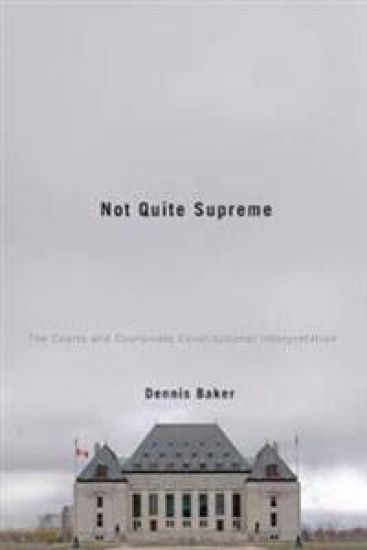
Baker argues that coordinate interpretation - a model which requires both elected and appointed officials to interpret the Charter - allows for the creation of a more robust democracy, alleviating some of the tension between constitutionalism and democracy while limiting judicial activism. Drawing on literature from Montesquieu to recent court decisions, Not Quite Supreme gives an extensive critique of both Canadian and American judicial models and explores the tensions between the separation of powers in both countries. Not Quite Supreme is a fresh and substantial contribution to the debate, advancing a new argument in support of a more diverse tradition of legal decision making in Canada that makes the constitution, rather than individual decisions of the Court, its cornerstone.
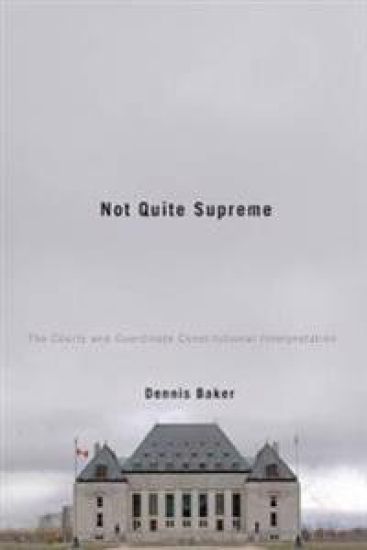
Baker argues that coordinate interpretation - a model which requires both elected and appointed officials to interpret the Charter - allows for the creation of a more robust democracy, alleviating some of the tension between constitutionalism and democracy while limiting judicial activism. Drawing on literature from Montesquieu to recent court decisions, Not Quite Supreme gives an extensive critique of both Canadian and American judicial models and explores the tensions between the separation of powers in both countries. Not Quite Supreme is a fresh and substantial contribution to the debate, advancing a new argument in support of a more diverse tradition of legal decision making in Canada that makes the constitution, rather than individual decisions of the Court, its cornerstone.

Tour of one of the most haunted landscapes in the United States. Walk the halls of the chilling Stanley Hotel in Estes Park, a place that gave even Stephen King the creeps. Explore legends of Doc Holiday at the Hotel Colorado in Glenwood Springs and visit his grave to see his ghost. Learn about "unsinkable" Molly Brown's haunted home in Denver, and read ghost stories that have haunted the Colorado Rockies for centuries. These places and more will chill you to the bone!