Kirjojen hintavertailu – 12 903 725 kirjaa ja 27 kauppaa

Kirjailija

Dennis Doverspike

Kirjat ja teokset yhdessä paikassa: 5 kirjaa, julkaisuja vuosilta 2006–2019, suosituimpiin kuuluu Psychological Perspective on Affirmative Action. Vertaile teosten hintoja ja tarkista saatavuus suomalaisista kirjakaupoista.

5 kirjaa

Kirjojen julkaisuvuodet: 2006–2019.

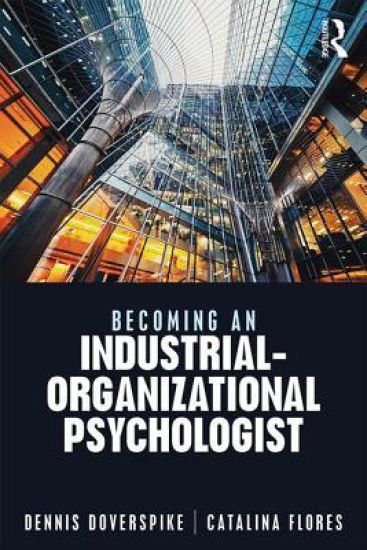
Becoming an Industrial-Organizational Psychologist

Becoming an Industrial-Organizational Psychologist

Dennis Doverspike; Catalina Flores

Routledge
2019
sidottu
So you want to be an Industrial-Organizational (I-O) Psychologist? You may have heard that it is one of the fields of the future, fast-growing, and a highly sought-after profession. But what is Industrial-Organizational Psychology? What does an Industrial-Organizational Psychologist do? Answering these questions and many more, Becoming an Industrial-Organizational Psychologist is the perfect introduction, providing an expert overview of careers in Industrial-Organizational Psychology, the study of human behavior in the workplace. Part 1 of the book discusses what I-O Psychology is and what I-O Psychologists do, including the history of the field, research areas, and job types and titles. Part 2 discusses the undergraduate years, including how to make oneself competitive for graduate school, and going through the process of identifying graduate programs, applying, and deciding on the right program. Part 3 focuses on the graduate years, including advice on success in a graduate program and in internships, as well as additional issues like licensure and transitioning from other careers. Finally, Part 4 discusses how to find a job and begin a career in the various sectors of I-O Psychology: academic, consulting, industry, and government.
Becoming an Industrial-Organizational Psychologist

Becoming an Industrial-Organizational Psychologist

Dennis Doverspike; Catalina Flores

Routledge
2019
nidottu
So you want to be an Industrial-Organizational (I-O) Psychologist? You may have heard that it is one of the fields of the future, fast-growing, and a highly sought-after profession. But what is Industrial-Organizational Psychology? What does an Industrial-Organizational Psychologist do? Answering these questions and many more, Becoming an Industrial-Organizational Psychologist is the perfect introduction, providing an expert overview of careers in Industrial-Organizational Psychology, the study of human behavior in the workplace. Part 1 of the book discusses what I-O Psychology is and what I-O Psychologists do, including the history of the field, research areas, and job types and titles. Part 2 discusses the undergraduate years, including how to make oneself competitive for graduate school, and going through the process of identifying graduate programs, applying, and deciding on the right program. Part 3 focuses on the graduate years, including advice on success in a graduate program and in internships, as well as additional issues like licensure and transitioning from other careers. Finally, Part 4 discusses how to find a job and begin a career in the various sectors of I-O Psychology: academic, consulting, industry, and government.
Essentials of Personnel Assessment and Selection

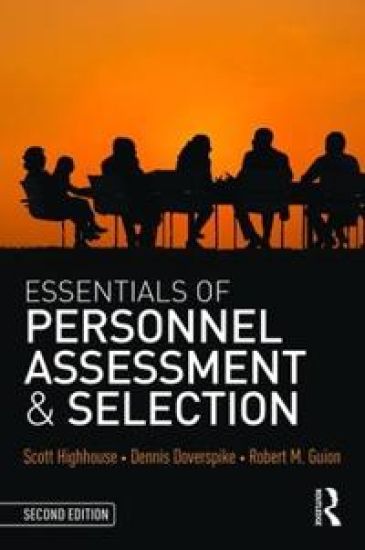
Essentials of Personnel Assessment and Selection

Scott Highhouse; Dennis Doverspike; Robert M Guion

Routledge
2015
nidottu

Halvin toimitettuna 75,60 €

This second edition provides managers and students the nuts and bolts of assessment processes and selection techniques. With this knowledge, managers learn to make informed personnel decisions based on the results of tests and assessments. The book emphasizes that employee performance predictions require well-formed hypotheses about personal characteristics that may be related to valued behavior at work. It also stresses the need for developing a theory of the attribute one hypothesizes as a predictor—a thought process too often missing from work on selection procedures. Topics such as team-member selection, situational judgment tests, nontraditional tests, individual assessment, and testing for diversity are explored. The book covers both basic and advanced concepts in personnel selection in a straightforward, readable style intended to be used in both undergraduate and graduate courses in Personnel Selection and Assessment.
Essentials of Personnel Assessment and Selection

Essentials of Personnel Assessment and Selection

Scott Highhouse; Dennis Doverspike; Robert M Guion

Routledge
2015
sidottu

Halvin toimitettuna 279,60 €

This second edition provides managers and students the nuts and bolts of assessment processes and selection techniques. With this knowledge, managers learn to make informed personnel decisions based on the results of tests and assessments. The book emphasizes that employee performance predictions require well-formed hypotheses about personal characteristics that may be related to valued behavior at work. It also stresses the need for developing a theory of the attribute one hypothesizes as a predictor—a thought process too often missing from work on selection procedures. Topics such as team-member selection, situational judgment tests, nontraditional tests, individual assessment, and testing for diversity are explored. The book covers both basic and advanced concepts in personnel selection in a straightforward, readable style intended to be used in both undergraduate and graduate courses in Personnel Selection and Assessment.
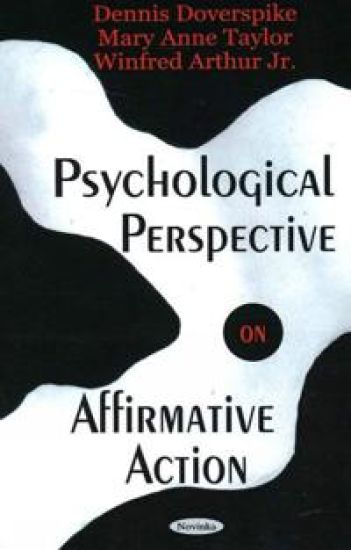
Psychological Perspective on Affirmative Action

Psychological Perspective on Affirmative Action

Dennis Doverspike; Mary Anne Taylor; Winifred Arthur

Nova Science Publishers Inc
2006
nidottu
What does psychology have to do with affirmative action? In the author's opinion, questioning the relevance of psychology to an issue such as affirmative action is, unfortunately, not an uncommon query, even among many people within the field of psychology. When most people, both within and outside the field, make an association between psychology and affirmative action, it is in terms of the debate over racial differences in performance on intelligence tests. Thus, the decision to write this book was based upon what was seen as a need to demonstrate and highlight the substantive contribution that psychology can make in terms of improving our understanding of why it is that people respond to affirmative action with a variety of reactions and emotions. The primary goal of this book is to discuss empirical research and theoretical work on affirmative action from a psychological perspective. The intended audience is academics, including undergraduate and graduate students, and social science researchers.