Kirjojen hintavertailu – 12 903 724 kirjaa ja 27 kauppaa

Kirjailija

Dennis F. Thompson

Kirjat ja teokset yhdessä paikassa: 13 kirjaa, julkaisuja vuosilta 1990–2016, suosituimpiin kuuluu Restoring Responsibility. Vertaile teosten hintoja ja tarkista saatavuus suomalaisista kirjakaupoista.

13 kirjaa

Kirjojen julkaisuvuodet: 1990–2016.

John Stuart Mill and Representative Government

John Stuart Mill and Representative Government

Dennis F. Thompson

Princeton University Press
2016
sidottu
Although Mill regarded Considerations on Representative Government as a mature statement of his theory of democracy, critics have tended to treat it less seriously than most of his other major works. Dennis Thompson argues that this neglect has led to inadequate interpretations of Mill's thought on democracy. Drawing where appropriate on other writings by Mill, the author restores a balanced view by studying the structure of the theory expounded in Representative Government. Representative Government is shown to be more coherent and systematic than has generally been assumed. In the first two chapters the author examines separately Mill's views of political participation and competence. He then considers the philosopher's effort to combine participation and competence at any particular time in a theory of government and to reduce conflict between them over time in a theory of development. Basic features of Mill's view are subjected to critical scrutiny, and modifications are suggested to overcome the deficiencies noted. Throughout, Mill's claims are compared with the ideas and findings of recent social science, leading to the conclusion that his theory remains a valuable resource for contemporary thinking about democracy. Originally published in 1976. The Princeton Legacy Library uses the latest print-on-demand technology to again make available previously out-of-print books from the distinguished backlist of Princeton University Press. These editions preserve the original texts of these important books while presenting them in durable paperback and hardcover editions. The goal of the Princeton Legacy Library is to vastly increase access to the rich scholarly heritage found in the thousands of books published by Princeton University Press since its founding in 1905.
John Stuart Mill and Representative Government

John Stuart Mill and Representative Government

Dennis F. Thompson

Princeton University Press
2015
pokkari
Although Mill regarded Considerations on Representative Government as a mature statement of his theory of democracy, critics have tended to treat it less seriously than most of his other major works. Dennis Thompson argues that this neglect has led to inadequate interpretations of Mill's thought on democracy. Drawing where appropriate on other writings by Mill, the author restores a balanced view by studying the structure of the theory expounded in Representative Government. Representative Government is shown to be more coherent and systematic than has generally been assumed. In the first two chapters the author examines separately Mill's views of political participation and competence. He then considers the philosopher's effort to combine participation and competence at any particular time in a theory of government and to reduce conflict between them over time in a theory of development. Basic features of Mill's view are subjected to critical scrutiny, and modifications are suggested to overcome the deficiencies noted. Throughout, Mill's claims are compared with the ideas and findings of recent social science, leading to the conclusion that his theory remains a valuable resource for contemporary thinking about democracy. Originally published in 1976. The Princeton Legacy Library uses the latest print-on-demand technology to again make available previously out-of-print books from the distinguished backlist of Princeton University Press. These editions preserve the original texts of these important books while presenting them in durable paperback and hardcover editions. The goal of the Princeton Legacy Library is to vastly increase access to the rich scholarly heritage found in the thousands of books published by Princeton University Press since its founding in 1905.

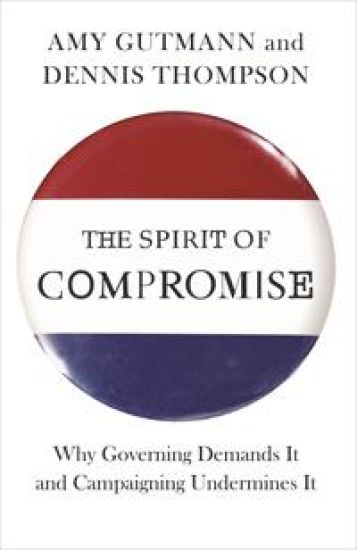
The Spirit of Compromise

The Spirit of Compromise

Amy Gutmann; Dennis F. Thompson

Princeton University Press
2014
pokkari
To govern in a democracy, political leaders have to compromise. When they do not, the result is political paralysis--dramatically demonstrated by the gridlock in Congress in recent years. In The Spirit of Compromise, eminent political thinkers Amy Gutmann and Dennis Thompson show why compromise is so important, what stands in the way of achieving it, and how citizens can make defensible compromises more likely. They urge politicians to focus less on campaigning and more on governing. In a new preface, the authors reflect on the state of compromise in Congress since the book's initial publication. Calling for greater cooperation in contemporary politics, The Spirit of Compromise will interest everyone who cares about making government work better for the good of all.
The Spirit of Compromise

The Spirit of Compromise

Amy Gutmann; Dennis F. Thompson

Princeton University Press
2012
sidottu
If politics is the art of the possible, then compromise is the artistry of democracy. Unless one partisan ideology holds sway over all branches of government, compromise is necessary to govern for the benefit of all citizens. A rejection of compromise biases politics in favor of the status quo, even when the rejection risks crisis. Why then is compromise so difficult in American politics today? In The Spirit of Compromise, eminent political thinkers Amy Gutmann and Dennis Thompson connect the rejection of compromise to the domination of campaigning over governing--the permanent campaign---in American democracy today. They show that campaigning for political office calls for a mindset that blocks compromise--standing tenaciously on principle to mobilize voters and mistrusting opponents in order to defeat them. Good government calls for an opposite cluster of attitudes and arguments--the compromising mindset--that inclines politicians to adjust their principles and to respect their opponents. It is a mindset that helps politicians appreciate and take advantage of opportunities for desirable compromise. Gutmann and Thompson explore the dynamics of these mindsets by comparing the historic compromises on tax reform under President Reagan in 1986 and health care reform under President Obama in 2010. Both compromises were difficult to deliver but only tax reform was bipartisan. Drawing lessons from these and other important compromises--and failures to compromise--in American politics, Gutmann and Thompson propose changes in our political institutions, processes, and mindsets that would encourage a better balance between campaigning and governing. Calling for greater cooperation in contemporary politics, The Spirit of Compromise will interest all who care about whether their government leaders can work together.
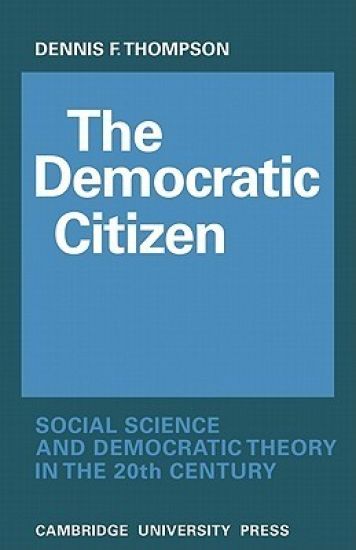
The Democratic Citizen

The Democratic Citizen

Dennis F. Thompson

Cambridge University Press
2010
pokkari
This 1970 study examines the implications of empirical studies in the social sciences with reference to various strands of American and British democratic theory. In presenting his case Professor Thompson provides an extremely valuable critical synthesis of a very large body of theoretical and empirical literature in this field. He weaves together in an original way the works of more than a dozen twentieth-century political theorists and several hundred empirical studies by political scientists, sociologists and social psychologists.
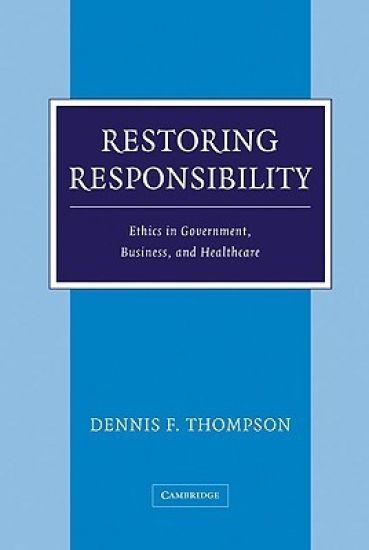
Restoring Responsibility

Restoring Responsibility

Dennis F. Thompson

Cambridge University Press
2004
sidottu
In this important collection of essays Dennis Thompson argues for a more robust conception of responsibility in public life than prevails in contemporary democracies. He suggests that we should stop thinking so much about public ethics in terms of individual vices (such as selfishness or sexual misconduct) and start thinking about it more in terms of institutional vices (such as abuse of power and lack of accountability). Combining theory and practice with many concrete examples and proposals for reform, these essays could be used in courses in applied ethics or political theory and will be read by professionals and graduate students in schools of political science, public policy, law, public health, journalism and business.
Restoring Responsibility

Restoring Responsibility

Dennis F. Thompson

Cambridge University Press
2004
pokkari
In this important collection of essays Dennis Thompson argues for a more robust conception of responsibility in public life than prevails in contemporary democracies. He suggests that we should stop thinking so much about public ethics in terms of individual vices (such as selfishness or sexual misconduct) and start thinking about it more in terms of institutional vices (such as abuse of power and lack of accountability). Combining theory and practice with many concrete examples and proposals for reform, these essays could be used in courses in applied ethics or political theory and will be read by professionals and graduate students in schools of political science, public policy, law, public health, journalism and business.
Why Deliberative Democracy?

Why Deliberative Democracy?

Amy Gutmann; Dennis F. Thompson

Princeton University Press
2004
pokkari
The most widely debated conception of democracy in recent years is deliberative democracy--the idea that citizens or their representatives owe each other mutually acceptable reasons for the laws they enact. Two prominent voices in the ongoing discussion are Amy Gutmann and Dennis Thompson. In Why Deliberative Democracy?, they move the debate forward beyond their influential book, Democracy and Disagreement. What exactly is deliberative democracy? Why is it more defensible than its rivals? By offering clear answers to these timely questions, Gutmann and Thompson illuminate the theory and practice of justifying public policies in contemporary democracies. They not only develop their theory of deliberative democracy in new directions but also apply it to new practical problems. They discuss bioethics, health care, truth commissions, educational policy, and decisions to declare war. In "What Deliberative Democracy Means," which opens this collection of essays, they provide the most accessible exposition of deliberative democracy to date. They show how deliberative democracy should play an important role even in the debates about military intervention abroad. Why Deliberative Democracy? contributes to our understanding of how democratic citizens and their representatives can make justifiable decisions for their society in the face of the fundamental disagreements that are inevitable in diverse societies. Gutmann and Thompson provide a balanced and fair-minded approach that will benefit anyone intent on giving reason and reciprocity a more prominent place in politics than power and special interests.
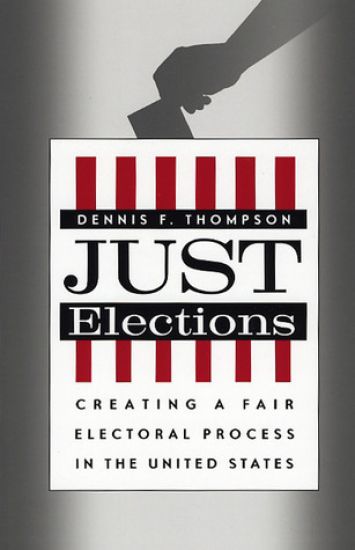
Just Elections

Just Elections

Dennis F. Thompson

University of Chicago Press
2004
nidottu
The 2000 election showed that the mechanies of voting, such as ballot design, can make a critical difference in the accuracy and fairness of our elections. But as Dennis F. Thompson persuasively shows, more fundamental issues must be addressed to ensure that our electoral system is fair. Just Elections argues that three central democratic principles - equal respect, free choice, and popular sovereignty - underlie our electoral institutions and should inform any assessment of the justice of elections. To create a fair electoral system, we must deliberate together about these principles and take greater control of the procedures that govern our elections.
Just Elections

Just Elections

Dennis F. Thompson

University of Chicago Press
2002
sidottu
The 2000 election showed that the mechanies of voting, such as ballot design, can make a critical difference in the accuracy and fairness of our elections. But as Dennis F. Thompson persuasively shows, more fundamental issues must be addressed to ensure that our electoral system is fair. Just Elections argues that three central democratic principles - equal respect, free choice, and popular sovereignty - underlie our electoral institutions and should inform any assessment of the justice of elections. To create a fair electoral system, we must deliberate together about these principles and take greater control of the procedures that govern our elections.
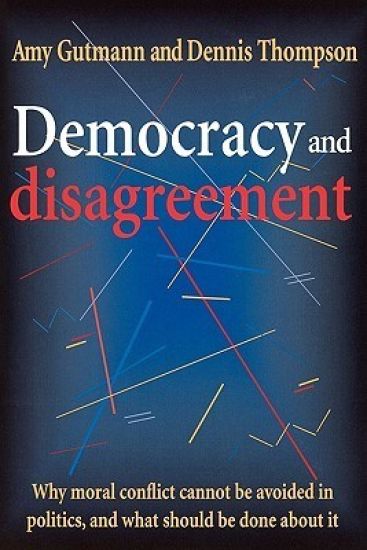
Democracy and Disagreement

Democracy and Disagreement

Amy Gutmann; Dennis F. Thompson

The Belknap Press
1998
nidottu
The din and deadlock of public life in America—where insults are traded, slogans proclaimed, and self-serving deals made and unmade—reveal the deep disagreement that pervades our democracy. The disagreement is not only political but also moral, as citizens and their representatives increasingly take extreme and intransigent positions. A better kind of public discussion is needed, and Amy Gutmann and Dennis Thompson provide an eloquent argument for “deliberative democracy” today. They develop a principled framework for opponents to come together on moral and political issues. Gutmann and Thompson show how a deliberative democracy can address some of our most difficult controversies—from abortion and affirmative action to health care and welfare—and can allow diverse groups separated by class, race, religion, and gender to reason together. Their work goes beyond that of most political theorists and social scientists by exploring both the principles for reasonable argument and their application to actual cases. Not only do the authors suggest how deliberative democracy can work, they also show why improving our collective capacity for moral argument is better than referring all disagreements to procedural politics or judicial institutions. Democracy and Disagreement presents a compelling approach to how we might resolve some of our most trying moral disagreements and live with those that will inevitably persist, on terms that all of us can respect.
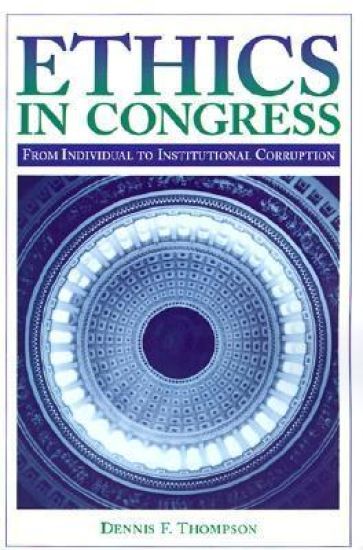
Ethics in Congress

Ethics in Congress

Dennis F. Thompson

Brookings Institution
1995
nidottu
"More members of Congress have been investigated and sanctioned for ethical misconduct in the past decade and a half than in the entire previous history of the institution. But individual members are probably less corrupt than they once were. Stricter ethics codes and closer scrutiny by the press and public have imposed standards no previous representatives have had to face. Dennis Thompson shows how the institution itself is posing new ethical challenges, how the complexity of the environment in which members work creates new occasions for corruption and invites more calls for accountability. Instead of the individual corruption that has long been the center of attention, Thompson focuses on institutional corruption which refers to conduct that under certain conditions is an acceptable part of the job of a representative. Members are required to solicit campaign contributions, and they are expected to help constituents with their problems with government, but some ways of doing these jobs give rise to institutional corruption. The author moves the discussion beyond bribery, extortion, and simple personal gain to delve into implicit understandings, ambiguous favors, and political advantage. Thompson examines many major ethics cases of recent years. Among them: the case of David Durenberger, accused of supplementing his income through book promotions; the case of the Keating Five, accused of using undue influence with the Federal Home Loan Bank Board on behalf of Lincoln Savings and Loan owner Charles Keating; and the case of House Speaker James Wright, accused of several offenses. Thompson shows why neither the electoral process nor the judicial process is sufficient and argues for stronger ethics committees and the creation of a new quasi-independent body to take over some of the enforcement process. He offers more than a dozen recommendations for changes in the procedures and practices of ethics in Congress. The book features a listing of ethics charges, classified by type of corruption, considered by Congress from 1789 to 1992. Selected by Choice as an Outstanding Book of 1995"
Political Ethics and Public Office

Political Ethics and Public Office

Dennis F. Thompson

Harvard University Press
1990
nidottu
Are public officials morally justified in threatening violence, engaging in deception, or forcing citizens to act for their own good? Can individual officials be held morally accountable for the wrongs that governments commit? Dennis Thompson addresses these questions by developing a conception of political ethics that respects the demands of both morality and politics. He criticizes conventional conceptions for failing to appreciate the difference democracy makes, and for ascribing responsibility only to isolated leaders or to impersonal organizations. His book seeks to recapture the sense that men and women, acting for us and together with us in a democratic process, make the moral choices that govern our public life. Thompson surveys ethical conflicts of public officials over a range of political issues, including nuclear deterrence, foreign intervention, undercover investigation, bureaucratic negligence, campaign finance, the privacy of officials, health care, welfare paternalism, drug and safety regulation, and social experimentation. He views these conflicts from the perspectives of many different kinds of public officials—elected and appointed executives at several levels of government, administrators, judges, legislators, governmental advisers, and even doctors, lawyers, social workers, and journalists whose professional roles often thrust them into public life. In clarifying the ethical problems faced by officials, Thompson combines theoretical analysis with practical prescription, and begins to define a field of inquiry for which many have said there is a need but to which few have yet contributed. Philosophers, political scientists, policy analysts, sociologists, lawyers, and other professionals interested in ethics in government will gain insight from this book.