Kirjojen hintavertailu – 12 859 828 kirjaa ja 27 kauppaa

Kirjailija

Department Of the Army

Kirjat ja teokset yhdessä paikassa: 587 kirjaa, julkaisuja vuosilta 1982–2021, suosituimpiin kuuluu Airdrop fo Supplies and Equipment: Rigging Landing Field Mat (FM 10-579 / TO 13C7-50-1). Vertaile teosten hintoja ja tarkista saatavuus suomalaisista kirjakaupoista.

587 kirjaa

Kirjojen julkaisuvuodet: 1982–2021.

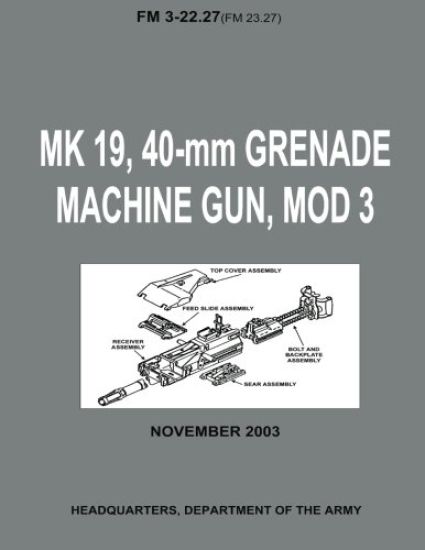
MK 19, 40-mm Grenade Machine Gun, Mod 3

MK 19, 40-mm Grenade Machine Gun, Mod 3

Department of the Army

Createspace Independent Publishing Platform
2014
nidottu
This manual discusses how to train the unit to use the MK 19, 40-mm grenade machinegun, model (MOD) 3, referred to in this manual as the MK 19. This manual highlightsmechanical training, weapon capabilities, and gunnery principles, methods, techniques, and standards that apply to the MOD 3. It also includes preliminary gunnery, a gunneryskills test, gunnery tables, and qualification tables. If this information conflicts with anapplicable technical manual (TM), revised TM, or TM update, the crew will follow theguidance in the most recently published document. The primary audiences for this manual are soldiers, trainers, and staff officers. Units canmodify the gunnery program to meet local training restraints. Although the gunnerytables are intended for use with live fire, trainers can use the tactical engagementsimulator system (TESS), a video disc trainer (VDT), a multipurpose arcade combatsimulator (MACS), or other training device, except on qualification tables. In all cases, units must evaluate their training to ensure that it follows the building-blockprinciple and adheres to sound training policy. Only a crew that is trained and does wellin preliminary gunnery exercises is likely to do well in live-fire exercises (LFX) and incombat situations
The Illustrated Guide to Edible Wild Plants

The Illustrated Guide to Edible Wild Plants

Department of the Army

Must Have Books
2021
nidottu
In a situation where survival is at stake, plants can provide crucial food and medicine. Their safe usage requires absolutely positive identification, knowing how to prepare them for eating, and a solid awareness of any dangerous properties they might have. Familiarity with the botanical structures of plants and information on where they grow will make them easier to locate and identify. THE ILLUSTRATED GUIDE TO WILD EDIBLE PLANTS describes the physical characteristics, habitat and distribution, and edible parts of wild plants. With color photography throughout, this guide facilitates the identification of these plants. Originally intended for Army use, this book serves as a survival aid for civilians as well. Anyone interested in the outdoors, botany, or even in unusual sources of nutrition will find this an indispensable resource.
Urban Operations - (ATP 3-06); (MCTP 12-10B) - December 2017 Edition
ATP 3-06/MCTP 12-10B provides commanders and staffs specific information they will need to plan and conduct urban operations. Second, the manual provides multiple templates and examples of products that are routinely used in the conduct of operations. Readers of this publication use ADRP 6-0 and MCDP 6 for discussions concerning roles and responsibilities Soldiers/Marines use to facilitate ease of communication among various members of different organizations. It should be noted that commanders may modify products as necessary to meet mission requirements. Local standard operating procedures (Army)/standing operating procedures (Marine Corps) (SOPs) may also provide examples of products more suitable to specific situations. The chapters are organized by topic and have been updated to reflect changes to both Army/Marine Corps doctrine. Specific to Army readers, this publication reflects changes in ADP 3-0, ADRP 3-0, ADP 5-0, ADRP 5-0, and ADP 6-0 and ADRP 6-0.
Tactical Employment of Mortars - ATTP 3-21.90 (FM 7-90) MCTP 3-01D (Formerly MCWP 3-15.2)
This Army and Marine Corps multiservice publication serves as doctrinal reference for the employment of mortar squads, sections, and platoons. It contains guidance on tactics and techniques that mortar units use to execute their part of combat operations described in battalion-, squadron-, troop-, and company-level manuals. This publication also contains guidance on how a mortar unit's fires and displacement are best planned and employed to sustain a commander's intent for fire support. The target audience of this publication includes mortar squad, section, and platoon leaders, company and battalion commanders, battalion staff officers, and all others responsible for controlling and coordinating fire support during combined arms operations. Training developers also use this manual as a source document for combat critical tasks
Insurgencies and Countering Insurgencies - FM 3-24, MCWP 3-02 (Formerly MCWP 3-33.5)
Part one, the "Strategic and Operational Context," provides a framework for understanding the environment where a counterinsurgency exists. Part one consists of chapters one through three. Part two, "Insurgencies," provides a doctrinal framework for understanding an insurgency. Part two consists of chapters four and five. Part three, "Counterinsurgencies," describes how to plan and execute operations to enable a host nation to defeat an insurgency.
Engineer Reconnaissance (ATP 3-34.81), (MCWP 3-17.4)
The three engineer disciplines are combat (with the capabilities and activities of mobility, countermobility, and survivability [M/CM/S]), general, and geospatial engineering. These disciplines include significant reconnaissance capabilities. The three engineer disciplines include extensive discussion on integrating the planning for, and conduct of, engineer reconnaissance support within the tactical operations of the combined arms team. This publication discusses the capability resident within combat engineer units to form and employ engineer reconnaissance teams (ERTs). It also describes the capability resident within general engineer elements to form and employ ERTs, augment combat engineer ERTs, or provide assessment and survey teams. Finally, geospatial engineering enables reconnaissance and may play a large role, especially during the planning process. Engineer reconnaissance, like chemical, biological, radiological, and nuclear (CBRN) and other technical applications, is not a form of reconnaissance.
Rifle Marksmanship

Rifle Marksmanship

Department of the Army

Skyhorse Publishing
2018
pokkari
Rifle Marksmanship is the newly revised, official guide to planning and executing training on the M16-series rifles (M16A1, M16A2, M16A3, and M16A4) and M4 carbine. This handbook is developed by the US Army for commanders, leaders, and instructors to help create training programs and materials for soldiers to complete the United States Army rifle marksmanship program. It offers a comprehensive guide to the specifics and capabilities of each weapon and an introduction to the fundamentals of marksmanship, followed by complete guidance through each of the five stages of rifle marksmanship training. Topics covered include: Weapon Characteristics, Accessories, and Ammunition Range Safety and Risk Management Preliminary Marksmanship and Mechanical Training Advanced Optics, Lasers, and Iron Sights 10-Meter Target Offsets and 25-Meter Zero Offsets Training Aids, Devices, and Scorecards Replete with information and training materials for learners and instructors, this handbook provides the guidance for all shooters, whether in combat or in hunting and recreation, to operate their rifles with deadly proficiency.