Kirjojen hintavertailu – 12 876 058 kirjaa ja 26 kauppaa

Kirjailija

Derek J S Robinson

Kirjat ja teokset yhdessä paikassa: 12 kirjaa, julkaisuja vuosilta 1991–2022, suosituimpiin kuuluu Course In Linear Algebra With Applications, A (2nd Edition). Vertaile teosten hintoja ja tarkista saatavuus suomalaisista kirjakaupoista.

Nimi esiintyy myös muodoissa: Derek J.S. Robinson, Derek J. S. Robinson

12 kirjaa

Kirjojen julkaisuvuodet: 1991–2022.

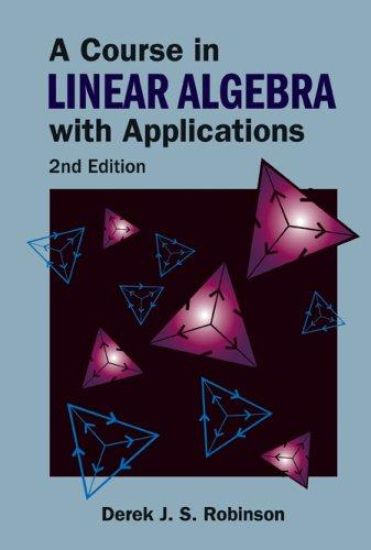
Course In Linear Algebra With Applications, A (2nd Edition)

Course In Linear Algebra With Applications, A (2nd Edition)

Derek J S Robinson

World Scientific Publishing Co Pte Ltd
2006
sidottu
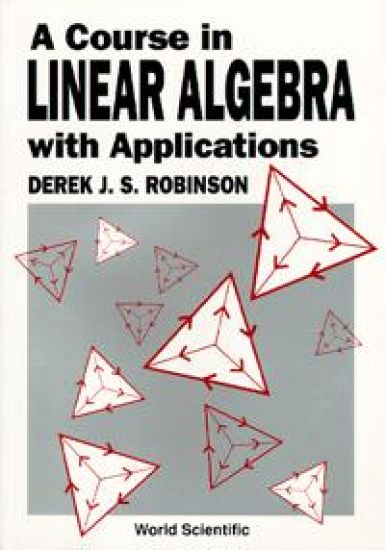
This is the second edition of the best-selling introduction to linear algebra. Presupposing no knowledge beyond calculus, it provides a thorough treatment of all the basic concepts, such as vector space, linear transformation and inner product. The concept of a quotient space is introduced and related to solutions of linear system of equations, and a simplified treatment of Jordan normal form is given. Numerous applications of linear algebra are described, including systems of linear recurrence relations, systems of linear differential equations, Markov processes, and the Method of Least Squares. An entirely new chapter on linear programing introduces the reader to the simplex algorithm with emphasis on understanding the theory behind it. The book is addressed to students who wish to learn linear algebra, as well as to professionals who need to use the methods of the subject in their own fields.
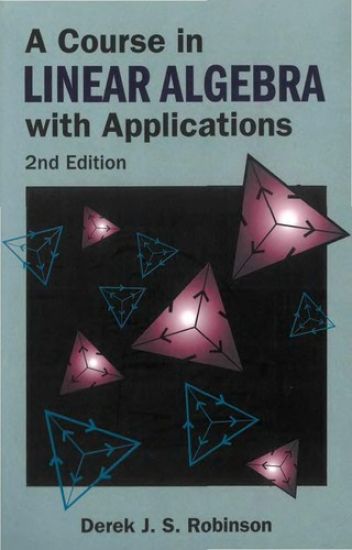
Course In Linear Algebra With Applications, A (2nd Edition)

Course In Linear Algebra With Applications, A (2nd Edition)

Derek J S Robinson

World Scientific Publishing Co Pte Ltd
2006
nidottu
This is the second edition of the best-selling introduction to linear algebra. Presupposing no knowledge beyond calculus, it provides a thorough treatment of all the basic concepts, such as vector space, linear transformation and inner product. The concept of a quotient space is introduced and related to solutions of linear system of equations, and a simplified treatment of Jordan normal form is given. Numerous applications of linear algebra are described, including systems of linear recurrence relations, systems of linear differential equations, Markov processes, and the Method of Least Squares. An entirely new chapter on linear programing introduces the reader to the simplex algorithm with emphasis on understanding the theory behind it. The book is addressed to students who wish to learn linear algebra, as well as to professionals who need to use the methods of the subject in their own fields.
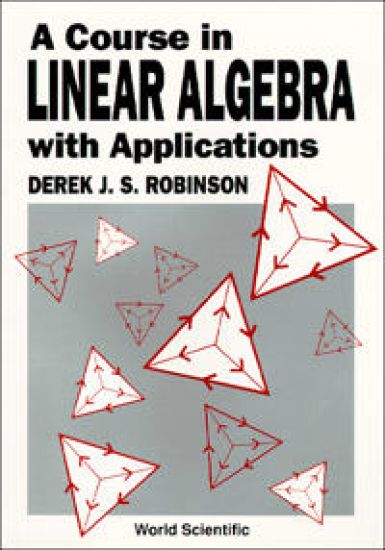
Course In Linear Algebra With Applications, A

Course In Linear Algebra With Applications, A

Derek J S Robinson

World Scientific Publishing Co Pte Ltd
1991
sidottu
The book is an introduction to Linear Algebra with an account of its principal applications. It is addressed to students of mathematics, the physical, engineering and social sciences, and commerce. The reader is assumed to have completed the calculus sequence. Special features of the book are thorough coverage of all core areas of linear algebra, with a detailed account of such important applications as least squares, systems of linear recurrences, Markov processes, and systems of differential equations. The book also gives an introduction to some more advanced topics such as diagonalization of Hermitian matrices and Jordan form. A principal aim of the book is to make the material accessible to the reader who is not a mathematician, without loss of mathematical rigor. This is reflected in a wealth of examples, the clarity of writing and the organization of material. There is a growing need for knowledge of linear algebra that goes beyond the basic skills of solving systems of linear equations and this book is intended to meet it.
Abstract Algebra

Abstract Algebra

Derek J.S. Robinson

De Gruyter
2022
isokokoinen pokkari
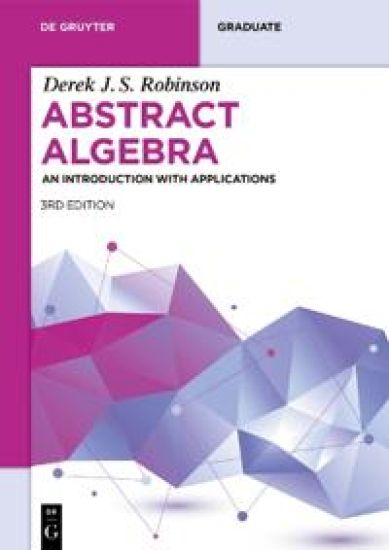
This is a high level introduction to abstract algebra which is aimed at readers whose interests lie in mathematics and the information and physical sciences. In addition to introducing the main concepts of modern algebra – groups, rings, modules and fields – the book contains numerous applications, which are intended to illustrate the concepts and to show the utility and relevance of algebra today. In particular applications to Polya coloring theory, latin squares, Steiner systems, error correcting codes and economics are described. There is ample material here for a two semester course in abstract algebra. Proofs of almost all results are given. The reader led through the proofs in gentle stages. There are more than 500 problems, of varying degrees of diffi culty. The book should be suitable for advanced undergraduate students in their fi nal year of study and for fi rst or second year graduate students at a university in Europe or North America. In this third edition three new chapters have been added: an introduction to the representation theory of fi nite groups, free groups and presentations of groups, an introduction to category theory.
A Course in the Theory of Groups

A Course in the Theory of Groups

Derek J.S. Robinson

Springer-Verlag New York Inc.
2012
nidottu
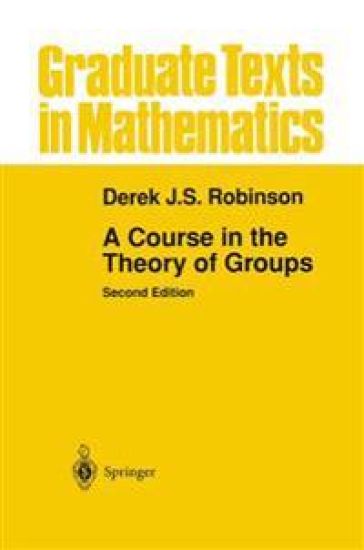
A Course in the Theory of Groups is a comprehensive introduction to the theory of groups - finite and infinite, commutative and non-commutative. Presupposing only a basic knowledge of modern algebra, it introduces the reader to the different branches of group theory and to its principal accomplishments. While stressing the unity of group theory, the book also draws attention to connections with other areas of algebra such as ring theory and homological algebra. This new edition has been updated at various points, some proofs have been improved, and lastly about thirty additional exercises are included. There are three main additions to the book. In the chapter on group extensions an exposition of Schreier's concrete approach via factor sets is given before the introduction of covering groups. This seems to be desirable on pedagogical grounds. Then S. Thomas's elegant proof of the automorphism tower theorem is included in the section on complete groups. Finally an elementary counterexample to the Burnside problem due to N. D. Gupta has been added in the chapter on finiteness properties.
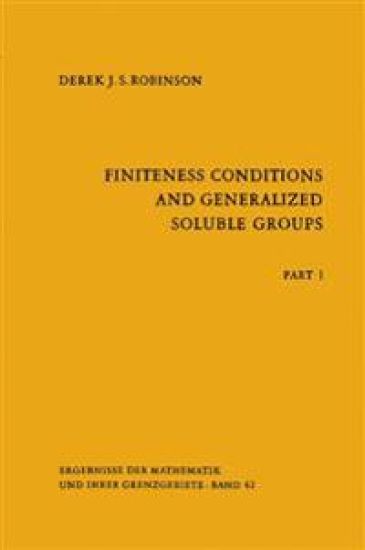
Finiteness Conditions and Generalized Soluble Groups

Finiteness Conditions and Generalized Soluble Groups

Derek J.S. Robinson

Springer-Verlag Berlin and Heidelberg GmbH Co. K
2010
nidottu
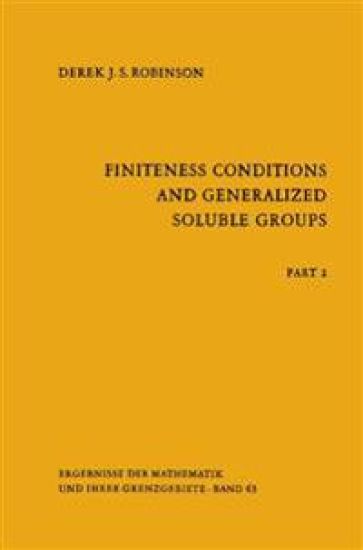
This book is a study of group theoretical properties of two dis­ parate kinds, firstly finiteness conditions or generalizations of fini­ teness and secondly generalizations of solubility or nilpotence. It will be particularly interesting to discuss groups which possess properties of both types. The origins of the subject may be traced back to the nineteen twenties and thirties and are associated with the names of R. Baer, S. N. Cernikov, K. A. Hirsch, A. G. Kuros, 0.]. Schmidt and H. Wie­ landt. Since this early period, the body of theory has expanded at an increasingly rapid rate through the efforts of many group theorists, particularly in Germany, Great Britain and the Soviet Union. Some of the highest points attained can, perhaps, be found in the work of P. Hall and A. I. Mal'cev on infinite soluble groups. Kuras's well-known book "The theory of groups" has exercised a strong influence on the development of the theory of infinite groups: this is particularly true of the second edition in its English translation of 1955. To cope with the enormous increase in knowledge since that date, a third volume, containing a survey of the contents of a very large number of papers but without proofs, was added to the book in 1967.
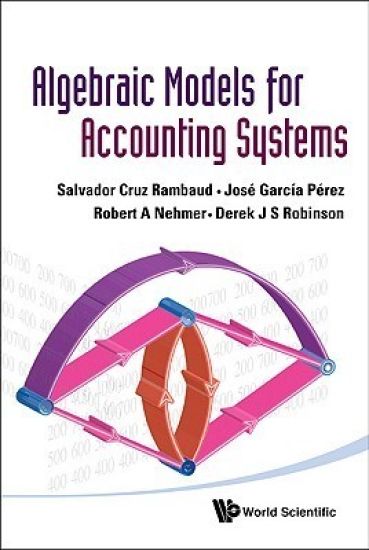
Algebraic Models For Accounting Systems

Algebraic Models For Accounting Systems

Robert A Nehmer; Jose Garcia Perez; Derek J S Robinson; Salvador Cruz Rambaud

World Scientific Publishing Co Pte Ltd
2010
sidottu
This book describes the construction of algebraic models which represent the operations of the double entry accounting system. It gives a novel, comprehensive, proof based treatment of the topic, using such concepts from abstract algebra as automata, digraphs, monoids and quotient structures.
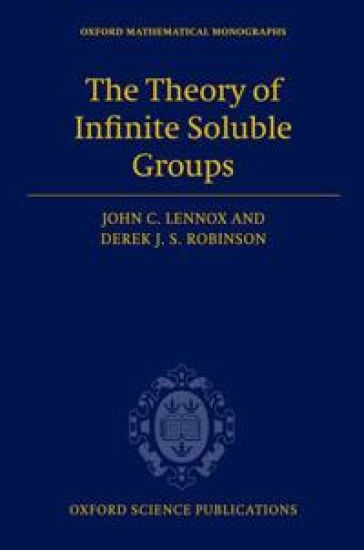
The Theory of Infinite Soluble Groups

The Theory of Infinite Soluble Groups

John C. Lennox; Derek J. S. Robinson

Clarendon Press
2004
sidottu
The central concept in this monograph is that of a soluble group - a group which is built up from abelian groups by repeatedly forming group extensions. It covers all the major areas, including finitely generated soluble groups, soluble groups of finite rank, modules over group rings, algorithmic problems, applications of cohomology, and finitely presented groups, whilst remaining fairly strictly within the boundaries of soluble group theory. An up-to-date survey of the area aimed at research students and academic algebraists and group theorists, it is a compendium of information that will be especially useful as a reference work for researchers in the field.
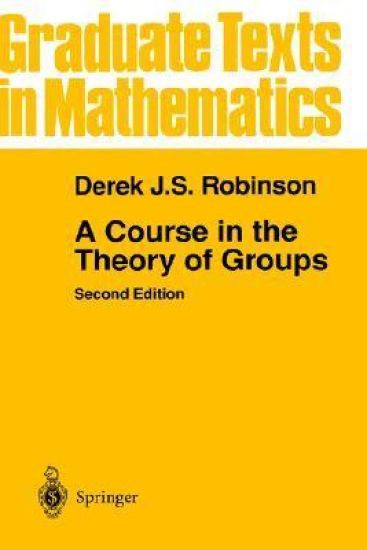
A Course in the Theory of Groups

A Course in the Theory of Groups

Derek J.S. Robinson

Springer-Verlag New York Inc.
1995
sidottu

Halvin toimitettuna 126,50 €

A Course in the Theory of Groups is a comprehensive introduction to the theory of groups - finite and infinite, commutative and non-commutative. Presupposing only a basic knowledge of modern algebra, it introduces the reader to the different branches of group theory and to its principal accomplishments. While stressing the unity of group theory, the book also draws attention to connections with other areas of algebra such as ring theory and homological algebra. This new edition has been updated at various points, some proofs have been improved, and lastly about thirty additional exercises are included. There are three main additions to the book. In the chapter on group extensions an exposition of Schreier's concrete approach via factor sets is given before the introduction of covering groups. This seems to be desirable on pedagogical grounds. Then S. Thomas's elegant proof of the automorphism tower theorem is included in the section on complete groups. Finally an elementary counterexample to the Burnside problem due to N. D. Gupta has been added in the chapter on finiteness properties.