Kirjojen hintavertailu – 12 903 725 kirjaa ja 27 kauppaa

Kirjailija

Diana Panke

Kirjat ja teokset yhdessä paikassa: 12 kirjaa, julkaisuja vuosilta 2008–2025, suosituimpiin kuuluu Consultative Committees in the European Union. Vertaile teosten hintoja ja tarkista saatavuus suomalaisista kirjakaupoista.

12 kirjaa

Kirjojen julkaisuvuodet: 2008–2025.

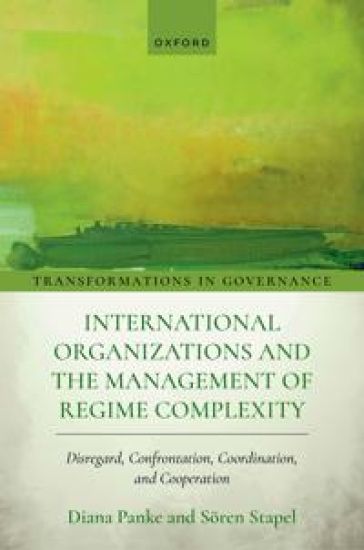
International Organizations and the Management of Regime Complexity

International Organizations and the Management of Regime Complexity

Diana Panke; Sören Stapel

Oxford University Press
2025
sidottu
Regime complexity, which is characterized by overlap between international organizations (IOs) concerning both policy competencies and member states, has been increasing over time. It is a defining feature of today's international system. As the regime complexity literature points out, overlaps between IOs carry potential negative effects, such as duplicated efforts or incompatible norms. This book argues that IOs can actively manage regime complexity and potentially avoid negative side effects or even create positive benefits. Yet, overlapping IOs differ in how they react. To explain under what conditions IOs disregard overlaps or manage them by resorting to confrontation or collaboration, this book addresses the following research questions: Why do organizations differ in their responses to overlaps? Why do some opt for disregard while others choose confrontation or engage in collaboration? These questions are answered by studying a subset of IOs, namely regional international organizations (RIOs), which recruit their member states on the basis of geographic criteria. It introduces a novel theoretical selection model on three junctures: saliency, ideological fit, and contextual uncertainties. This influences whether overlapping RIOs disregard one another and do not actively manage regional regime complexity (low saliency), when they choose confrontation (high saliency but low ideological fit) and when they opt for one of two ways to engage in collaboration, namely coordination (high saliency, high ideological fit, limited contextual uncertainty), or cooperation (high saliency, high ideological fit, high contextual uncertainty). The corresponding hypotheses are comprehensively analyzed in qualitative case studies from Africa, the Americas, Asia, and Europe. Transformations in Governance is a major academic book series from Oxford University Press. It is designed to accommodate the impressive growth of research in comparative politics, international relations, public policy, federalism, and environmental and urban studies concerned with the dispersion of authority from central states to supranational institutions, subnational governments, and public-private networks. It brings together work that advances our understanding of the organization, causes, and consequences of multilevel and complex governance. The series is selective, containing annually a small number of books of exceptionally high quality by leading and emerging scholars. The series is edited by Liesbet Hooghe and Gary Marks of the University of North Carolina, Chapel Hill, and Walter Mattli of the University of Oxford.

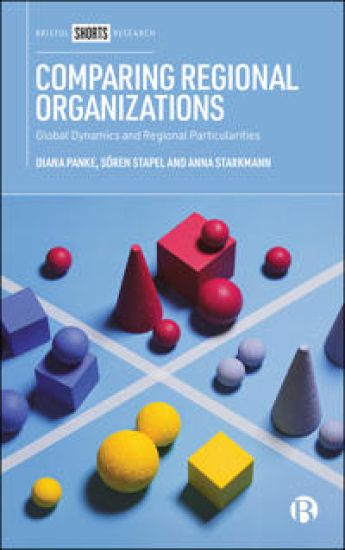
Comparing Regional Organizations

Comparing Regional Organizations

Diana Panke; Sören Stapel; Anna Starkmann

Bristol University Press
2020
sidottu
This book provides a comprehensive overview of the evolution and particularities of regional organizations across Africa, the Americas, Asia and Europe since 1945. The authors analyze the membership dynamics and policy scopes of 76 organizations, and compare their opportunities and challenges in regional governance. They consider organizations’ competencies in eleven different policy areas, including trade, security and environment, and trace patterns in their development. For those with interests in comparative regionalism, international relations, political science and international law, this is an essential companion to some of the world’s most significant organizations.
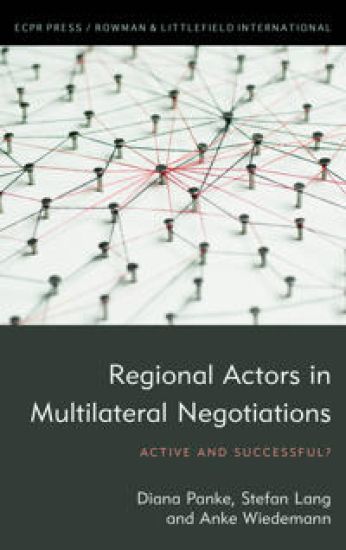
Regional Actors in Multilateral Negotiations

Regional Actors in Multilateral Negotiations

Diana Panke; Stefan Lang; Anke Wiedemann

ECPR Press
2019
nidottu
Since the end of WWII, not only the number of international regimes and organizations, but also the number of regional organisations and groups increased considerably. Today, states are often members of regional and international organisations at the same time and cover similar policies in both. This contributes to a regionalization of international relations since not only states, but also regional actors are active in international negotiations. This book provides a comprehensive analysis of how active and how influential regional actors are in today’s international negotiations. Based on a quantitative analysis of more than 500 international negotiations and three in-depth case studies, the book not only explains why some regional actors are more vocal than others in international organisations, but also why they differ concerning their prospects for success.
Research Design & Method Selection

Research Design & Method Selection

Diana Panke

SAGE Publications Ltd
2018
nidottu

Halvin toimitettuna 65,80 €

Heavily grounded in helping students make the best choices for their projects, this book explores how to develop and work with theory, research questions, and method selection to build solid, logical proposals and move from research concepts to fully realized designs. Rather than rushing initial planning stages or reverse engineering questions from preferred methods, it encourages students to challenge unconscious biases around method selection and analysis and provides step-by-step guidance on choosing a method that is in-line with the question being explored. Focused on the role of the researcher within research design, it stresses the need to consider the theoretical underpinnings of research and not just practical issues when designing a project. It provides a sophisticated toolkit to understand: - The critical issues associated with both qualitative and quantitative methods - The approach that works best for specific research questions - How design choices can affect practice. Perfect for upper undergraduate and postgraduate students, this book will instil confidence and good decision making to ensure constructively informed design and practice.
Research Design & Method Selection

Research Design & Method Selection

Diana Panke

SAGE Publications Ltd
2018
sidottu
Heavily grounded in helping students make the best choices for their projects, this book explores how to develop and work with theory, research questions, and method selection to build solid, logical proposals and move from research concepts to fully realized designs. Rather than rushing initial planning stages or reverse engineering questions from preferred methods, it encourages students to challenge unconscious biases around method selection and analysis and provides step-by-step guidance on choosing a method that is in-line with the question being explored. Focused on the role of the researcher within research design, it stresses the need to consider the theoretical underpinnings of research and not just practical issues when designing a project. It provides a sophisticated toolkit to understand: - The critical issues associated with both qualitative and quantitative methods - The approach that works best for specific research questions - How design choices can affect practice. Perfect for upper undergraduate and postgraduate students, this book will instil confidence and good decision making to ensure constructively informed design and practice.
Regional Actors in Multilateral Negotiations

Regional Actors in Multilateral Negotiations

Diana Panke; Stefan Lang; Anke Wiedemann

ECPR Press
2018
sidottu
Since the end of WWII, not only the number of international regimes and organizations, but also the number of regional organisations and groups increased considerably. Today, states are often members of regional and international organisations at the same time and cover similar policies in both. This contributes to a regionalization of international relations since not only states, but also regional actors are active in international negotiations. This book provides a comprehensive analysis of how active and how influential regional actors are in today’s international negotiations. Based on a quantitative analysis of more than 500 international negotiations and three in-depth case studies, the book not only explains why some regional actors are more vocal than others in international organisations, but also why they differ concerning their prospects for success.
Small States in the European Union
The most recent EU-enlargements have considerably increased the number of small member states. In the EU-27, 19 countries have fewer votes in the Council of Ministers than the EU-average. These small states face a series of size-related disadvantages in day-to-day EU negotiations. Against this backdrop the book asks: are some small states better at coping with structural disadvantages than others? How active are small states in participating in day-to-day EU negotiations and why do some states use negotiation strategies more frequently than others? Under which conditions are the different negotiation strategies effective and when can small states punch above their weight? Based on more than 100 interviews with policy-makers and an analysis of a unique database on the negotiation activities of EU member states, this book explains how active participation is essential for the shaping success of small states and shows that small states are more influential with persuasion-based rather than bargaining-based strategies. Two case studies on the pesticides and the spirit drinks regulations further reveal that persuasion strategies are especially effective if the arguments match the nature of the issue at stake and resonate well with prior beliefs of addressees. No other study comprehensively analyzes small states in a comparative perspective, examines their activity levels in EU negotiations and outlines which conditions are needed for the effectiveness of a broad range of strategies. An indispensable resource for students and researchers interested in how and under which conditions small states can influence policies in negotiations beyond the nation-state.
Consultative Committees in the European Union

Consultative Committees in the European Union

Diana Panke; Christoph H?nnige; Julia Gollub

ECPR Press
2015
nidottu
How, and under which conditions, can consultative committees exert influence if they have access to legislators (voice) but no formal veto power (vote)? In drawing on the Committee of the Regions and the European Economic and Social Committee of the European Union, this book shows that consultative committees face several challenges when it comes to influencing the content of policies, but are nevertheless sometimes successful in getting their opinions heard. It develops a sender-receiver model and puts it to a comprehensive empirical test. A quantitative analysis and three in-depth case studies on the European citizens’ initiative, the European grouping of territorial cooperation and the Liberalisation of Community Postal Services show how capacities, incentives and preferences of consultative committees and legislative decision-makers need to be configured to allow for the influence of the CoR and the EESC.
The Effectiveness of the European Court of Justice

The Effectiveness of the European Court of Justice

Diana Panke

Manchester University Press
2010
sidottu
The effectiveness of international law depends upon the willingness of states to comply with its provisions. Despite the current move towards binding international law, every international organisation grapples with serious instances of non-compliance. As a reaction, numerous international courts and arbitration bodies have been strengthened in the last two decades. Unlike their domestic counterparts, international courts cannot rely on the monopoly of legitimate force as a last resort for restoring compliance. This raises the question under which conditions international courts are nevertheless able to promote compliance with international norms - even against the initial will of the affected states. This book looks at the European Court of Justice (ECJ) as an example of a court, which can apply judicial discourses, judgments and sanction-threats to cases in which states are reluctant to comply. Overall, the ECJ is very successful in ending norm violations through its compliance-instruments. However, some cases require up to 17 years or even a threat with sanctions until the effectiveness of European law is restored, while others are settled somewhat faster via judgments, or very quickly through judicial discourses. The book shows that issue-specific variables, such as the nature of the issue, its interpretational scope, its fit to domestic ideas, influence whether one of the three compliance instruments successfully induces compliance - even against the strong initial will of member states.
Small States in the European Union

Small States in the European Union

Diana Panke

Ashgate Publishing Limited
2010
sidottu
The most recent EU-enlargements have considerably increased the number of small member states. In the EU-27, 19 countries have fewer votes in the Council of Ministers than the EU-average. These small states face a series of size-related disadvantages in day-to-day EU negotiations. Against this backdrop the book asks: are some small states better at coping with structural disadvantages than others? How active are small states in participating in day-to-day EU negotiations and why do some states use negotiation strategies more frequently than others? Under which conditions are the different negotiation strategies effective and when can small states punch above their weight? Based on more than 100 interviews with policy-makers and an analysis of a unique database on the negotiation activities of EU member states, this book explains how active participation is essential for the shaping success of small states and shows that small states are more influential with persuasion-based rather than bargaining-based strategies. Two case studies on the pesticides and the spirit drinks regulations further reveal that persuasion strategies are especially effective if the arguments match the nature of the issue at stake and resonate well with prior beliefs of addressees. No other study comprehensively analyzes small states in a comparative perspective, examines their activity levels in EU negotiations and outlines which conditions are needed for the effectiveness of a broad range of strategies. An indispensable resource for students and researchers interested in how and under which conditions small states can influence policies in negotiations beyond the nation-state.