Kirjojen hintavertailu – 12 903 725 kirjaa ja 27 kauppaa

Kirjailija

Diane Bricker

Kirjat ja teokset yhdessä paikassa: 37 kirjaa, julkaisuja vuosilta 2002–2021, suosituimpiin kuuluu AEPSi™ Provider Guide. Vertaile teosten hintoja ja tarkista saatavuus suomalaisista kirjakaupoista.

37 kirjaa

Kirjojen julkaisuvuodet: 2002–2021.

Assessment, Evaluation, and Programming System for Infants and Children (AEPS®-3): Curriculum, Volume 4

Assessment, Evaluation, and Programming System for Infants and Children (AEPS®-3): Curriculum, Volume 4

Diane Bricker; Carmen Dionne; Jennifer Grisham; JoAnn Johnson; Marisa Macy; Kristine Slentz; Misti Waddell

Brookes Publishing Co
2021
nidottu
For use after the AEPS®-3 Test, the AEPS®-3 Curriculum is an activity-based, multitiered curriculum that helps professionals support every child's development with differentiated instruction in eight developmental areas: fine motor, gross motor, adaptive, social-emotional, social-communication, cognitive, literacy, and math. This Growing curriculum volume covers skills that typically appear during the toddler years (from 18 months to 3 years of age). Two additional levels, Beginning (for skills typically developing in the first year to 18 months of life) and Ready (covering more complex developmental and early academic skills), are also available. In this volume, professionals will find:a complete introduction to the curriculum's foundations, content, and organizationhelpful guidelines for selecting goals and outcomesstrategies for matching tiered teaching/intervention strategies—universal, focused, and specialized supports—with young children's individual needsinstructions on collecting progress monitoring data at each teaching/intervention tierevidence-based strategies for teaching specific developmental skills within 18 typical routines and activities, such as mealtime, naps, toileting, blocks, and artABOUT AEPS-3Streamlined and enhanced with user-requested updates, the new AEPS-3 gives your early childhood program the most accurate, useful child data and a proven way to turn data into action across everything you do, from goal setting to teaching to progress monitoring. Use this highly effective and efficient linked system to assess, develop goals, implement instruction/intervention, and monitor progress of every child you work with, from the first months of life through kindergarten. AEPS-3 HELPS YOU:Collect essential assessment data and use it across your key tasks: OSEP reporting, determining eligibility, building IFSPs and IEPs, planning teaching and intervention, monitoring progress, and sharing results with familiesTrack and support emerging skills, where real growth and development happenLink assessment data to a tiered curriculum for designing teaching and intervention strategies that get resultsPick up small increments of progress—important when demonstrating growth for children with disabilitiesActively involve families, with handouts to support engagement, forms to gather input, and reports to share resultsStrengthen school readiness for every young child by checking and supporting core skills across all areas of child development, including pre-academic and social-emotional skillsStreamline reporting and data management with AEPS®i, the user-friendly web-based systemThere's never been a more effective or efficient system for assessing, tracking, and nurturing the development of every child you work with, from the first months of life through kindergarten.
Assessment, Evaluation, and Programming System for Infants and Children (AEPS®-3): Curriculum, Volume 2

Assessment, Evaluation, and Programming System for Infants and Children (AEPS®-3): Curriculum, Volume 2

Diane Bricker; Carmen Dionne; Jennifer Grisham; JoAnn Johnson; Marisa Macy; Kristine Slentz; Misti Waddell

Brookes Publishing Co
2021
nidottu
A criterion-referenced, curriculum-based measure, the AEPS®-3 Test evaluates the developmental and early academic skills that children need to function independently and succeed in kindergarten. Spanning birth to 6 years in one continuous, seamless test, this Assessment volume covers eight curricular areas—fine motor, gross motor, adaptive, social-emotional, social-communication, cognitive, literacy, and math. Fully linked with the tiered AEPS-3 Curriculum, AEPS-3 Test results can be used to determine a child's level of performance, develop meaningful learning goals and outcomes, plan effective instruction/intervention, and monitor progress over time. In this volume, professionals will find:administration and scoring guidelines for the testtest items and criteria for 407 goals and objectivestips on how to use the AEPS-3 assessment activities with individual children or groups of childrentips on how to score all test items efficientlyinstructions on using the Family Support Forms and Ready-Set assessmentguidance on using test results to write IEP/IFSPs and determine eligibility for servicesABOUT AEPS-3Streamlined and enhanced with user-requested updates, the new AEPS-3 gives your early childhood program the most accurate, useful child data and a proven way to turn data into action across everything you do, from goal setting to teaching to progress monitoring. Use this highly effective and efficient linked system to assess, develop goals, implement instruction/intervention, and monitor progress of every child you work with, from the first months of life through kindergarten. AEPS-3 HELPS YOU:Collect essential assessment data and use it across your key tasks: OSEP reporting, determining eligibility, building IFSPs and IEPs, planning teaching and intervention, monitoring progress, and sharing results with familiesTrack and support emerging skills, where real growth and development happenLink assessment data to a tiered curriculum for designing teaching and intervention strategies that get resultsPick up small increments of progress—important when demonstrating growth for children with disabilitiesActively involve families, with handouts to support engagement, forms to gather input, and reports to share resultsStrengthen school readiness for every young child by checking and supporting core skills across all areas of child development, including pre-academic and social-emotional skillsStreamline reporting and data management with AEPS®i, the user-friendly web-based systemThere's never been a more effective or efficient system for assessing, tracking, and nurturing the development of every child you work with, from the first months of life through kindergarten.
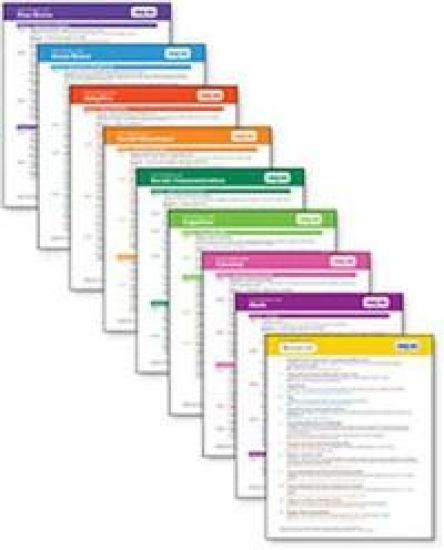
Assessment, Evaluation, and Programming System for Infants and Children (AEPS®-3)

Assessment, Evaluation, and Programming System for Infants and Children (AEPS®-3)

Kristine Slentz; Diane Bricker; Carmen Dionne; Jennifer Grisham; JoAnn Johnson; Marisa Macy; Misti Waddell

BROOKES PUBLISHING CO
2021
irtolehti
AEPS®?3 Quick Reference Guides are handy, on?the?go guides that provide all AEPS®?3 Test items and criteria in a clear, convenient format. These colourful guides are helpful resources for users as they observe children and administer the test. This pack includes 9 separate laminated guides:Fine MotorGross MotorAdaptiveSocial? EmotionalSocial? CommunicationCognitiveLiteracyMathReady-SetAEPS?3 HELPS YOU:Collect essential assessment data and use it across your key tasks: OSEP reporting, determining eligibility, building IFSPs and IEPs, planning teaching and intervention, monitoring progress, and sharing results with families. Track and support emerging skills, where real growth and development happens. Link assessment data to a tiered curriculum for designing teaching and intervention strategies that get results. Pick up small increments of progress—important when demonstrating growth for children with disabilities. Actively involve families, with handouts to support communication and family engagement, forms to collect information about child skills, and reports to share results and progress. Strengthen school readiness for every young child by checking and supporting core skills across all areas of child development, including pre?academic and social?emotional skills. There's never been a more effective or efficient system for assessing, tracking, and nurturing the development of every child you work with, from the first months of life through kindergarten.

Assessment, Evaluation, and Programming System for Infants and Children (AEPS®-3)

Assessment, Evaluation, and Programming System for Infants and Children (AEPS®-3)

Kristine Slentz; Diane Bricker; Carmen Dionne; Jennifer Grisham; JoAnn Johnson; Marisa Macy; Misti Waddell

BROOKES PUBLISHING CO
2021
irtolehti
The AEPS®?3 Ready? Set form helps professionals gather child assessment data on skills needed for school readiness and early school success. New to the third edition, the Ready? Set contains 40 developmentally advanced AEPS?3 goals across all 8 areas of the AEPS?3 Test. This shorter measure supports efficient assessment of groups of children in preschool and Head Start classrooms, and it allows users to easily move to the full AEPS?3 Test for children who need it. The Ready? Set is available as a set of 10 4-page forms. AEPS?3 HELPS YOU:Collect essential assessment data and use it across your key tasks: OSEP reporting, determining eligibility, building IFSPs and IEPs, planning teaching and intervention, monitoring progress, and sharing results with families. Track and support emerging skills, where real growth and development happens. Link assessment data to a tiered curriculum for designing teaching and intervention strategies that get results. Pick up small increments of progress—important when demonstrating growth for children with disabilities. Actively involve families, with handouts to support communication and family engagement, forms to collect information about child skills, and reports to share results and progress. Strengthen school readiness for every young child by checking and supporting core skills across all areas of child development, including pre?academic and social?emotional skills. There's never been a more effective or efficient system for assessing, tracking, and nurturing the development of every child you work with, from the first months of life through kindergarten.

Assessment, Evaluation, and Programming System for Infants and Children (AEPS®-3)

Assessment, Evaluation, and Programming System for Infants and Children (AEPS®-3)

Kristine Slentz; Diane Bricker; Carmen Dionne; Jennifer Grisham; JoAnn Johnson; Marisa Macy; Misti Waddell

BROOKES PUBLISHING CO
2021
irtolehti
The AEPS®?3 Family Report helps families to share important, useful information about the child and family needs, as well as family concerns and priorities. It gathers input about the child's participation at home and in the community; daily routines related to eating, sleeping, dressing and toileting, bathing, traveling, playing, and communicating; and specifics related to making changes in routines or transitions. The Family Report is available as a set of 10 8-page forms. AEPS?3 HELPS YOU:Collect essential assessment data and use it across your key tasks: OSEP reporting, determining eligibility, building IFSPs and IEPs, planning teaching and intervention, monitoring progress, and sharing results with families. Track and support emerging skills, where real growth and development happens. Link assessment data to a tiered curriculum for designing teaching and intervention strategies that get results. Pick up small increments of progress—important when demonstrating growth for children with disabilities. Actively involve families, with handouts to support communication and family engagement, forms to collect information about child skills, and reports to share results and progress. Strengthen school readiness for every young child by checking and supporting core skills across all areas of child development, including pre?academic and social?emotional skills. There's never been a more effective or efficient system for assessing, tracking, and nurturing the development of every child you work with, from the first months of life through kindergarten.
Assessment, Evaluation, and Programming System for Infants and Children (AEPS®-3): Curriculum, Volume 1

Assessment, Evaluation, and Programming System for Infants and Children (AEPS®-3): Curriculum, Volume 1

Diane Bricker; Carmen Dionne; Jennifer Grisham; JoAnn Johnson; Marisa Macy; Kristine Slentz; Misti Waddell

Brookes Publishing Co
2021
nidottu
Comprehensive and reader-friendly, this User's Guide gives early childhood professionals the practical knowledge they need to use the Assessment, Evaluation, and Programming System for Infants and Children, Third Edition (AEPS®-3) accurately and effectively. In this volume, professionals will find:a complete overview of the AEPS-3 linked system approachan introduction to each AEPS-3 component and how they work togetherstrategies for encouraging family engagement and fostering team collaborationguidance on using AEPS-3 to work with children and families who have diverse needsa summary of the research behind AEPS-3, including data on the utility, validity, and reliability of the AEPS-3 TestABOUT AEPS-3Streamlined and enhanced with user-requested updates, the new AEPS-3 gives your early childhood program the most accurate, useful child data and a proven way to turn data into action across everything you do, from goal setting to teaching to progress monitoring. Use this highly effective and efficient linked system to assess, develop goals, implement instruction/intervention, and monitor progress of every child you work with, from the first months of life through kindergarten. AEPS-3 HELPS YOU:Collect essential assessment data and use it across your key tasks: OSEP reporting, determining eligibility, building IFSPs and IEPs, planning teaching and intervention, monitoring progress, and sharing results with familiesTrack and support emerging skills, where real growth and development happenLink assessment data to a tiered curriculum for designing teaching and intervention strategies that get resultsPick up small increments of progress—important when demonstrating growth for children with disabilitiesActively involve families, with handouts to support engagement, forms to gather input, and reports to share resultsStrengthen school readiness for every young child by checking and supporting core skills across all areas of child development, including pre-academic and social-emotional skillsStreamline reporting and data management with AEPS®i, the user-friendly web-based systemThere's never been a more effective or efficient system for assessing, tracking, and nurturing the development of every child you work with, from the first months of life through kindergarten.
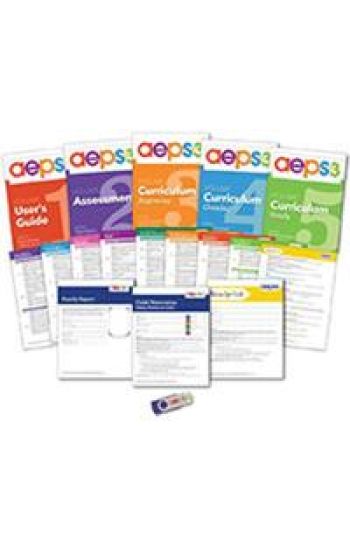
Assessment, Evaluation, and Programming System for Infants and Children (AEPS®-3) (English and Spanish Edition)

Assessment, Evaluation, and Programming System for Infants and Children (AEPS®-3) (English and Spanish Edition)

Kristine Slentz; Diane Bricker; Carmen Dionne; Jennifer Grisham; JoAnn Johnson; Marisa Macy; Misti Waddell

BROOKES PUBLISHING CO
2021
muu
Streamlined and enhanced with user?requested updates, the new AEPS®-3 gives your early childhood program the most accurate, useful child data and a proven way to turn data into action across everything you do, from goal setting to teaching to progress monitoring. This Complete Kit contains everything you need to implement AEPS®-3. AEPS®-3 HELPS YOU:Collect essential assessment data and use it across your key tasks: OSEP reporting, determining eligibility, building IFSPs and IEPs, planning teaching and intervention, monitoring progress, and sharing results with families. Track and support emerging skills, where real growth and development happens. Link assessment data to a tiered curriculum for designing teaching and intervention strategies that get results. Pick up small increments of progress—important when demonstrating growth for children with disabilities. Actively involve families, with handouts to support communication and family engagement, forms to collect information about child skills, and reports to share results and progress. Strengthen school readiness for every young child by checking and supporting core skills across all areas of child development, including pre-academic and social-emotional skills. There's never been a more effective or efficient system for assessing, tracking, and nurturing the development of every child you work with, from the first months of life through kindergarten. The AEPS®-3 Complete Kit includes:AEPS®-3 User's GuideAEPS®-3 AssessmentAEPS®-3 Beginning CurriculumAEPS®-3 Growing CurriculumAEPS®-3 Ready Curriculum2 5-packs of AEPS®-3 Child Observation Data Form (CODF) 1 10-pack of AEPS®-3 Family Report1 10-pack of AEPS®-3 Ready-SetAEPS®-3 Quick Reference GuidesAEPS®-3 Forms USB
Assessment, Evaluation, and Programming System for Infants and Children (AEPS®-3): Curriculum, Volume 5

Assessment, Evaluation, and Programming System for Infants and Children (AEPS®-3): Curriculum, Volume 5

Diane Bricker; Carmen Dionne; Jennifer Grisham; JoAnn Johnson; Marisa Macy; Kristine Slentz; Misti Waddell

Brookes Publishing Co
2021
nidottu
For use after the AEPS®-3 Test, the AEPS®-3 Curriculum is an activity-based, multitiered curriculum that helps professionals support every child's development with differentiated instruction in eight developmental areas: fine motor, gross motor, adaptive, social-emotional, social-communication, cognitive, literacy, and math. This Ready curriculum volume covers more complex developmental and early academic skills that are considered important for school success. Two additional levels, Beginning (for skills typically developing in the first year to 18 months of life) and Growing (for the toddler years) are also available. In this volume, professionals will find:a complete introduction to the curriculum's foundations, content, and organizationhelpful guidelines for selecting goals and outcomesstrategies for matching tiered teaching/intervention strategies—universal, focused, and specialized supports—with young children's individual needsinstructions on collecting progress monitoring data at each teaching/intervention tierevidence-based strategies for teaching specific developmental skills within 18 typical routines and activities, such as snack time, handwashing, dramatic play, circle time, and scienceABOUT AEPS-3Streamlined and enhanced with user-requested updates, the new AEPS-3 gives your early childhood program the most accurate, useful child data and a proven way to turn data into action across everything you do, from goal setting to teaching to progress monitoring. Use this highly effective and efficient linked system to assess, develop goals, implement instruction/intervention, and monitor progress of every child you work with, from the first months of life through kindergarten. AEPS-3 HELPS YOU:Collect essential assessment data and use it across your key tasks: OSEP reporting, determining eligibility, building IFSPs and IEPs, planning teaching and intervention, monitoring progress, and sharing results with familiesTrack and support emerging skills, where real growth and development happenLink assessment data to a tiered curriculum for designing teaching and intervention strategies that get resultsPick up small increments of progress—important when demonstrating growth for children with disabilitiesActively involve families, with handouts to support engagement, forms to gather input, and reports to share resultsStrengthen school readiness for every young child by checking and supporting core skills across all areas of child development, including pre-academic and social-emotional skillsStreamline reporting and data management with AEPS®i, the user-friendly web-based systemThere's never been a more effective or efficient system for assessing, tracking, and nurturing the development of every child you work with, from the first months of life through kindergarten.
Assessment, Evaluation, and Programming System for Infants and Children (AEPS®-3): Curriculum, Volume 3

Assessment, Evaluation, and Programming System for Infants and Children (AEPS®-3): Curriculum, Volume 3

Diane Bricker; Carmen Dionne; Jennifer Grisham; JoAnn Johnson; Marisa Macy; Kristine Slentz; Misti Waddell

Brookes Publishing Co
2021
nidottu
For use after the AEPS®-3 Test, the AEPS®-3 Curriculum is an activity-based, multi-tiered curriculum that helps professionals support every child's development with differentiated instruction in eight developmental areas: fine motor, gross motor, adaptive, social-emotional, social-communication, cognitive, literacy, and math. This Beginning curriculum volume includes foundational skills that typically developing children acquire in the first year to 18 months of life. Two additional levels, Growing (for the toddler years) and Ready (covering more complex developmental and early academic skills), are also available. In this volume, professionals will find:a complete introduction to the curriculum's foundations, content, and organizationhelpful guidelines for selecting goals and outcomesstrategies for matching tiered teaching/intervention strategies—universal, focused, and specialized supports—with young children's individual needsinstructions on collecting progress monitoring data at each teaching/intervention tierevidence-based strategies for teaching specific developmental skills within 18 typical routines and activities, such as mealtime, naps, dressing, bathtime, sensory, and outdoor playABOUT AEPS-3Streamlined and enhanced with user-requested updates, the new AEPS-3 gives your early childhood program the most accurate, useful child data and a proven way to turn data into action across everything you do, from goal setting to teaching to progress monitoring. Use this highly effective and efficient linked system to assess, develop goals, implement instruction/intervention, and monitor progress of every child you work with, from the first months of life through kindergarten. AEPS-3 HELPS YOU:Collect essential assessment data and use it across your key tasks: OSEP reporting, determining eligibility, building IFSPs and IEPs, planning teaching and intervention, monitoring progress, and sharing results with familiesTrack and support emerging skills, where real growth and development happenLink assessment data to a tiered curriculum for designing teaching and intervention strategies that get resultsPick up small increments of progress—important when demonstrating growth for children with disabilitiesActively involve families, with handouts to support engagement, forms to gather input, and reports to share resultsStrengthen school readiness for every young child by checking and supporting core skills across all areas of child development, including pre-academic and social-emotional skillsStreamline reporting and data management with AEPS®i, the user-friendly web-based systemThere's never been a more effective or efficient system for assessing, tracking, and nurturing the development of every child you work with, from the first months of life through kindergarten.
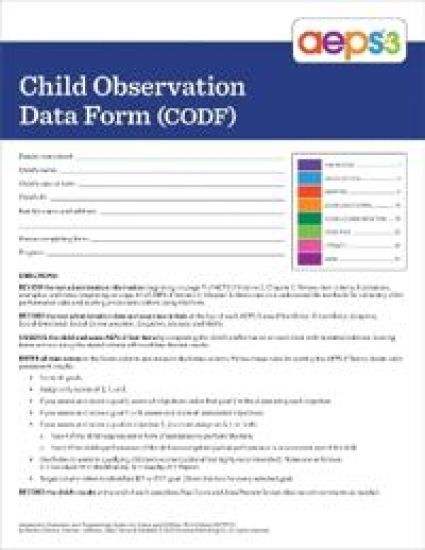
Assessment, Evaluation, and Programming System for Infants and Children (AEPS®-3)

Assessment, Evaluation, and Programming System for Infants and Children (AEPS®-3)

Kristine Slentz; Diane Bricker; Carmen Dionne; Jennifer Grisham; JoAnn Johnson; Marisa Macy; Misti Waddell

BROOKES PUBLISHING CO
2021
irtolehti
The AEPS®?3 Child Observation Data Form helps professionals gather child assessment data in all 8 AEPS-3 developmental areas across 3 time periods through observation, direct test, and/or report. It is available in a pack of 5 36-page forms. AEPS?3 HELPS YOU:Collect essential assessment data and use it across your key tasks: OSEP reporting, determining eligibility, building IFSPs and IEPs, planning teaching and intervention, monitoring progress, and sharing results with families. Track and support emerging skills, where real growth and development happens. Link assessment data to a tiered curriculum for designing teaching and intervention strategies that get results. Pick up small increments of progress—important when demonstrating growth for children with disabilities. Actively involve families, with handouts to support communication and family engagement, forms to collect information about child skills, and reports to share results and progress. Strengthen school readiness for every young child by checking and supporting core skills across all areas of child development, including pre?academic and social?emotional skills. There's never been a more effective or efficient system for assessing, tracking, and nurturing the development of every child you work with, from the first months of life through kindergarten.
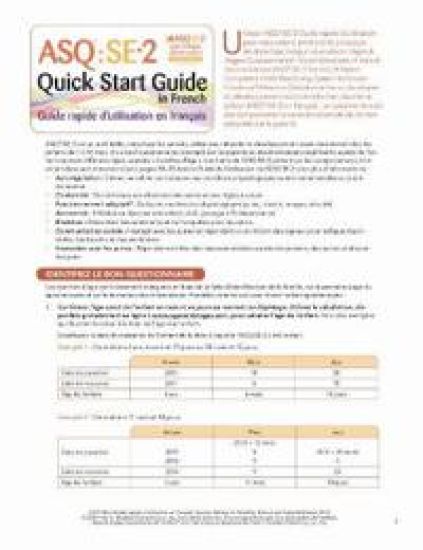
Ages & Stages Questionnaires®: Social-Emotional (ASQ®:SE-2): Quick Start Guide (French)

Ages & Stages Questionnaires®: Social-Emotional (ASQ®:SE-2): Quick Start Guide (French)

Jane Squires; Diane Bricker; Elizabeth Twombly; Suzie McKinnon; Carmen Dionne

Brookes Publishing Co
2018
nidottu
The ASQ®:SE-2 Quick Start Guide is a convenient, at-a-glance guide that keeps ASQ®:SE-2 scoring and administration basics right at the fingertips. Perfect for busy French-speaking professionals on the go, this Quick Start Guide is laminated, lightweight, and so cost-effective that every professional in a program can have one (it's sold in a package of 5). ASQ®:SE-2 users will turn to the Quick Start Guide for clear, simple directions on selecting the correct questionnaire, scoring ASQ®:SE-2, and communicating results to parents. This product is sold in a package of 5.
Ages & Stages Questionnaires® (ASQ®-3): Quick Start Guide (French)

Ages & Stages Questionnaires® (ASQ®-3): Quick Start Guide (French)

Jane Squires; Diane Bricker

Brookes Publishing Co
2016
nidottu
The ASQ®-3 Quick Start Guide, is just what French-speaking users have been asking for: a concise, at-a-glance guide that keeps ASQ®-3 scoring and administration basics right at the fingertips. Perfect for busy professionals on the go, the Quick Start Guide is laminated, lightweight, and so cost-effective that every professional in a program can have one. French-speaking ASQ®-3 users will turn to the Quick Start Guide for clear, simple directions on selecting the correct questionnaire, scoring ASQ®-3, and communicating results to parents. They'll get the quick facts they need to implement the #1 developmental screener accurately—and help their program improve screening results. This product is sold in a package of 5.
Ages & Stages Questionnaires®: Social-Emotional (ASQ®:SE-2): Questionnaires (English)

Ages & Stages Questionnaires®: Social-Emotional (ASQ®:SE-2): Questionnaires (English)

Jane Squires; Diane Bricker; Elizabeth Twombly

Brookes Publishing Co
2015
muu
The ASQ:SE-2™ trade questionnaires are the most cost-effective, reliable way to screen young children for social-emotional issues in the first 6 years of life. Now in a NEW second edition, the 9 age-appropriate questionnaires (2, 6, 12, 18, 24, 30, 36, 48, and 60 months) effectively screen 7 key social-emotional areas: self-regulation, compliance, adaptive functioning, autonomy, affect, social-communication, and interaction with people. What's New in ASQ:SE-2:ASQ:SE-2 questionnaires are better than ever, with helpful new features like: New 2 month questionnaire: Reliably screen and start monitoring children as young as 1 month, so critical interventions can start earlier. Screen through kindergarten: Now you can screen children from 1 - 72 months with no gaps, so you can use ASQ:SE-2 through kindergarten and the transition to school. New behavior and communication items designed to elicit parent concerns that may point to autism and early communication issues. New data and cutoffs: ASQ:SE-2 is based on updated research and a large sample size of more than 14,000 diverse children. New monitoring zone that clearly identifies children who are close to the cutoff and should be monitored and rescreened. Questionnaire items revised and refined based on user feedback, to help parents provide the best responses. Sturdy, convenient new box with a handle for easy portability. How to Use ASQ:SE-2 Questionnaires Fast and easy to use, ASQ:SE-2 questionnaires take just 10 - 15 minutes for parents to complete. First, parents fill out the questionnaire, checking the response that best describes their child's behavior: often or always, sometimes, or rarely or never. Clear questions help parents complete the questionnaires quickly and accurately, and open-ended questions ask about any related parental concerns. Professionals score the questionnaire in just 2 - 3 minutes, and then transfer a total score to a simple summary sheet along with any concerns the parent has noted. The summary sheet, a visual indicator of social emotional development and parent concerns, indicates whether any followup should be considered. Total scores that fall in the graph's range of Risk (dark shaded zone) indicate the child may need further evaluation. NEW! A total score in the new monitoring zone (light shaded area) helps identify children that may require followup actions based on items of concern. Professionals can work with parents to address behaviors of concern and provide social-emotional development information sheets and activities to help their child make progress before the next screening. Scores outside the shaded zones mean the child's social-emotional development appears to be developing on schedule. Parents can monitor their child's development by rescreening at the next ASQ:SE-2 interval. When you purchase a box of ASQ:SE-2 questionnaires, you'll get photocopiable master copies on paper and printable PDF master copies on CD-ROM so you and your staff will always have the format you want, right at your fingertips.
Ages & Stages Questionnaires®: Social-Emotional (ASQ®:SE-2): Questionnaires (Spanish)

Ages & Stages Questionnaires®: Social-Emotional (ASQ®:SE-2): Questionnaires (Spanish)

Jane Squires; Diane Bricker; Elizabeth Twombly

Brookes Publishing Co
2015
muu
The ASQ:SE™ trade; questionnaires are the most cost-effective, reliable way to screen young children for social-emotional issues in the first 6 years of life. Now in a NEW second edition, the 9 age-appropriate questionnaires (2, 6, 12, 18, 24, 30, 36, 48, and 60 months) effectively screen 7 key social-emotional areas: self-regulation, compliance, adaptive functioning, autonomy, affect, social-communication, and interaction with people. What's New in ASQ:SE-2: The Spanish ASQ:SE-2 questionnaires are better than ever, with helpful new features like: Updated Spanish translation that went through a rigorous vetting process by Spanish language experts, so the questionnaires are appropriate across dialects spoken in the US. New 2 month questionnaire: Reliably screen and start monitoring children as young as 1 month, so critical interventions can start earlier. Screen through kindergarten: Now you can screen children from 1 - 72 months with no gaps, so you can use ASQ:SE-2 through kindergarten and the transition to school. New behavior and communication items designed to elicit parent concerns that may point to autism and early communication issues. New data and cutoffs: ASQ:SE-2 is based on updated research and a large sample size of more than 14,000 diverse children. New monitoring zone that clearly identifies children who are close to the cutoff and should be monitored and rescreened. Questionnaire items revised and refined based on user feedback, to help parents provide the best responses. Sturdy, convenient new box with a handle for easy portability. How to Use ASQ:SE-2 Questionnaires: Fast and easy to use, ASQ:SE-2 questionnaires take just 10 - 15 minutes for parents to complete. First, parents fill out the questionnaire, checking the response that best describes their child's behavior: often or always, sometimes, or rarely or never. Clear questions help parents complete the questionnaires quickly and accurately, and open-ended questions ask about any related parental concerns. Professionals score the questionnaire in just 2 - 3 minutes, and then transfer a total score to a simple summary sheet along with any concerns the parent has noted. The summary sheet, a visual indicator of social emotional development and parent concerns, indicates whether any followup should be considered. Total scores that fall in the graph's range of Risk (dark shaded zone) indicate the child may need further evaluation. NEW! A total score in the new monitoring zone (light shaded area) helps identify children that may require followup actions based on items of concern. Professionals can work with parents to address behaviors of concern and provide social-emotional development information sheets and activities to help their child make progress before the next screening. Scores outside the shaded zones mean the child's social-emotional development appears to be developing on schedule. Parents can monitor their child's development by rescreening at the next ASQ:SE-2 interval. When you purchase a box of ASQ:SE-2 questionnaires, you'll get photocopiable master copies on paper and printablePDF master copies on CD-ROM so you and your staff will always have the format you want, right at your fingertips.
Ages & Stages Questionnaires®: Social-Emotional (ASQ®:SE-2): Starter Kit (English)

Ages & Stages Questionnaires®: Social-Emotional (ASQ®:SE-2): Starter Kit (English)

Jane Squires; Diane Bricker; Elizabeth Twombly

Brookes Publishing Co
2015
muu
This convenient Starter Kit includes everything you need to start screening children with ASQ:SE-2, a box of 9 photocopiable paper masters of the questionnaires and scoring sheets, the ASQ:SE-2 CD-ROM, with printable PDF questionnaires, the ASQ:SE-2 Users Guide, and ASQ:SE-2 Quick Start Guide. ASQ:SE-2 questionnaires are better than ever, with helpful new features like: New 2 month questionnaire: Reliably screen and start monitoring children as young as 1 month, so critical interventions can start earlier. Screen through kindergarten: Now you can screen children from 1 - 72 months with no gaps, so you can use ASQ:SE-2 through kindergarten and the transition to school. New behavior and communication items designed to elicit parent concerns that may point to autism and early communication issues. New data and cutoffs: ASQ:SE-2 is based on updated research and a large sample size of more than 14,000 diverse children. New monitoring zone that clearly identifies children who are close to the cutoff and should be monitored and rescreened. Questionnaire items revised and refined based on user feedback, to help parents provide the best responses. Sturdy, convenient new box with a handle for easy portability. The Starter Kit is part of the ASQ:SE-2 screening system. ASQ:SE-2 is the NEW edition of the bestselling screener trusted to uncover possible social-emotional issues as early as possible during the crucial first 6 years of life. The 9 age-appropriate ASQ:SE-2 questionnaires effectively screen 7 key developmental areas: self-regulation, compliance, adaptive functioning, autonomy, affect, social-communication, and interaction with people.
Ages & Stages Questionnaires®: Social-Emotional (ASQ®:SE-2): Starter Kit (Spanish)

Ages & Stages Questionnaires®: Social-Emotional (ASQ®:SE-2): Starter Kit (Spanish)

Jane Squires; Diane Bricker; Elizabeth Twombly

Brookes Publishing Co
2015
muu
Everything you need to start screening children from Spanish-speaking families with ASQ:SE™trade, this Spanish Starter Kit includes a box of 9 photocopiable print masters of the Spanish questionnaires and scoring sheets, a CD-ROM with printable PDF Spanish questionnaires, the Ages Stages Questionnaires Social Emotional ASQSE 2 Users Guide Second Edition ASQ:SE-2 User's Guide in English with all key letters, forms, handouts, and forms in Spanish. What's New in ASQ:SE-2: ASQ:SE-2 questionnaires are better than ever, with helpful new features like: New 2 month questionnaire: Reliably screen and start monitoring children as young as 1 month, so critical interventions can start earlier. Screen through kindergarten: Now you can screen children from 1 - 72 months with no gaps, so you can use ASQ:SE-2 through kindergarten and the transition to school. New behavior and communication items designed to elicit parent concerns that may point to autism and early communication issues. New data and cutoffs: ASQ:SE-2 is based on updated research and a large sample size of more than 14,000 diverse children. New monitoring zone that clearly identifies children who are close to the cutoff and should be monitored and rescreened. Updated Spanish translation vetted by Spanish language expertsSturdy, convenient new box with a handle for easy portability. The Spanish Starter Kit part of the ASQ:SE-2 screening system. ASQ:SE-2 is the NEW edition of the bestselling screener trusted to uncover possible social-emotional issues as early as possible during the crucial first 6 years of life. The 9 age-appropriate ASQ:SE-2 questionnaires effectively screen 7 key developmental areas: self-regulation, compliance, adaptive functioning, autonomy, affect, social-communication, and interaction with people.
Ages & Stages Questionnaires®: Social-Emotional (ASQ®:SE-2): Quick Start Guide (English)

Ages & Stages Questionnaires®: Social-Emotional (ASQ®:SE-2): Quick Start Guide (English)

Jane Squires; Diane Bricker; Elizabeth Twombly

Brookes Publishing Co
2015
nidottu
The ASQ®:SE-2 Quick Start Guide is a convenient, at-a-glance guide that keeps ASQ:SE-2 scoring and administration basics right at the fingertips. Perfect for busy professionals on the go, this Quick Start Guide is laminated, lightweight, and so cost-effective that every professional in a program can have one (it's sold in a package of 5). ASQ:SE-2 users will turn to the Quick Start Guide for clear, simple directions on selecting the correct questionnaire, scoring ASQ:SE-2, and communicating results to parents. The Quick Start Guide is part of the ASQ:SE-2 screening system. ASQ:SE-2 is the NEW edition of the bestselling screener trusted to uncover possible social-emotional issues as early as possible during the crucial first 6 years of life. The 9 age-appropriate ASQ:SE-2 questionnaires effectively screen 7 key developmental areas: self-regulation, compliance, adaptive functioning, autonomy, affect, social-communication, and interaction with people. The second edition of ASQ:SE-2 has been revised and updated with invaluable new features, including a NEW 2 month questionnaire, an expanded age range, updated cutoff scores, new behavior and communication items, and more updates to help you better support families and promote social-emotional development.
Ages & Stages Questionnaires®: Social-Emotional (ASQ®:SE-2): User's Guide (English)

Ages & Stages Questionnaires®: Social-Emotional (ASQ®:SE-2): User's Guide (English)

Jane Squires; Diane Bricker; Elizabeth Twombly

Brookes Publishing Co
2015
nidottu
The essential guide to the NEW edition of the trusted social-emotional screener, the updated ASQ:SE-2™trade User's Guide gives your program all the information and guidance you need to use the screener accurately and effectively. You'll get thorough, step-by-step instructions on screening with ASQ:SE-2, including planning and managing your screening program, administering and scoring the questionnaires, and evaluating your program's effectivenessa complete technical report with psychometric data, including validity, sensitivity, and specificityguidance on using ASQ:SE-2 in a wide variety of settings sample letters and forms that increase family engagement, including a welcome letter, parent feedback survey, and parent conference sheethandouts and activities families can use to help promote children's social-emotional development between screenings, plus a list of resources to support professionalsWith this clear, comprehensive guide, professionals will be sure they're making the most of this highly reliable, accurate, and parent-friendly screener so they can catch social-emotional issues early and help improve child outcomes. The ASQ:SE-2 User's Guide is part of the ASQ:SE-2 screening system. ASQ:SE-2 is the NEW edition of the bestselling screener trusted to pinpoint social-emotional issues as early as possible during the crucial first 6 years of life. The 9 age-appropriate ASQ:SE-2 questionnaires effectively screen 7 key developmental areas: self-regulation, compliance, adaptive functioning, autonomy, affect, social-communication, and interaction with people. The second edition of ASQ:SE-2 has been revised and updated with invaluable new features, including a NEW 2 month questionnaire, an expanded age range, updated cutoff scores, new behavior and communication items, and more updates to help you better support families and promote social-emotional development.
Ages & Stages Questionnaires®: Social Emotional (ASQ®:SE-2): Quick Start Guide (Spanish) / Guia Rapida en Espanol
The ASQ:SE-2™trade; Quick Start Guide is a convenient, at-a-glance guide that keeps ASQ:SE-2 scoring and administration basics right at the fingertips. Perfect for busy professionals on the go, this Quick Start Guide is laminated, lightweight, and so cost-effective that every professional in a program can have one (it's sold in a package of 5). ASQ:SE-2 users will turn to the Quick Start Guide for clear, simple directions on selecting the correct questionnaire, scoring ASQ:SE-2, and communicating results to parents. The Quick Start Guide is part of the ASQ:SE-2 screening system. ASQ:SE-2 is the NEW edition of the bestselling screener trusted to uncover possible social-emotional issues as early as possible during the crucial first 6 years of life. The 9 age-appropriate ASQ:SE-2 questionnaires effectively screen 7 key developmental areas: self-regulation, compliance, adaptive functioning, autonomy, affect, social-communication, and interaction with people. The second edition of ASQ:SE-2 has been revised and updated with invaluable new features, including a NEW 2 month questionnaire, an expanded age range, updated cutoff scores, new behavior and communication items, and more updates to help you better support families and promote social-emotional development.
An Activity-Based Approach to Early Intervention

An Activity-Based Approach to Early Intervention

Naomi L. Rahn; Diane Bricker

Brookes Publishing Co
2015
nidottu
Early childhood professionals—learn the nuts and bolts of activity-based intervention (ABI), the trusted, child-directed approach for young children birth to 5. With the fourth edition of this classic textbook and professional guide—now expanded by 30%!—you'll discover how to embed learning opportunities in everyday activities to help children acquire and generalize functional skills and reach their developmental goals. You'll get a comprehensive introduction to the benefits, challenges, and foundations of ABI, and you'll find in-depth guidance on how to apply this popular approach with children in center- and home-based programs. Case stories, examples, and sample forms throughout clarify important points and procedures. Updated with practical new information on ABI training, implementation, and more, this book is a keystone of professional preparation for early interventionists and special educators. Implement ABI in multiple settings with diverse groups of young children, including kids with disabilities and those at riskCreate multiple and varied learning opportunities within young children's natural routines and interactionsSeamlessly link screening, assessment, goal development, intervention, and evaluationDevelop individualized IFSP and IEP goalsObserve children before and after intervention to determine next stepsUnderstand and address the challenges of establishing evidence-based practicesWork as a team with other professionals and familiesWHAT'S NEW:New chapters on conducting high-quality child observations, applying ABI in centers and in homes, and using ABI with children who have significant disabilitiesExpanded information on key topics, including training paraprofessionals on ABI and keeping families involvedUpdated course companion website with PowerPoint slides, study questions, and application activities