Kirjojen hintavertailu – 12 874 857 kirjaa ja 26 kauppaa

Kirjailija

Didier Eribon

Kirjat ja teokset yhdessä paikassa: 31 kirjaa, julkaisuja vuosilta 2004–2026, suosituimpiin kuuluu Michel Foucault. Vertaile teosten hintoja ja tarkista saatavuus suomalaisista kirjakaupoista.

31 kirjaa

Kirjojen julkaisuvuodet: 2004–2026.

Hjem til Reims

Hjem til Reims

Didier Eribon

Aschehoug
2018
sidottu
Etter farens død, vender Didier Eribon tilbake til barndomsbyen Reims. Det blir også et gjensyn med et arbeiderhjem han brøt med nærmere 30 år tidligere. Han bestemmer seg for å gå fortiden i sømmene og gjenfortelle sin egen og familiens historie. I Hjem til Reims blandes barndom, skam og klassereise, med analyser av seksualitet og politikk. Denne blandingen av den individuelle og den kollektive historien, er svært tankevekkende. Det er blitt en både rørende oppvekstroman og en sylskarp samfunnsanalyse.
Tillbaka till Reims

Tillbaka till Reims

Didier Eribon

Verbal Förlag
2018
sidottu
I Tillbaka till Reims (Retour à Reims) söker sig Didier Eribon tillbaka till hemstaden för att reflektera kring den sociala skammen. På vägen till frigörelse har författaren förträngt sin uppväxt och arbetarbakgrund. Mer än halva livet har den franske sociologen levt som öppet homosexuell i kosmopolitiska storstadsmiljöer, på betryggande avstånd från den nordfranska arbetarkultur han flydde i sin ungdom. I sina akademiska arbeten om sexuell skam har han med tiden etablerat sig som en av Frankrikes ledande queerteoretiker. Men genom resan till Reims inser han hur lite han under alla dessa år velat befatta sig med en annan typ av skam: den sociala skammen. Didier Eribons banbrytande essä hyllades av Le Monde, Libération, L Express och andra tidningar när den gavs ut 2009. Den har gjort stort intryck på debatten om högerpopulistiska Front Nationals framgångar inom arbetarklassen och getts ut på en rad andra språk.
Returning to Reims

Returning to Reims

Didier Eribon

Semiotext (E)
2013
pokkari
A memoir and a meditation on individual and class identity, and the forces that keep us locked in political closets. On thinking the matter through, it doesn't seem exaggerated to assert that my coming out of the sexual closet, my desire to assume and assert my homosexuality, coincided within my personal trajectory with my shutting myself up inside what I might call a class closet.-from Returning to ReimsAfter his father dies, Didier Eribon returns to his hometown of Reims and rediscovers the working-class world he had left behind thirty years earlier. For years, Eribon had thought of his father largely in terms of the latter's intolerable homophobia. Yet his father's death provokes new reflection on Eribon's part about how multiple processes of domination intersect in a given life and in a given culture. Eribon sets out to investigate his past, the history of his family, and the trajectory of his own life. His story weaves together a set of remarkable reflections on the class system in France, on the role of the educational system in class identity, on the way both class and sexual identities are formed, and on the recent history of French politics, including the shifting voting patterns of the working classes-reflected by Eribon's own family, which changed its allegiance from the Communist Party to the National Front. Returning to Reims is a remarkable book of sociological inquiry and critical theory, of interest to anyone concerned with the direction of leftist politics in the contemporary world, and to anyone who has ever experienced how sexual identity can clash with other parts of one's identity. A huge success in France since its initial publication in 2009, Returning to Reims received enthusiastic reviews in Le Monde, Liberation, L'Express, Les Inrockuptibles, and elsewhere.

Michel Foucault

Michel Foucault

Didier Eribon

SUHRKAMP VERLAG
2009
pokkari
Mit Michel Foucault starb 1984 einer der bedeutendsten Philosophen Frankreichs. Wenigen ist es wie ihm gelungen, ihre Zeit nicht nur zu reflektieren, sondern ihr auch das Signum des eigenen Denkens aufzuprägen. Didier Eribon schildert nicht nur Foucaults Leben, sondern wirft auch exemplarische Schlaglichter auf die französische Geistesgeschichte.
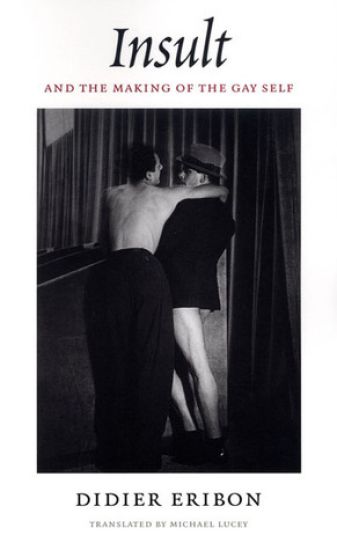
Insult and the Making of the Gay Self

Insult and the Making of the Gay Self

Didier Eribon

Duke University Press
2004
sidottu
A bestseller in France following its publication in 1999, Insult and the Making of the Gay Self is an extraordinary set of reflections on “the gay question” by Didier Eribon, one of France’s foremost public intellectuals. Known internationally as the author of a pathbreaking biography of Michel Foucault, Eribon is a leading voice in French gay studies. In explorations of gay subjectivity as it is lived now and as it has been expressed in literary history and in the life and work of Foucault, Eribon argues that gay male politics, social life, and culture are transformative responses to an oppressive social order. Bringing together the work of Jean-Paul Sartre, Pierre Bourdieu, Judith Butler, and Erving Goffman, he contends that gay culture and political movements flow from the need to overcome a world of insult in the process of creating gay selves. Eribon describes the emergence of homosexual literature in Britain and France at the turn of the last century and traces this new gay discourse from Oscar Wilde and the literary circles of late-Victorian Oxford to AndrÉ Gide and Marcel Proust. He asserts that Foucault should be placed in a long line of authors-including Wilde, Gide, and Proust-who from the nineteenth century onward have tried to create spaces in which to resist subjection and reformulate oneself. Drawing on his unrivaled knowledge of Foucault’s oeuvre, Eribon presents a masterful new interpretation of Foucault. He calls attention to a particular passage from Madness and Civilization that has never been translated into English. Written some fifteen years before The History of Sexuality, this passage seems to contradict Foucault’s famous idea that homosexuality was a late-nineteenth-century construction. Including an argument for the use of Hannah Arendt’s thought in gay rights advocacy, Insult and the Making of the Gay Self is an impassioned call for critical, active engagement with the question of how gay life is shaped both from without and within.
Insult and the Making of the Gay Self

Insult and the Making of the Gay Self

Didier Eribon

Duke University Press
2004
pokkari
A bestseller in France following its publication in 1999, Insult and the Making of the Gay Self is an extraordinary set of reflections on “the gay question” by Didier Eribon, one of France’s foremost public intellectuals. Known internationally as the author of a pathbreaking biography of Michel Foucault, Eribon is a leading voice in French gay studies. In explorations of gay subjectivity as it is lived now and as it has been expressed in literary history and in the life and work of Foucault, Eribon argues that gay male politics, social life, and culture are transformative responses to an oppressive social order. Bringing together the work of Jean-Paul Sartre, Pierre Bourdieu, Judith Butler, and Erving Goffman, he contends that gay culture and political movements flow from the need to overcome a world of insult in the process of creating gay selves. Eribon describes the emergence of homosexual literature in Britain and France at the turn of the last century and traces this new gay discourse from Oscar Wilde and the literary circles of late-Victorian Oxford to AndrÉ Gide and Marcel Proust. He asserts that Foucault should be placed in a long line of authors-including Wilde, Gide, and Proust-who from the nineteenth century onward have tried to create spaces in which to resist subjection and reformulate oneself. Drawing on his unrivaled knowledge of Foucault’s oeuvre, Eribon presents a masterful new interpretation of Foucault. He calls attention to a particular passage from Madness and Civilization that has never been translated into English. Written some fifteen years before The History of Sexuality, this passage seems to contradict Foucault’s famous idea that homosexuality was a late-nineteenth-century construction. Including an argument for the use of Hannah Arendt’s thought in gay rights advocacy, Insult and the Making of the Gay Self is an impassioned call for critical, active engagement with the question of how gay life is shaped both from without and within.