
Kirjojen hintavertailu – 12 859 829 kirjaa ja 27 kauppaa

Kirjailija

Diego Rodríguez-Pinzón

Kirjat ja teokset yhdessä paikassa: 3 kirjaa, julkaisuja vuosilta 2008–2016, suosituimpiin kuuluu Advocating for Human Rights. Vertaile teosten hintoja ja tarkista saatavuus suomalaisista kirjakaupoista.

3 kirjaa

Kirjojen julkaisuvuodet: 2008–2016.

Human Rights of Older People

Human Rights of Older People

Claudia Martin; Diego Rodríguez-Pinzón; Bethany Brown

Springer
2016
nidottu
This book focuses on descriptions of the developments in legal frameworks and policies regarding the human rights of older persons. First, it covers the policies adopted and practices developed at the universal system, particularly within the sphere of the United Nations. Second, it includes a side-by-side comparison of the work of regional human rights mechanisms, which have picked up some momentum in the past decade. Through its inclusion of law, policy, and current processes, the widest net possible has been cast to collect a descriptive resource for advocates. Overall, we hope that this book contributes to a better understanding of the current limitations and possibilities that international institutions offer to uphold the human rights of older persons. We expect that this information will allow states and other policy makers to move forward with the international recognition of the human rights of older persons. We know this is only a first effort in compiling and reporting the standards that are being produced by different international institutions. But we have no doubt that many others will follow with their expert analysis of these emerging standards, and that the ongoing discussion will finally crystalize in international human rights binding instruments explicitly recognizing the universal rights of older persons.
Human Rights of Older People

Human Rights of Older People

Claudia Martin; Diego Rodríguez-Pinzón; Bethany Brown

Springer
2015
sidottu
This book focuses on descriptions of the developments in legal frameworks and policies regarding the human rights of older persons. First, it covers the policies adopted and practices developed at the universal system, particularly within the sphere of the United Nations. Second, it includes a side-by-side comparison of the work of regional human rights mechanisms, which have picked up some momentum in the past decade. Through its inclusion of law, policy, and current processes, the widest net possible has been cast to collect a descriptive resource for advocates. Overall, we hope that this book contributes to a better understanding of the current limitations and possibilities that international institutions offer to uphold the human rights of older persons. We expect that this information will allow states and other policy makers to move forward with the international recognition of the human rights of older persons. We know this is only a first effort in compiling and reporting the standards that are being produced by different international institutions. But we have no doubt that many others will follow with their expert analysis of these emerging standards, and that the ongoing discussion will finally crystalize in international human rights binding instruments explicitly recognizing the universal rights of older persons.
Advocating for Human Rights

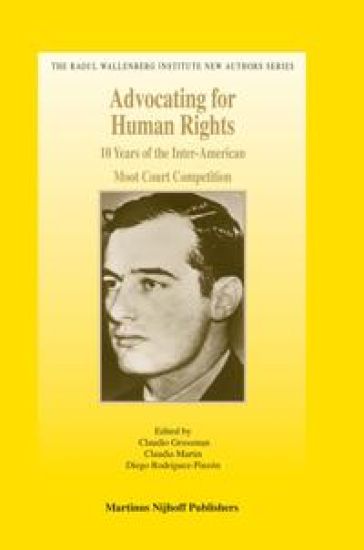
Advocating for Human Rights

Claudia Martin; Diego Rodríguez-Pinzón

BRILL
2008
sidottu
Moot Court competitions constitute an alternative model of human rights training, giving students the skills to contribute to the development of international human rights law and thus make them qualified advocates for human rights change in their home countries and abroad. By focusing on the perfection of oral as well as written skills, participants are more likely to be successful not only in cases brought before their home courts, but in front of international tribunals and other organs. Such competitions have opened the doorway for more human rights classes in law schools, more clinical training programs, more NGOs dedicated to human rights law, and overall more lawyers dedicated to participating in an expanded notion of a human rights community. As demonstrated in this volume, moot court competitions have revolutionized human rights legal education in Africa, Europe and the Americas. The yearly Inter-American Human Rights Moot Court Competition was established in 1995. The full text of the hypothetical cases, bench memoranda, and winning memorials from the first ten years of this Competition are included as a resource to be used creatively by scholars, NGOs, international organizations, governments, practitioners, students, etc., to further promote human rights legal obligations.