Kirjojen hintavertailu – 12 903 724 kirjaa ja 27 kauppaa
Kirjailija
Dilip Parameshwar Gaonkar
Kirjat ja teokset yhdessä paikassa: 3 kirjaa, julkaisuja vuosilta 2002–2024, suosituimpiin kuuluu Zerfallserscheinungen der Demokratie. Vertaile teosten hintoja ja tarkista saatavuus suomalaisista kirjakaupoista.
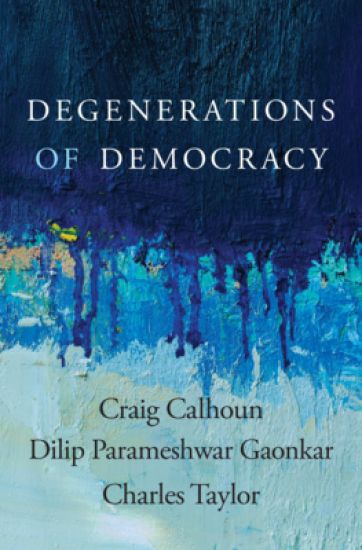
Three leading thinkers analyze the erosion of democracy’s social foundations and call for a movement to reduce inequality, strengthen inclusive solidarity, empower citizens, and reclaim pursuit of the public good. Democracy is in trouble. Populism is a common scapegoat but not the root cause. More basic are social and economic transformations eroding the foundations of democracy, ruling elites trying to lock in their own privilege, and cultural perversions like making individualistic freedom the enemy of democracy’s other crucial ideals of equality and solidarity. In Degenerations of Democracy three of our most prominent intellectuals investigate democracy gone awry, locate our points of fracture, and suggest paths to democratic renewal. In Charles Taylor’s phrase, democracy is a process, not an end state. Taylor documents creeping disempowerment of citizens, failures of inclusion, and widespread efforts to suppress democratic participation, and he calls for renewing community. Craig Calhoun explores the impact of disruption, inequality, and transformation in democracy’s social foundations. He reminds us that democracies depend on republican constitutions as well as popular will, and that solidarity and voice must be achieved at large scales as well as locally. Taylor and Calhoun together examine how ideals like meritocracy and authenticity have become problems for equality and solidarity, the need for stronger articulation of the idea of public good, and the challenges of thinking big without always thinking centralization. Dilip Parameshwar Gaonkar points out that even well-designed institutions will not integrate everyone, and inequality and precarity make matters worse. He calls for democracies to be prepared for violence and disorder at their margins—and to treat them with justice, not oppression. The authors call for bold action building on projects like Black Lives Matter and the Green New Deal. Policy is not enough to save democracy; it will take movements.
How do ordinary people identify themselves as part of a group? By what means do they express a largely unspoken understanding of themselves in society? This special issue on new social imaginaries examines the emergent forms of solidarity and collective identity in a global context. The essays explore how local cultural forms and global social movements contribute to the making and unmaking of imagined collective identities. Contributors to this collection include major voices in the fields of philosophy, critical literature, sociology, anthropology, and communication studies. The articles consider how people conceive of and categorize themselves as part of a cohesive group under the multiple rubrics of the public and counterpublic, nation, ethnos, civilization, genealogy, democracy, and the market. Many of the essays are situated in specific national and cultural sites such as Africa, Australia, eighteenth-century England, the European Union, India, and Turkey. Others examine the intersections of global financial markets and democratic institutions. As a whole, New Imaginaries suggests a new way of synthesizing economic, political, and cultural approaches to social life. Contributors. Arjun Appadurai, Craig Calhoun, Dilip Parameshwar Gaonkar, Nilüfer Göle, Benjamin Lee, Edward LiPuma, Achille Mbembe, Mary Poovey, Elizabeth A. Povinelli, Charles Taylor, Michael Warner