Kirjojen hintavertailu – 12 903 725 kirjaa ja 27 kauppaa

Kirjailija

Dilip Soman

Kirjat ja teokset yhdessä paikassa: 6 kirjaa, julkaisuja vuosilta 2009–2022, suosituimpiin kuuluu Managing Customer Value: One Step At A Time. Vertaile teosten hintoja ja tarkista saatavuus suomalaisista kirjakaupoista.

6 kirjaa

Kirjojen julkaisuvuodet: 2009–2022.

Managing Customer Value: One Step At A Time

Managing Customer Value: One Step At A Time

Dilip Soman; Sara N-marandi

WORLD SCIENTIFIC PUBLISHING CO PTE LTD
2022
sidottu
How do you take an individual who has never done business with your organization and gradually transform them into the best possible customer? How do you decide how much to spend on various marketing actions? How do you think about the pricing decision with a view to optimizing the value of your customers as assets? Where do you start, what tools do you use, and what heuristics are useful in making these decisions? This book attempts to answer questions such as these. The one-sentence summary of the answer, though, is simple — hold the individual's hands and walk them up a value ladder, one step at a time. This book is written for an advanced student of business and the practicing manager. It presents an integrated view of the marketing function. In particular, it focuses on all the activities that a firm engages in to create and manage value - not just the customer-facing activities. It links the traditional views of customer value with the finance, accounting, human resources, organizational behaviour, information technology and operations functions of the organization. It draws on the science of behaviour change and the data sciences to present a contemporary view of the customer value function. The content is meant to be prescriptive — it describes a process for value creation and management, yet analytical; theoretical, yet empirically driven. It urges the reader to think about the customer value function to be organized along activities that the firm would like the customers to engage in, not activities that the firm engages in. It presents a framework that is not only conceptually driven but also has a sound mathematical basis.
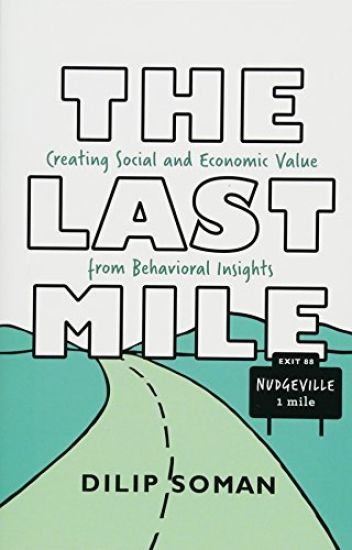
The Last Mile

The Last Mile

Dilip Soman

University of Toronto Press
2017
pokkari
Most organizations spend much of their effort on the start of the value creation process: namely, creating a strategy, developing new products or services, and analyzing the market. They pay a lot less attention to the end: the crucial "last mile" where consumers come to their website, store, or sales representatives and make a choice. In The Last Mile, Dilip Soman shows how to use insights from behavioral science in order to close that gap. Beginning with an introduction to the last mile problem and the concept of choice architecture, the book takes a deep dive into the psychology of choice, money, and time. It explains how to construct behavioral experiments and understand the data on preferences that they provide. Finally, it provides a range of practical tools with which to overcome common last mile difficulties. The Last Mile helps lay readers not only to understand behavioral science, but to apply its lessons to their own organizations’ last mile problems, whether they work in business, government, or the nonprofit sector. Appealing to anyone who was fascinated by Dan Ariely’s Predictably Irrational, Richard Thaler and Cass Sunstein’s Nudge, or Daniel Kahneman’s Thinking, Fast and Slow but was not sure how those insights could be practically applied, The Last Mile is full of solid, concrete advice on how to put the lessons of behavioral science to work.
Innovating for the Global South

Innovating for the Global South

Dilip Soman; Janice Gross Stein; Joseph Wong

University of Toronto Press
2014
sidottu
Despite the vast wealth generated in the last half century, in today’s world inequality is worsening and poverty is becoming increasingly chronic. Hundreds of millions of people continue to live on less than $2 per day and lack basic human necessities such as nutritious food, shelter, clean water, primary health care, and education. Innovating for the Global South offers fresh solutions for reducing poverty in the developing world. Highlighting the multidisciplinary expertise of the University of Toronto’s Global Innovation Group, leading experts from the fields of engineering, medicine, management, and global public policy examine the causes and consequences of endemic poverty and the challenges of mitigating its effects from the perspective of the world’s poorest of the poor. Can we imagine ways to generate solar energy to run essential medical equipment in the countryside? Can we adapt information and communication technologies to provide up-to-the-minute agricultural market prices for remote farming villages? How do we create more inclusive innovation processes to hear the voices of those living in urban slums? Is it possible to reinvent a low-cost toilet that operates beyond the water and electricity grids? Motivated by the imperatives of developing, delivering, and harnessing innovation in the developing world, Innovating for the Global South is essential reading for managers, practitioners, and scholars of development, business, and policy.
Innovating for the Global South

Innovating for the Global South

Dilip Soman; Janice Gross Stein; Joseph Wong

University of Toronto Press
2014
pokkari
Despite the vast wealth generated in the last half century, in today’s world inequality is worsening and poverty is becoming increasingly chronic. Hundreds of millions of people continue to live on less than $2 per day and lack basic human necessities such as nutritious food, shelter, clean water, primary health care, and education. Innovating for the Global South offers fresh solutions for reducing poverty in the developing world. Highlighting the multidisciplinary expertise of the University of Toronto’s Global Innovation Group, leading experts from the fields of engineering, medicine, management, and global public policy examine the causes and consequences of endemic poverty and the challenges of mitigating its effects from the perspective of the world’s poorest of the poor. Can we imagine ways to generate solar energy to run essential medical equipment in the countryside? Can we adapt information and communication technologies to provide up-to-the-minute agricultural market prices for remote farming villages? How do we create more inclusive innovation processes to hear the voices of those living in urban slums? Is it possible to reinvent a low-cost toilet that operates beyond the water and electricity grids? Motivated by the imperatives of developing, delivering, and harnessing innovation in the developing world, Innovating for the Global South is essential reading for managers, practitioners, and scholars of development, business, and policy.
Flux

Flux

David Soberman; Dilip Soman

University of Toronto Press
2012
sidottu
The past decade has seen a number of developments that threaten the very fabric of how marketing activities have traditionally been conducted. On one hand, consumers are increasingly socially networked and value-conscious, with heightened expectations of how companies will react to their demands. Along with the challenges, however, come new opportunities: the growth of behavioural economics and the emergence of new data collection techniques, for instance, give marketers unprecedented access to previously hidden aspects of consumer behavior. Clearly, ‘business as usual’ is not an option for marketing managers who want their firms to stay in the game. To help managers adapt to the rapidly changing business environment, Flux offers a collection of the very best thinking on key areas of marketing activity and decision-making. Each chapter is written by a leading expert in a specific ‘new’ marketing subject area, from managing brands to dealing with new media, and addresses substantive challenges in that area while providing steps for taking action. The book’s integrated approach makes it an excellent resource not only for marketing managers but any managers dealing with customers.
Managing Customer Value: One Stage At A Time

Managing Customer Value: One Stage At A Time

Dilip Soman; Sara N-marandi

World Scientific Publishing Co Pte Ltd
2009
sidottu
How do you take individuals who have never done business with your organization and work on them till some of them eventually become the best possible customers that you have? How do you decide how much to spend on various marketing tactics? How do you think about the pricing decision with a view to optimizing the value of your customers as assets? Where do you start — what tools do you use — what heuristics are useful in making these decisions? This book attempts to answer questions such as these. The one-sentence summary of the answer, though, is simple — hold the individuals hands and walk them through a value chain, one stage at a time. This book is written for an advanced student of business, as well as for the practicing manager, and presents an integrated view of the marketing function. In particular, it focuses on all the activities that a firm engages in to create and manage value, and not just the customer-facing activities. In that sense, it links the traditional views of customer value with the finance, accounting, human resources, organizational behaviour, information technology and operations functions. The content is meant to be prescriptive — it describes a process for value creation and management, yet analytical; theoretical, yet empirically driven. It urges the reader to think about the customer value function to be organized along activities that the firm would like the customers to engage in, not activities that the firm engages in. It presents a framework that is not only conceptually driven but also has a sound mathematical basis.