Kirjojen hintavertailu – 12 903 735 kirjaa ja 27 kauppaa

Kirjailija

Dominic Ford

Kirjat ja teokset yhdessä paikassa: 9 kirjaa, julkaisuja vuosilta 2014–2026, suosituimpiin kuuluu Night Sky Almanac 2027. Vertaile teosten hintoja ja tarkista saatavuus suomalaisista kirjakaupoista.

9 kirjaa

Kirjojen julkaisuvuodet: 2014–2026.

2026 Guide to the Night Sky Southern Hemisphere

2026 Guide to the Night Sky Southern Hemisphere

Radmila Topalovic; Dominic Ford

HARPERCOLLINS PUBLISHERS
2025
nidottu

Halvin toimitettuna 15,90 €

The ideal gift for all amateur and seasoned astronomers. A comprehensive handbook to the planets, stars and constellations visible from the southern hemisphere. 6 pages for each month covering January–December 2026. Diagrams drawn for the latitude of southern Australia, but including events visible from New Zealand and South Africa. Written and illustrated by astronomical experts. Content includes: Advice on where to start lookingEasy-to-use star maps for each month with descriptions of what to seeSpecial, detailed charts for positions of planets, minor planets and comets in 2026Seasonal chartsDetails of dark sky sitesDetails of objects and events you might see in 2026Diagrams of notable events visible from Australia, and some for New Zealand and South Africa Also available: A month-by-month guide to exploring the skies above Britain and Ireland and A month-by-month guide to exploring the skies above North America.
Night Sky Almanac 2026

Night Sky Almanac 2026

Radmila Topalovic; Dominic Ford

HARPERCOLLINS PUBLISHERS
2025
sidottu

Halvin toimitettuna 18,90 €

A beautiful gift for anyone interested in the night sky. Follow the progress of constellations throughout the seasons with this beautiful companion to the night sky from Astronomy experts Collins. With the aid of easy-to-understand monthly calendars and maps, you will chart the rhythm of the lunar phases, discover events that light up the sky for brief periods, and explore the rich tapestry of characters that adorn the starry canvas overhead. never miss a night sky event wherever you are in the world with this month-by-month guidego meteor spotting, track the phases of the moon and explore the constellationsworldwide coverage – with details for both the Northern and Southern hemispheresdiscover fascinating celestial facts and notable astronomical anniversaries Written and illustrated by astronomical experts and approved by the astronomers of Royal Observatory Greenwich.
2026 Guide to the Night Sky

2026 Guide to the Night Sky

Radmila Topalovic; Dominic Ford

HARPERCOLLINS PUBLISHERS
2025
nidottu

Halvin toimitettuna 15,90 €

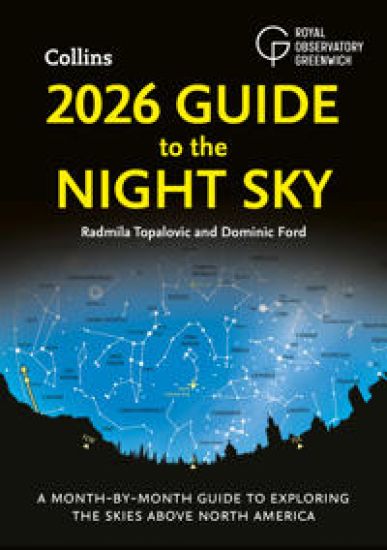
The ideal gift for all amateur and seasoned astronomers. This is the ideal resource for beginners and experienced stargazers in the United States and Canada, and has been updated to include new and practical information covering events occurring in North America's night sky throughout 2026. This practical guide is both an easy introduction to astronomy and a useful reference for seasoned stargazers. Now includes a section on comets and a map of the moon. Designed specifically for North America. Written and illustrated by astronomical experts. Content includes: Advice on where to start looking. Easy-to-use star maps for each month with descriptions of what to see. Positions of the moon and visible planets. Details of objects and events in 2026. Now in three editions: Britain and Ireland; North America; Southern Hemisphere.
2026 Guide to the Night Sky

2026 Guide to the Night Sky

Radmila Topalovic; Dominic Ford

HARPERCOLLINS PUBLISHERS
2025
nidottu

Halvin toimitettuna 15,90 €

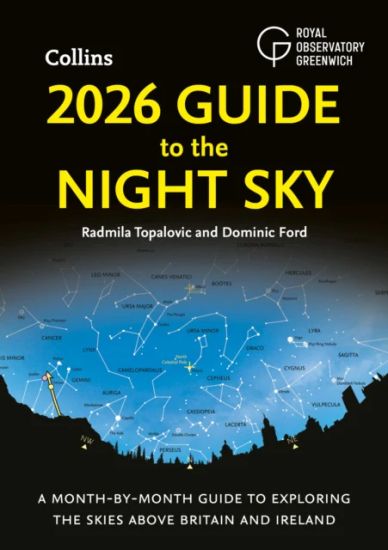
The ideal gift for all amateur and seasoned astronomers. “This is a great guide to the night sky at a great price.” Astronomy Now “A handy and straightforward guide.” British Astronomical Association's Journal “An ideal Christmas stocking-filler.” The Observatory From the UK’s Number One Astronomy publisher, this is the bestselling stargazing handbook to the planets, stars and constellations visible from the northern hemisphere. With 6 pages for each month covering January–December 2026. This practical guide is an easy introduction to astronomy and a useful reference for seasoned stargazers. Designed for Britain and Ireland but usable anywhere in the world between 40°N and 60°N, covering most of Europe, southern Canada and the northern United States. Advice on where to start looking and a map of dark sky sites to avoid light pollution. Charts for the circumpolar and seasonal constellations. Easy-to-use star charts for each month with descriptions of objects and events to look for in 2026. Positions of the moon, visible planets and eclipses. Includes a section on comets and a detailed map of the moon. Now in three editions: Britain and Ireland; North America; Southern Hemisphere. Written and illustrated by astronomical experts and approved by the astronomers of the Royal Observatory Greenwich.
The Observer's Guide to Planetary Motion

The Observer's Guide to Planetary Motion

Dominic Ford

Springer-Verlag New York Inc.
2014
nidottu
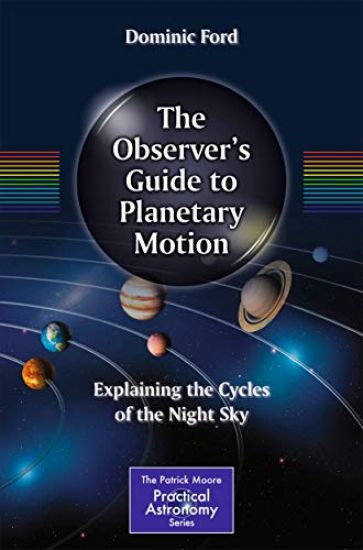
To the naked eye, the most evident defining feature of the planets is their motion across the night sky. It was this motion that allowed ancient civilizations to single them out as different from fixed stars. “The Observer’s Guide to Planetary Motion” takes each planet and its moons (if it has them) in turn and describes how the geometry of the Solar System gives rise to its observed motions. Although the motions of the planets may be described as simple elliptical orbits around the Sun, we have to observe them from a particular vantage point: the Earth, which spins daily on its axis and circles around the Sun each year. The motions of the planets as observed relative to this spinning observatory take on more complicated patterns. Periodically, objects become prominent in the night sky for a few weeks or months, while at other times they pass too close to the Sun to be observed. “The Observer’s Guide to Planetary Motion” provides accurate tables of the best time for observing each planet, together with other notable events in their orbits, helping amateur astronomers plan when and what to observe. Uniquely each of the chapters includes extensive explanatory text, relating the events listed to the physical geometry of the Solar System. Along the way, many questions are answered: Why does Mars take over two years between apparitions (the times when it is visible from Earth) in the night sky, while Uranus and Neptune take almost exactly a year? Why do planets appear higher in the night sky when they’re visible in the winter months? Why do Saturn’s rings appear to open and close every 15 years? This book places seemingly disparate astronomical events into an understandable three-dimensional structure, enabling an appreciation that, for example, very good apparitions of Mars come around roughly every 15 years and that those in 2018 and 2035 will be nearly as good as that seen in 2003. Events are listed for the time period2010-2030 and in the case of rarer events (such as eclipses and apparitions of Mars) even longer time periods are covered. A short closing chapter describes the seasonal appearance of deep sky objects, which follow an annual cycle as a result of Earth’s orbital motion around the Sun.