Kirjojen hintavertailu – 12 859 829 kirjaa ja 27 kauppaa

Kirjailija

Dominic Scott

Kirjat ja teokset yhdessä paikassa: 10 kirjaa, julkaisuja vuosilta 1995–2024, suosituimpiin kuuluu Levels of Argument. Vertaile teosten hintoja ja tarkista saatavuus suomalaisista kirjakaupoista.

10 kirjaa

Kirjojen julkaisuvuodet: 1995–2024.

Contemplation and Civic Happiness in Plato and Aristotle

Contemplation and Civic Happiness in Plato and Aristotle

Dominic Scott

Cambridge University Press
2024
sidottu
This Element concerns the civic value of contemplation in Plato and Aristotle: how does intellectual contemplation contribute to the happiness of the ideal state? The texts discussed include the Republic, the Nicomachean Ethics and the Politics, works in which contemplation is viewed from a political angle. The Element concludes that in the Republic contemplation has purely instrumental value, whereas in the Politics and Nicomachean Ethics it has purely intrinsic value. To do justice to the complexity of the issues involved, the author addresses a broader question about the nature of civic happiness: whether it is merely the aggregate of individual happiness or an organic quality that arises from the structure of the state. Answering this question has implications for how contemplation contributes to civic happiness. The Element also discusses how many citizens Plato and Aristotle expected to be engaged in contemplation in the ideal state.
Contemplation and Civic Happiness in Plato and Aristotle

Contemplation and Civic Happiness in Plato and Aristotle

Dominic Scott

Cambridge University Press
2024
pokkari
This Element concerns the civic value of contemplation in Plato and Aristotle: how does intellectual contemplation contribute to the happiness of the ideal state? The texts discussed include the Republic, the Nicomachean Ethics and the Politics, works in which contemplation is viewed from a political angle. The Element concludes that in the Republic contemplation has purely instrumental value, whereas in the Politics and Nicomachean Ethics it has purely intrinsic value. To do justice to the complexity of the issues involved, the author addresses a broader question about the nature of civic happiness: whether it is merely the aggregate of individual happiness or an organic quality that arises from the structure of the state. Answering this question has implications for how contemplation contributes to civic happiness. The Element also discusses how many citizens Plato and Aristotle expected to be engaged in contemplation in the ideal state.
Models of Leadership in Plato and Beyond

Models of Leadership in Plato and Beyond

Dominic Scott; R. Edward Freeman

Oxford University Press
2021
sidottu
Leadership has become a prevalent concept across a variety of disciplines, among them history, politics, management studies, economics, and psychology. An array of definitions and theories have been proposed both by those who study leadership, and by those in leadership positions themselves. Here, Dominic Scott and R. Edward Freeman adopt a highly innovative approach by going back to one of the greatest thought leaders of all time, the Greek philosopher Plato. Plato brought a richness and complexity to common ideas about the nature and purpose of leadership. Rather than attempting to give a single 'one-size-fits-all' definition, his strategy was to break it into its different strands. He presents several 'models' of leadership, mostly through images or analogies: the leader as doctor, navigator, artist, teacher, shepherd, weaver, or sower. Each model points to features of leadership that we intuitively recognize to be important, and which still carry significant weight today, such as curing a social malaise or charting a new course. Scott and Freeman set out the essentials of Plato's thought and illustrate each model through modern case studies, including presidents, CEOs, and Nobel laureates. They also measure Plato's models against more recent concepts, using his insights to throw light on contemporary theory and practice. With a principal focus on leadership, and an assumption of no prior knowledge of Plato's works, this book takes a multi-faceted approach to a complex phenomenon.
Listening to Reason in Plato and Aristotle

Listening to Reason in Plato and Aristotle

Dominic Scott

Oxford University Press
2020
sidottu

Halvin toimitettuna 143,00 €

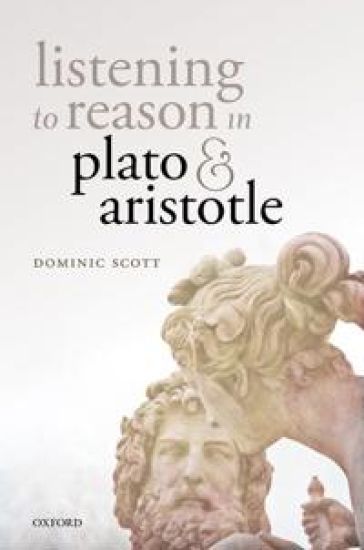
Focusing on Plato's Republic and Aristotle's Nicomachean Ethics, this book compares their views on the persuasiveness of moral argument: how far did they think it could reach beyond a narrow circle of believers and influence people more generally? Answering this question requires a wide-ranging approach, which examines their views on such topics as rationality, moral psychology, rhetoric, education, and gender. The first part of the book shows that for Plato certain kinds of argument are beyond the reach of most people, specifically arguments that make appeal to transcendent Forms. But he still thought that there is another level of argument, restricted to human psychology and politics, which could have a much wider appeal, especially if supplemented by the appropriate rhetoric. The second half of the book turns to the Nicomachean Ethics to determine Aristotle's views about the reach of moral argument, as well as its purposes. He is certainly very restrictive when it comes to the kinds of argument pursued in the work itself, proposing to talk only to those who are mature in years and well brought up. Like Plato, however, he also allows for the possibility of another type of discourse, which is more rhetorical in nature and could benefit those who are less mature. Though mainly focused on the Republic and Nicomachean Ethics, this book also examines relevant passages from Plato's Laws and Aristotle's Politics.
Levels of Argument

Levels of Argument

Dominic Scott

Oxford University Press
2018
nidottu
In Levels of Argument, Dominic Scott compares the Republic and Nicomachean Ethics from a methodological perspective. In the first half he argues that the Republic distinguishes between two levels of argument in the defence of justice, the 'longer' and 'shorter' routes. The longer is the ideal and aims at maximum precision, requiring knowledge of the Forms and a definition of the Good. The shorter route is less precise, employing hypotheses, analogies and empirical observation. This is the route that Socrates actually follows in the Republic, because it is appropriate to the level of his audience and can stand on its own feet as a plausible defence of justice. In the second half of the book, Scott turns to the Nicomachean Ethics. Scott argues that, even though Aristotle rejects a universal Form of the Good, he implicitly recognises the existence of longer and shorter routes, analogous to those distinguished in the Republic. The longer route would require a comprehensive theoretical worldview, incorporating elements from Aristotle's metaphysics, physics, psychology, and biology. But Aristotle steers his audience away from such an approach as being a distraction from the essentially practical goals of political science. Unnecessary for good decision-making, it is not even an ideal. In sum, Platonic and Aristotelian methodologies both converge and diverge. Both distinguish analogously similar levels of argument, and it is the shorter route that both philosophers actually follow--Plato because he thinks it will have to suffice, Aristotle because he thinks that there is no need to go beyond it.
Levels of Argument

Levels of Argument

Dominic Scott

Oxford University Press
2015
sidottu
In Levels of Argument, Dominic Scott compares the Republic and Nicomachean Ethics from a methodological perspective. In the first half he argues that the Republic distinguishes between two levels of argument in the defence of justice, the 'longer' and 'shorter' routes. The longer is the ideal and aims at maximum precision, requiring knowledge of the Forms and a definition of the Good. The shorter route is less precise, employing hypotheses, analogies and empirical observation. This is the route that Socrates actually follows in the Republic, because it is appropriate to the level of his audience and can stand on its own feet as a plausible defence of justice. In the second half of the book, Scott turns to the Nicomachean Ethics. Scott argues that, even though Aristotle rejects a universal Form of the Good, he implicitly recognises the existence of longer and shorter routes, analogous to those distinguished in the Republic. The longer route would require a comprehensive theoretical worldview, incorporating elements from Aristotle's metaphysics, physics, psychology, and biology. But Aristotle steers his audience away from such an approach as being a distraction from the essentially practical goals of political science. Unnecessary for good decision-making, it is not even an ideal. In sum, Platonic and Aristotelian methodologies both converge and diverge. Both distinguish analogously similar levels of argument, and it is the shorter route that both philosophers actually follow--Plato because he thinks it will have to suffice, Aristotle because he thinks that there is no need to go beyond it.
Plato's Meno

Plato's Meno

Dominic Scott

Cambridge University Press
2009
pokkari
Given its brevity, Plato's Meno covers an astonishingly wide array of topics: politics, education, virtue, definition, philosophical method, mathematics, the nature and acquisition of knowledge and immortality. Its treatment of these, though profound, is tantalisingly short, leaving the reader with many unresolved questions. This book confronts the dialogue's many enigmas and attempts to solve them in a way that is both lucid and sympathetic to Plato's philosophy. Reading the dialogue as a whole, it explains how different arguments are related to one another and how the interplay between characters is connected to the philosophical content of the work. In a new departure, this book's exploration focuses primarily on the content and coherence of the dialogue in its own right and not merely in the context of other dialogues, making it required reading for all students of Plato, be they from the world of classics or philosophy.
Recollection and Experience

Recollection and Experience

Dominic Scott

Cambridge University Press
2007
pokkari
Questions about learning and discovery have fascinated philosophers from Plato onwards. Does the mind bring innate resources of its own to the process of learning or does it rely wholly upon experience? Plato was the first philosopher to give an innatist response to this question and in doing so was to provoke the other major philosophers of ancient Greece to give their own rival explanations of learning. This book examines these theories of learning in relation to each other. It presents an entirely different interpretation of the theory of recollection which also changes the way we understand the development of ancient philosophy after Plato. The final section of the book compares ancient theories of learning with the seventeenth-century debate about innate ideas, and finds that the relation between the two periods is far more interesting and complete than is usually supposed.
Plato's Meno

Plato's Meno

Dominic Scott

Cambridge University Press
2006
sidottu
Given its brevity, Plato's Meno covers an astonishingly wide array of topics: politics, education, virtue, definition, philosophical method, mathematics, the nature and acquisition of knowledge and immortality. Its treatment of these, though profound, is tantalisingly short, leaving the reader with many unresolved questions. This book confronts the dialogue's many enigmas and attempts to solve them in a way that is both lucid and sympathetic to Plato's philosophy. Reading the dialogue as a whole, it explains how different arguments are related to one another and how the interplay between characters is connected to the philosophical content of the work. In a new departure, this book's exploration focuses primarily on the content and coherence of the dialogue in its own right and not merely in the context of other dialogues, making it required reading for all students of Plato, be they from the world of classics or philosophy.
Recollection and Experience

Recollection and Experience

Dominic Scott

Cambridge University Press
1995
sidottu
Questions about learning and discovery have fascinated philosophers from Plato onwards. Does the mind bring innate resources of its own to the process of learning or does it rely wholly upon experience? Plato was the first philosopher to give an innatist response to this question and in doing so was to provoke the other major philosophers of ancient Greece to give their own rival explanations of learning. This book is the first to examine these theories of learning in relation to each other. It presents an entirely new interpretation of the theory of recollection which also changes the way we understand the development of ancient philosophy after Plato. The final section of the book compares ancient theories of learning with the seventeenth-century debate about innate ideas, and finds that the relation between the two periods is far more interesting and complete than is usually supposed.