Kirjojen hintavertailu – 12 859 829 kirjaa ja 27 kauppaa

Kirjailija

Dominic Wilkinson

Kirjat ja teokset yhdessä paikassa: 5 kirjaa, julkaisuja vuosilta 2013–2020, suosituimpiin kuuluu Death or Disability?. Vertaile teosten hintoja ja tarkista saatavuus suomalaisista kirjakaupoista.

5 kirjaa

Kirjojen julkaisuvuodet: 2013–2020.

F. X. Velarde

F. X. Velarde

Dominic Wilkinson; Andrew Crompton

Historic England
2020
nidottu
Notable undiscovered architects, like undiscovered composers, are implausible, yet Frances Xavier Velarde OBE, 1897-1960, could be just such a person hiding in plain sight. A stylish architect who took a road less travelled then died as he was getting into his stride. There have been no followers. Yet whenever enthusiasts gather to discuss modern church architecture his name will be mentioned. He was no earnest modernist; instead he loved patterns, bold colour and gold. The Catholic churches he built in Liverpool and London are closer to European Expressionism than International Modernism; many of them have a toy like quality and come with a campanile like a rocket. Today his buildings seem fresh and playful, but also poignant as they evoke the 1950s, brightening the drab parts in which they are to be found and serving to make both spiritually and architecturally aware those who visit. Many are threatened and have been published here for the first time. Dominic Wilkinson and Andrew Crompton have combined Velarde’s papers with interviews and archive images, including many by his friend and famous photographer Edward Chambré Hardman. Their book, lavishly illustrated with new photography by Historic England, is a must for architects, students and connoisseurs wanting to discover a different route that modernism could have taken.
Medical Ethics and Law

Medical Ethics and Law

Dominic Wilkinson; Jonathan Herring; Julian Savulescu

Elsevier Health Sciences
2019
nidottu
This short textbook of ethics and law is aimed at doctors in training and in practice. Medical ethics and law are now firmly embedded in the curricula of medical schools. The ability to make clinical decisions on the basis of critical reasoning is a skill that is rightly presumed as necessary in today's doctors. Medical decisions involve not only scientific understanding but also ethical values and legal analysis. The belief that it is ethically right to act in one way rather than another should be based on good reasons: it is not enough to follow what doctors have always done, nor what experienced doctors now do. The third edition has been revised and updated to reflect changes in the core curriculum for students, developments in the law as well as advances in medicine and technology. It includes a new 'extensions' section, providing an outline of important developing areas in medical ethics. The first part of the book covers the foundations of ethics and law in the context of medicine. The second part covers specific core topics that are essential for health professionals to understand. The third section of the book includes new chapters on cutting edge topics that will be crucial for the doctors and health professionals of tomorrow. This new edition includes a new third section that provides an extension to the core curriculum focused on four key emerging topics in medical ethics - neuroethics, genethics, information ethics and public health ethics. The chapters on Consent, Capacity and Mental Health Law have been extensively revised to reflect changes in legislation. Chapters on confidentiality and information ethics contain new sections relating to information technology, sharing information and breaching confidentiality. Each chapter contains case examples drawn from personal experience or from the media. This edition also includes cartoons to highlight cutting edge and topical issues. Most chapters include revision questions and an extension case to encourage readers who are interested in a topic to explore further.
Ethics, Conflict and Medical Treatment for Children

Ethics, Conflict and Medical Treatment for Children

Dominic Wilkinson; Julian Savulescu

Elsevier Health Sciences
2018
nidottu
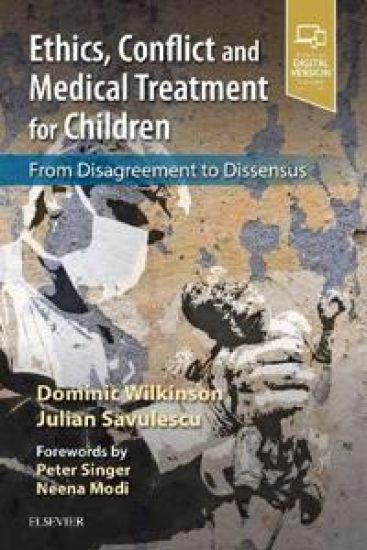
What should happen when doctors and parents disagree about what would be best for a child? When should courts become involved? Should life support be stopped against parents' wishes? The case of Charlie Gard, reached global attention in 2017. It led to widespread debate about the ethics of disagreements between doctors and parents, about the place of the law in such disputes, and about the variation in approach between different parts of the world. In this book, medical ethicists Dominic Wilkinson and Julian Savulescu critically examine the ethical questions at the heart of disputes about medical treatment for children. They use the Gard case as a springboard to a wider discussion about the rights of parents, the harms of treatment, and the vital issue of limited resources. They discuss other prominent UK and international cases of disagreement and conflict. From opposite sides of the debate Wilkinson and Savulescu provocatively outline the strongest arguments in favour of and against treatment. They analyse some of the distinctive and challenging features of treatment disputes in the 21st century and argue that disagreement about controversial ethical questions is both inevitable and desirable. They outline a series of lessons from the Gard case and propose a radical new 'dissensus' framework for future cases of disagreement. . This new book critically examines the core ethical questions at the heart of disputes about medical treatment for children. The contents review prominent cases of disagreement from the UK and internationally and analyse some of the distinctive and challenging features around treatment disputes in the 21st century. The book proposes a radical new framework for future cases of disagreement around the care of gravely ill people.
Death or Disability?

Death or Disability?

Dominic Wilkinson

Oxford University Press
2017
nidottu
In ancient Rome parents would consult the priestess Carmentis shortly after birth to obtain prophecies of the future of their newborn infant. Today, parents and doctors of critically ill children consult a different oracle. Neuroimaging provides a vision of the child's future, particularly of the nature and severity of any disability. Based on the results of brain scans and other tests doctors and parents face heart-breaking decisions about whether or not to continue intensive treatment or to allow the child to die. Paediatrician and ethicist Dominic Wilkinson looks at the profound and contentious ethical issues facing those who work in intensive care caring for critically ill children and infants. When should infants or children be allowed to die? How accurate are predictions of future quality of life? How much say should parents have in these decisions? How should they deal with uncertainty about the future? He combines philosophy, medicine and science to shed light on current and future dilemmas.
Death or Disability?

Death or Disability?

Dominic Wilkinson

Oxford University Press
2013
sidottu
In ancient Rome parents would consult the priestess Carmentis shortly after birth to obtain prophecies of the future of their newborn infant. Today, parents and doctors of critically ill children consult a different oracle. Neuroimaging provides a vision of the child's future, particularly of the nature and severity of any disability. Based on the results of brain scans and other tests doctors and parents face heart-breaking decisions about whether or not to continue intensive treatment or to allow the child to die. Paediatrician and ethicist Dominic Wilkinson looks at the profound and contentious ethical issues facing those who work in intensive care caring for critically ill children and infants. When should infants or children be allowed to die? How accurate are predictions of future quality of life? How much say should parents have in these decisions? How should they deal with uncertainty about the future? He combines philosophy, medicine and science to shed light on current and future dilemmas.