Kirjojen hintavertailu – 12 859 828 kirjaa ja 27 kauppaa

Kirjailija

Don Cupitt

Kirjat ja teokset yhdessä paikassa: 29 kirjaa, julkaisuja vuosilta 1992–2015, suosituimpiin kuuluu Creative Faith. Vertaile teosten hintoja ja tarkista saatavuus suomalaisista kirjakaupoista.

29 kirjaa

Kirjojen julkaisuvuodet: 1992–2015.

Ethics in the Last Days of Humanity

Ethics in the Last Days of Humanity

Don Cupitt

Polebridge Press
2015
nidottu
Don Cupitt’s concern is not so much the science of global warming as it is the absence of a serious ethical and religious response to it. When all existing “reality” breaks down, ethics can no longer be based on nature or religious law. Cupitt advocates for an alternative inspired by the historical Jesus.
Creative Faith

Creative Faith

Don Cupitt

Polebridge Press
2014
nidottu
Prior to the late nineteenth century, classical Christianity developed no social ethics. Rather, it concerned itself with self-purification. Christians needed only to be `in a state of grace’, unsullied and ready for the return of Christ. Muslims, in contrast, have always attempted to Islamicize the world. Today, many Christians and activist post-Christians are moving in that same direction. For them Christianity no longer entails a private practice of self-purification, but instead represents an ethical decision to struggle patiently and lovingly towards a new `reality’ in this life. In Creative Faith, Don Cupitt argues that Christians need to replace a heaven-obsessed theology with a new theology of moral striving. No longer should they aim to conserve the self, preparing for eternity: they must simply expend it, by living generously.
Creation Out of Nothing

Creation Out of Nothing

Don Cupitt

SCM Press
2012
nidottu
Don Cupitt reinterprets the traditional doctrine that the world has been created out of nothing by the divine Word. He shows how recent developments in thought have led to the rediscovery both of nihilism and of the creative power of language. Cupitt undertakes extended examinations of the relation of thought to language and of the relation of God to language - all in an effort to make intelligible a major worldview that has begun in philosophy, and which must now be applied also to religion. The consequence of all this is that divine and human creativity come to be seen as coinciding in the present moment. The creation of the world happens all of the time, in and through us, as language surges up within us and pours out of us to form and reform the world of experience. Reality and the conquest of nihilism are, in fact, effected by language, and the way is thus opened for a new 'creationist' conception of religious truth and life. This book offers a philosophy of religion for the future and a genuine alternative to pietism and fundamentalism.
What is a Story?

What is a Story?

Don Cupitt

SCM Press
2012
nidottu
Western thought began with an attack on religious myth by philosophers who held that the highest truth must be non-narrative and timeless. They left a paradox to haunt us: for on the one hand everyone knows that stories are important to us and our religion is full of them, while on the other hand stories continue to have a bad name as myths or fictions. It has been so difficult to say just how stories convey truth that until recently theologians were still trying to 'demythologize' religious belief. Now, however, philosophy has at last become more friendly to literature. There is talk of narrative theology and of rehabilitating story. Don Cupitt spells out the remarkable implications of the current return of philosophical and religious thought into time and narrative. He shows how stories produce reality, the self and time, how they awaken our desires and shape our lives, and how they express our paradoxical hopes of individual and corporate redemption.
The Last Testament

The Last Testament

Don Cupitt

SCM Press
2012
nidottu
Do you envy the suicide bombers their firm faith in life after death? Probably not: you think they are deluded. People in the west have quite recently lost all their old ideas about a Better World Hereafter. We now accept that we are already in the Last World, the world with no further reality beyond it, and that we’d better live our life to the full while we have it. If so, then what happens to the traditional problem of Christian origins? Jesus preached the arrival of the Last World, and urged us to begin a new ‘solar’ kind of living. His message was one of secular fulfilment. But the Apostolic Faith, by raising him to the supernatural world, took us all a whole dispensation back, to the Penultimate World, a world dominated by supernatural fears and hopes, a world of watching and waiting under strict discipline. The new era announced by Jesus was thus aborted, probably during the late 40s. But today we need, not the New Testament message, but a Last Testament for the Last World, which is our world. Don Cupitt attempts some midwifery. It is time for the faith to be born properly, and to become public property, not a clerical monopoly.
Crisis of Moral Authority

Crisis of Moral Authority

Don Cupitt

SCM Press
2012
nidottu
This book was written in 1970, in the days when even the Church Times was welcoming Don Cupitt as a stalwart believer. However, as the author now points out, it is an important pointer to the future. The straitlaced early Cupitt is obviously struggling to prevent the later Cupitt from bursting out.' Its starting point was straightforward enough. Many, perhaps most of the great critics of Christianity have rejected it chiefly on moral grounds. Yet, because they have tended to suffer from an entrenched sense of their own moral superiority, Christians have never really taken this fact seriously enough and so have failed fully to understand one very important factor in the modern world's rejection of faith, The idea was therefore to outline the principal moral criticisms of Christianity, in order to discover how strong they are and what should be done about them. This was the beginning of a course which took Don Cupitt, as he himself confesses, much further than he ever expected. Many have parted company on the way at various stages; they, and those who find what Don Cupitt says speaks to them more than most modern theology, will find that these early stages, in retrospect, make fascinating reading.
Lifelines

Lifelines

Don Cupitt

SCM Press
2012
nidottu
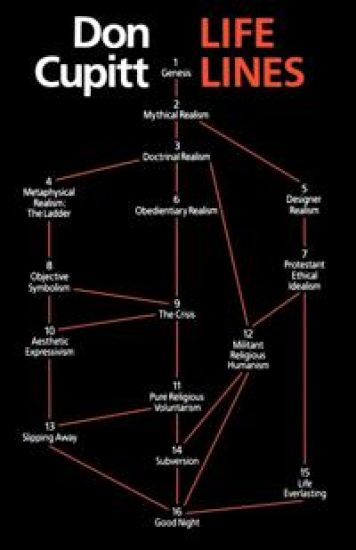
'If you are one of those who persist in thinking that the old questions about the meaning of life, however badly framed they were, had something important behind them, then the answer offered here is that there is indeed such a thing as the religious life, that it has a variety of different possible shapes or courses, and that there is something important to be learnt from a consideration of the map of life as a whole. THere is not just one linear track running through three or four stations, as used to be thought in the past, but there are at any rate a large number of stations and a web of lines connecting them. I have set them out (in a necessarily simplified form) in a diagram on the cover and after the Contents page as a kind of Metro map of the spirit. The idea is that after the book has explained the map, you may be able to find on it the life-route you have yourself followed so far.'
Turns of Phrase

Turns of Phrase

Don Cupitt

SCM Press
2011
nidottu
In 40 years of writing Don Cupitt has coined many new words and phrases to communicate his ideas, but he has written so much that critics have split him up into stages, and readers complain of obscurity. Piqued, he here represents an entertaining ‘Devil’s Dictionary’ of his own ideas, with cross-links from entry to entry guiding the reader around his system. Cupitt’s teaching is a form of religious naturalism based, not like Spinoza’s on geometrical reasoning, but upon the more biological idea of an uprush of energies pouring out into symbolic expression. He points out that the non-arrival of the Kingdom left the early Christians looking up vigilantly towards a better world that was yet to come. Today, people no longer expect any further world after this one, and Church-religion no longer works. It is too inhibited. Instead, we need to work out, and start living out, the philosophy and the ethic of the final world, now. It is a world in which the original spirituality of the ‘inner life’ is replaced by a new religion of ‘self-outing’ and putting on a ‘good show’ – the religion of ‘solar’ generosity that Cupitt attributes to the original Jesus.
The Fountain

The Fountain

Don Cupitt

SCM Press
2010
nidottu
During the past 30 years, what we used to call ‘the passing show of existence’ has turned into a global torrent of electronic communication and cultural change. Everywhere, Tradition is collapsing. Local fundamentalist reactions – hailed by some as evidence that ‘God is back’ – cannot hope to stem the flood. They are merely symptoms of faith’s increasing desperation. In our time, Don Cupitt says, religion is no longer about gaining immortality, or the forgiveness of our sins: it is about becoming reconciled to our life's transience, to time and death. This ultra-clear and secular 'theology' therefore centres around the image of 'The Fountain', which close-up, is all noisy, rushing transience, but when we step back becomes a healing, unifying symbol of life's perpetual self-renewal. This is religious thought with no supernatural world, and with none of the local divine names. But it works.
Theology's Strange Return

Theology's Strange Return

Don Cupitt

SCM Press
2010
nidottu
For two centuries and more our culture has been secular, and no religious doctrine now plays a constitutive part in any established branch of knowledge. Yet if God is dead, he won’t lie down, and reminders of the old faith still pervade our language, the built environment, our art and our literature. Most important, themes of the old theology are currently returning to us in new and strange guises. Thus God, the strict Judge who searches our hearts and demands inner integrity, returns in the critical thinking which makes everyone trained it ‘his own hardest taskmaster’. Again, the biblical idea that the world is made by the utterance of language returns in modern poetry and linguistic philosophy. By assembling such reminders, Don Cupitt shows that a surprising amount of traditional Christian belief — including a new Grand Narrative, and a non-metaphysical theology — is currently returning to us in secular form.
Jesus and Philosophy

Jesus and Philosophy

Don Cupitt

SCM Press
2009
nidottu
Around twenty years or so after his death, the fiery and interesting Jewish teacher Jesus of Nazareth was made into the personification of his own teaching, and given an exalted cosmic status. Within a few decades he had been so completely buried by supernatural beliefs about himself that in all the years since it has been very difficult to make out his own voice, and quite impossible to take him seriously as a thinker. "Jesus and Philosophy" asks on the basis of recent reconstructions of his teaching, what was Jesus' moral philosophy? What was his world view? And, is he a big enough figure in the history of ethics to survive the end of the classic ecclesiastical beliefs about him? The author, Don Cupitt, argues that Jesus will be bigger after Christianity, which blocked the realization of just how revolutionary a figure he was.
The Meaning of the West

The Meaning of the West

Don Cupitt

SCM Press
2008
nidottu
Don Cupitt proposes a reinterpretation of Christian history, arguing that the meaning of the West is not Catholic Christian, but radical Christian. The original Jesus was a secular figure, a utopian teacher of ethical wisdom. He argues that the core of Western culture is simply the old Christian spirituality extraverted. Today, Christian supernatural doctrine is dead, but in the secular 'West' Christianity itself is now emerging in its final, 'Kingdom' form.
Above Us Only Sky

Above Us Only Sky

Don Cupitt

Polebridge Press
2008
nidottu
Don Cupitt believes that a new and truly global religious consciousness has been quietly easing itself in around the world. It does not need any visible organization and does not make any non-rational doctrinal claims. It is the religion of life - a secular, purely this-worldly, and radically-democratic affirmation of ordinary life. Where prescientific ages saw Heaven, he says, we see only sky. We have given up belief in a supernatural world, and we have felt compelled to break with the received ecclesiastical form of Christianity. But the Christian spirit of critical thinking, of systematic self-criticism and perpetual reform, has spread around the whole world in modern science, technology, critical history, and liberal democracy. In ""Above Us Only Sky"", in 27 brief slogans, he presents a systematic theology of this religion of ordinary life, setting it against its philosophical background, its spirituality and its relation to other faiths. It is, he says, the legacy and the long-awaited fulfilment of Christianity.

Radical Theology

Radical Theology

Don Cupitt

Polebridge Press
2006
nidottu
According to Don Cupitt, radical theology is a personal struggle for a new and better kind of religion following the loss of the older sort of popular, traditional, ecclesiastical faith. It is, he says, inevitably, highly autobiographical. This set of eighteen unpublished or little known published essays which document his gradual radicalization over the last thirty years open a window onto the progression of his thought and demonstrate his long held desire to come up with a message that can reach and influence ordinary people. Because, in Cupitt s judgment, the real radical theology is your own voice, if you can but find it.
The Old Creed and the New

The Old Creed and the New

Don Cupitt

SCM Press
2006
nidottu
The Old Creed and the New, is Don Cupitt's return to the UK market, after a five year absence, with a successor to his earlier works, which can be seen as the next stage in his long project to modernise religious thought. Here he sharply juxtaposes the traditional Apostles' Creed of Western Christianity and the emergent creed of modern radical theology. Side by side they look amazingly different, and Cupitt carefully explains what is happening and why. The main change is that the old creed situated the believer within a huge narrative cosmology, the central myth of a great religion-based civilization, whereas the new creed merely defines the bare outlines of a modern spirituality. The difference is very great, and it is vital that we understand it clearly. Whilst in previous works Cupitt has attempted to define the real religion of modern people, and help them learn religious thinking for themselves in a post-ecclesiastical Christianity, in this book he attempts to bridge the gap between the old way of dogma and Church, and the new, plural, post-ecclesiastical kind of religion.
The Great Questions of Life

The Great Questions of Life

Don Cupitt

Polebridge Press
2006
nidottu
In everyday speech we often hear people jokingly mention what they call the 'ultimate questions', the 'big questions', or 'the great questions' of life. In Don Cupitt's judgment, however, these questions are no joking matter. He believes that there is no higher truth than the truth that is built into our everyday speech and that, therefore, these questions should be taken seriously. In The Great Questions of Life, he collects and classifies all the great questions, in the wordings that are most familiar to us, and interprets and answers them. He shows how the decline of the old religion has led to the return of the great questions and explains why they have become important to us in modern times.
Sea of Faith

Sea of Faith

Don Cupitt

SCM Press
2003
nidottu
The Sea of Faith made a huge impact when it was first published to accompany a major television series in the mid 1980's. For a generation that was embodying the ebbing of the tide of faith, it articulated the huge intellectual and cultural shifts that had resulted in most people no longer having any connection with official religion. For many who, whilst still going to church, glimpsed horizons wider than those offered by traditional forms of religious thought, The Sea of Faith offered liberating freedom, encouraging them to have minds of their own in matters of faith. For many more who had abandoned the church, it once again made the wider question a matter of serious and worthwhile concern. Today, the Sea of Faith networks exist in Britain, Australia and New Zealand and the movement is known around much of the world. The Sea of Faith is rightly acknowledged as one of the most influential theological texts of recent years. With a preface by George Pattison
Emptiness and Brightness

Emptiness and Brightness

Don Cupitt

Polebridge Press
2002
nidottu
If new Platos or Buddhas were to appear today, what would they say about the nature of reality, the human condition and the way to happiness? The period 800-200 b.c.e. the so-called Axial Age was the time when Old World pioneering philosophers and religious teachers laid down the basic ideas by which people have been living ever since. Today those great religious and cultural traditions are coming to an end. We are entering a new Axial Age. Don Cupitt observes that this second Axial Age is one of communication. Everything is accessible to everyone, and everyone can make a contribution. The world is therefore made and remade not by the individual genius, but by a change in the general consensus. Cupitt describes the emergent religion and philosophy of the new Axial Period in clear and accessible language. He predicts that, while it may seem very strange at first, we will learn to love it
Is Nothing Sacred?

Is Nothing Sacred?

Don Cupitt

Fordham University Press
2002
sidottu
Don Cupitt is best known for developing a non-realistic interpretation of Christian doctrine and an ever-more radically antirealist position in philosophy. Cupitt has sought to go beyond ecclesiastical religion to a purely this-worldly humanistic religion of life: he argues for a "kingdom" version of Christianity that will bring it closer to the original Jewish Jesus. This book contains essays written over twenty years that appear in book form for the first time.