
Kirjojen hintavertailu – 12 903 735 kirjaa ja 27 kauppaa

Kirjailija

Don M. Gottfredson

Kirjat ja teokset yhdessä paikassa: 2 kirjaa, julkaisuja vuosilta 1987–2013, suosituimpiin kuuluu Decision Making in Criminal Justice. Vertaile teosten hintoja ja tarkista saatavuus suomalaisista kirjakaupoista.

2 kirjaa

Kirjojen julkaisuvuodet: 1987–2013.

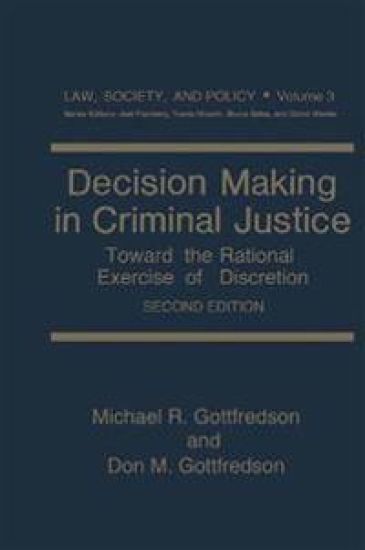
Decision Making in Criminal Justice

Decision Making in Criminal Justice

Michael R. Gottfredson; Don M. Gottfredson

Springer-Verlag New York Inc.
2013
nidottu
The study of decisions in the criminal justice process provides a useful focus for the examination of many fundamental aspects of criminal jus­ tice. These decisions are not always highly visible. They are made, or­ dinarily, within wide areas of discretion. The aims of the decisions are not always clear, and, indeed, the principal objectives of these decisions are often the subject of much debate. Usually they are not guided by explicit decision policies. Often the participants are unable to verbalize the basis for the selection of decision alternatives. Adequate information for the decisions is usually unavailable. Rarely can the decisions be demonstrated to be rational. By a rationaldecision we mean "that decision among those possible for the decisionmaker which, in the light of the information available, maximizes the probability of the achievement of the purpose of the decisionmaker in that specific and particular case" (Wilkins, 1974a: 70; also 1969). This definition, which stems from statistical decision theory, points to three fundamental characteristics of decisions. First, it is as­ sumed that a choice of possible decisions (or, more precisely, of possible alternatives) is available. If only one choice is possible, there is no de­ cision problem, and the question of rationality does not arise. Usually, of course, there will be a choice, even if the alternative is to decide not to decide-a choice that, of course, often has profound consequences.
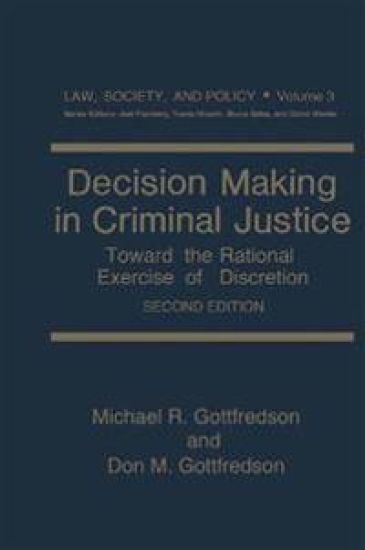
Decision Making in Criminal Justice

Decision Making in Criminal Justice

Michael R. Gottfredson; Don M. Gottfredson

Kluwer Academic/Plenum Publishers
1987
sidottu
The study of decisions in the criminal justice process provides a useful focus for the examination of many fundamental aspects of criminal jus­ tice. These decisions are not always highly visible. They are made, or­ dinarily, within wide areas of discretion. The aims of the decisions are not always clear, and, indeed, the principal objectives of these decisions are often the subject of much debate. Usually they are not guided by explicit decision policies. Often the participants are unable to verbalize the basis for the selection of decision alternatives. Adequate information for the decisions is usually unavailable. Rarely can the decisions be demonstrated to be rational. By a rationaldecision we mean "that decision among those possible for the decisionmaker which, in the light of the information available, maximizes the probability of the achievement of the purpose of the decisionmaker in that specific and particular case" (Wilkins, 1974a: 70; also 1969). This definition, which stems from statistical decision theory, points to three fundamental characteristics of decisions. First, it is as­ sumed that a choice of possible decisions (or, more precisely, of possible alternatives) is available. If only one choice is possible, there is no de­ cision problem, and the question of rationality does not arise. Usually, of course, there will be a choice, even if the alternative is to decide not to decide-a choice that, of course, often has profound consequences.