

Kirjojen hintavertailu – 12 903 724 kirjaa ja 27 kauppaa

Kirjailija

Don Zagier

Kirjat ja teokset yhdessä paikassa: 2 kirjaa, julkaisuja vuosilta 2008–2013, suosituimpiin kuuluu The 1-2-3 of Modular Forms. Vertaile teosten hintoja ja tarkista saatavuus suomalaisista kirjakaupoista.

2 kirjaa

Kirjojen julkaisuvuodet: 2008–2013.

The Theory of Jacobi Forms

The Theory of Jacobi Forms

Martin Eichler; Don Zagier

Birkhauser Boston Inc
2013
nidottu
The functions studied in this monogra9h are a cross between elliptic functions and modular forms in one variable. Specifically, we define a Jacobi form on SL (~) to be a holomorphic function 2 (JC = upper half-plane) satisfying the t\-10 transformation eouations 2Tiimcz* k CT +d a-r +b z ) (1) ( (cT+d) e cp(T,z) cp CT +d ' CT +d (2) rjl(T, z+h+]l) and having a Four*ier expansion of the form 00 e2Tii(nT +rz) (3) cp(T,z) 2: c(n,r) 2:: rE~ n=O 2 r ~ 4nm Here k and m are natural numbers, called the weight and index of rp, respectively. Note that th e function cp (T, 0) is an ordinary modular formofweight k, whileforfixed T thefunction z-+rjl(-r,z) isa function of the type normally used to embed the elliptic curve ~/~T + ~ into a projective space. If m= 0, then cp is independent of z and the definition reduces to the usual notion of modular forms in one variable. We give three other examples of situations where functions satisfying (1)-(3) arise classically: 1. Theta series. Let Q: ~-+ ~ be a positive definite integer valued quadratic form and B the associated bilinear form.
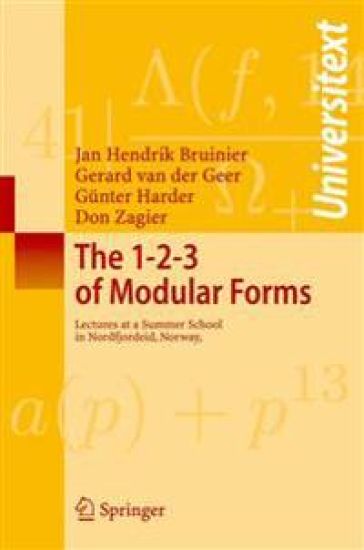
The 1-2-3 of Modular Forms

The 1-2-3 of Modular Forms

Jan Hendrik Bruinier; Gerard van der Geer; Günter Harder; Don Zagier

Springer-Verlag Berlin and Heidelberg GmbH Co. K
2008
nidottu
This book grew out of three series of lectures given at the summer school on "Modular Forms and their Applications" at the Sophus Lie Conference Center in Nordfjordeid in June 2004. The first series treats the classical one-variable theory of elliptic modular forms. The second series presents the theory of Hilbert modular forms in two variables and Hilbert modular surfaces. The third series gives an introduction to Siegel modular forms and discusses a conjecture by Harder. It also contains Harder's original manuscript with the conjecture. Each part treats a number of beautiful applications.