Kirjojen hintavertailu – 12 903 724 kirjaa ja 27 kauppaa

Kirjailija

Donal O'Regan

Kirjat ja teokset yhdessä paikassa: 45 kirjaa, julkaisuja vuosilta 1997–2023, suosituimpiin kuuluu Dynamic Inequalities On Time Scales. Vertaile teosten hintoja ja tarkista saatavuus suomalaisista kirjakaupoista.

Nimi esiintyy myös muodoissa: Donal O’Regan, Donal O' Regan

45 kirjaa

Kirjojen julkaisuvuodet: 1997–2023.

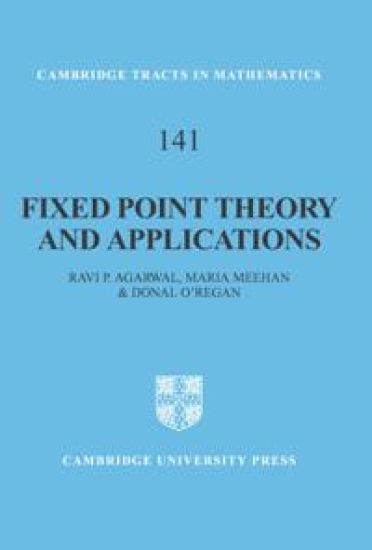
Fixed Point Theory and Applications

Fixed Point Theory and Applications

Ravi P. Agarwal; Maria Meehan; Donal O'Regan

Cambridge University Press
2001
sidottu
This book provides a clear exposition of the flourishing field of fixed point theory. Starting from the basics of Banach's contraction theorem, most of the main results and techniques are developed: fixed point results are established for several classes of maps and the three main approaches to establishing continuation principles are presented. The theory is applied to many areas of interest in analysis. Topological considerations play a crucial role, including a final chapter on the relationship with degree theory. Researchers and graduate students in applicable analysis will find this to be a useful survey of the fundamental principles of the subject. The very extensive bibliography and close to 100 exercises mean that it can be used both as a text and as a comprehensive reference work, currently the only one of its type.
Oscillation Theory for Difference and Functional Differential Equations

Oscillation Theory for Difference and Functional Differential Equations

R.P. Agarwal; Said R. Grace; Donal O'Regan

Springer
2000
sidottu
This monograph is devoted to a rapidly developing area of research of the qualitative theory of difference and functional differential equations. In fact, in the last 25 years Oscillation Theory of difference and functional differential equations has attracted many researchers. This has resulted in hundreds of research papers in every major mathematical journal, and several books. In the first chapter of this monograph, we address oscillation of solutions to difference equations of various types. Here we also offer several new fundamental concepts such as oscillation around a point, oscillation around a sequence, regular oscillation, periodic oscillation, point-wise oscillation of several orthogonal polynomials, global oscillation of sequences of real­ valued functions, oscillation in ordered sets, (!, R, ~)-oscillate, oscillation in linear spaces, oscillation in Archimedean spaces, and oscillation across a family. These concepts are explained through examples and supported by interesting results. In the second chapter we present recent results pertaining to the oscil­ lation of n-th order functional differential equations with deviating argu­ ments, and functional differential equations of neutral type. We mainly deal with integral criteria for oscillation. While several results of this chapter were originally formulated for more complicated and/or more general differ­ ential equations, we discuss here a simplified version to elucidate the main ideas of the oscillation theory of functional differential equations. Further, from a large number of theorems presented in this chapter we have selected the proofs of only those results which we thought would best illustrate the various strategies and ideas involved.
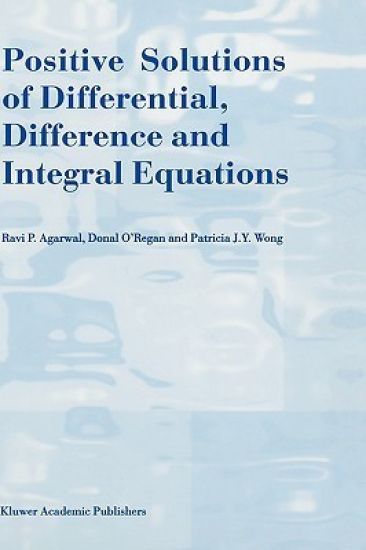
Positive Solutions of Differential, Difference and Integral Equations

Positive Solutions of Differential, Difference and Integral Equations

R.P. Agarwal; Donal O'Regan; Patricia J.Y. Wong

Springer
1998
sidottu
In analysing nonlinear phenomena many mathematical models give rise to problems for which only nonnegative solutions make sense. In the last few years this discipline has grown dramatically. This state-of-the-art volume offers the authors' recent work, reflecting some of the major advances in the field as well as the diversity of the subject. Audience: This volume will be of interest to graduate students and researchers in mathematical analysis and its applications, whose work involves ordinary differential equations, finite differences and integral equations.
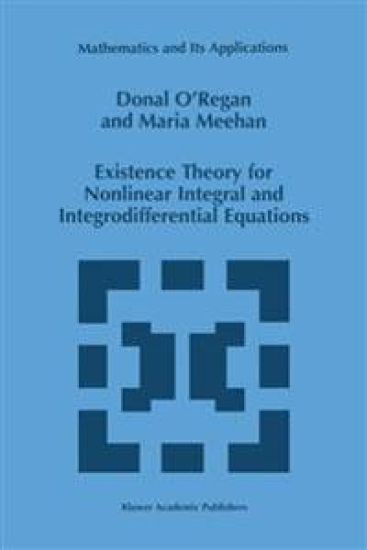
Existence Theory for Nonlinear Integral and Integrodifferential Equations
The theory of integral and integrodifferential equations has ad­ vanced rapidly over the last twenty years. Of course the question of existence is an age-old problem of major importance. This mono­ graph is a collection of some of the most advanced results to date in this field. The book is organized as follows. It is divided into twelve chap­ ters. Each chapter surveys a major area of research. Specifically, some of the areas considered are Fredholm and Volterra integral and integrodifferential equations, resonant and nonresonant problems, in­ tegral inclusions, stochastic equations and periodic problems. We note that the selected topics reflect the particular interests of the authors. Donal 0 'Regan Maria Meehan CHAPTER 1 INTRODUCTION AND PRELIMINARIES 1.1. Introduction The aim of this book is firstly to provide a comprehensive existence the­ ory for integral and integrodifferential equations, and secondly to present some specialised topics in integral equations which we hope will inspire fur­ ther research in the area. To this end, the first part of the book deals with existence principles and results for nonlinear, Fredholm and Volterra inte­ gral and integrodifferential equations on compact and half-open intervals, while selected topics (which reflect the particular interests of the authors) such as nonresonance and resonance problems, equations in Banach spaces, inclusions, and stochastic equations are presented in the latter part.
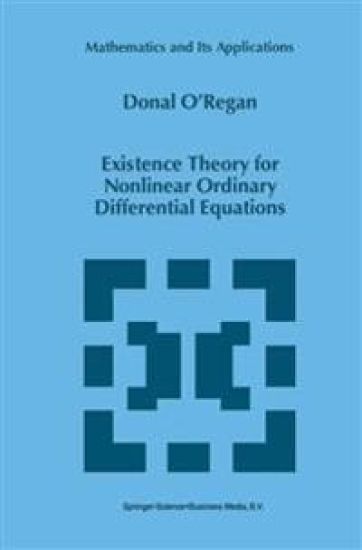
Existence Theory for Nonlinear Ordinary Differential Equations
We begin our applications of fixed point methods with existence of solutions to certain first order initial initial value problems. This problem is relatively easy to treat, illustrates important methods, and in the end will carry us a good deal further than may first meet the eye. Thus, we seek solutions to Y'. = I(t,y) (1. 1 ) { yeO) = r n where I: I X R n ---+ R and I = [0, b]. We shall seek solutions that are de­ fined either locally or globally on I, according to the assumptions imposed on I. Notice that (1. 1) is a system of first order equations because I takes its values in Rn. In section 3. 2 we will first establish some basic existence theorems which guarantee that a solution to (1. 1) exists for t > 0 and near zero. Familiar examples show that the interval of existence can be arbi­ trarily short, depending on the initial value r and the nonlinear behaviour of I. As a result we will also examine in section 3. 2 the dependence of the interval of existence on I and r. We mention in passing that, in the results which follow, the interval I can be replaced by any bounded interval and the initial value can be specified at any point in I. The reasoning needed to cover this slightly more general situation requires minor modifications on the arguments given here.