Kirjojen hintavertailu – 12 859 818 kirjaa ja 27 kauppaa

Kirjailija

Donald A. Norman

Kirjat ja teokset yhdessä paikassa: 5 kirjaa, julkaisuja vuosilta 1993–2024, suosituimpiin kuuluu Design for a Better World. Vertaile teosten hintoja ja tarkista saatavuus suomalaisista kirjakaupoista.

5 kirjaa

Kirjojen julkaisuvuodet: 1993–2024.

Design for a Better World

Design for a Better World

Donald A. Norman

MIT PRESS LTD
2024
nidottu

Halvin toimitettuna 26,80 €

How human behavior brought our world to the brink, and how human behavior can save us. The world is a mess. Our dire predicament, from collapsing social structures to the climate crisis, has been millennia in the making and can be traced back to the erroneous belief that the earth's resources are infinite. The key to change, says Don Norman, is human behavior, covered in the book's three major themes: meaning, sustainability, and humanity-centeredness. Emphasize quality of life, not monetary rewards; restructure how we live to better protect the environment; and focus on all of humanity. Design for a Better World presents an eye-opening diagnosis of where we've gone wrong and a clear prescription for making things better. Norman proposes a new way of thinking, one that recognizes our place in a complex global system where even simple behaviors affect the entire world. He identifies the economic metrics that contribute to the harmful effects of commerce and manufacturing and proposes a recalibration of what we consider important in life. His experience as both a scientist and business executive gives him the perspective to show how to make these changes while maintaining a thriving economy. Let the change begin with this book before it's too late.

Living with Complexity

Living with Complexity

Donald A. Norman

MIT Press
2016
pokkari

Halvin toimitettuna 30,00 €

Why we don't really want simplicity, and how we can learn to live with complexity. If only today's technology were simpler! It's the universal lament, but it's wrong. In this provocative and informative book, Don Norman writes that the complexity of our technology must mirror the complexity and richness of our lives. It's not complexity that's the problem, it's bad design. Bad design complicates things unnecessarily and confuses us. Good design can tame complexity. Norman gives us a crash course in the virtues of complexity. Designers have to produce things that tame complexity. But we too have to do our part: we have to take the time to learn the structure and practice the skills. This is how we mastered reading and writing, driving a car, and playing sports, and this is how we can master our complex tools. Complexity is good. Simplicity is misleading. The good life is complex, rich, and rewarding—but only if it is understandable, sensible, and meaningful.
The Design of Everyday Things

The Design of Everyday Things

Donald A. Norman

Basic Books
2013
pokkari

Halvin toimitettuna 22,00 €

Even the smartest among us can feel inept as we fail to figure out which light switch or oven burner to turn on, or whether to push, pull, or slide a door. The fault, argues this ingenious,even liberating,book, lies not in ourselves, but in product design that ignores the needs of users and the principles of cognitive psychology. The problems range from ambiguous and hidden controls to arbitrary relationships between controls and functions, coupled with a lack of feedback or other assistance and unreasonable demands on memorization. The Design of Everyday Things shows that good, usable design is possible. The rules are simple: make things visible, exploit natural relationships that couple function and control, and make intelligent use of constraints. The goal: guide the user effortlessly to the right action on the right control at the right time. In this entertaining and insightful analysis, cognitive scientist Don Norman hails excellence of design as the most important key to regaining the competitive edge in influencing consumer behaviour. Now fully expanded and updated, with a new introduction by the author, The Design of Everyday Things is a powerful primer on how,and why,some products satisfy customers while others only frustrate them.
Inner Navigation

Inner Navigation

Erik Jonsson; Donald A. Norman

Scribner
2002
pokkari
A FASCINATING INVESTIGATION OF HOW WE NAVIGATE THE PHYSICAL WORLD, "INNER NAVIGATION" IS A LIVELY, ENGAGING ACCOUNT OF SUBCONSCIOUS MAPMAKING. Why are we so often disoriented when we come up from the subway? Do we really walk in circles when we lose our bearings in the wilderness? How -- and why -- do we get lost at all? In this surprising, stimulating book, Erik Jonsson, a Swedish-born engineer who has spent a lifetime exploring navigation over every terrain, from the crowded cities of Europe to the emptiness of the desert, gives readers extraordinary new insights into the human way-finding system. Written for the nonscientist, "Inner Navigation" explains the astonishing array of physical and psychological cues the brain uses to situate us in space and build its "cognitive maps" -- the subconscious maps it employs to organize landmarks. Humans, Jonsson explains, also possess an intuitive direction frame -- an internal compass -- that keeps these maps oriented (when it functions properly) and a dead-reckoning system that constantly updates our location on the map as we move through the world. Even the most cynical city-dweller will be amazed to learn how much of this innate sense we use every day as we travel across town or around the world. Both a scientific and a human story, "Inner Navigation" contains a rich assortment of real-life insights and examples of the navigational challenges we all face, no matter where or how we live. It's a book that is as provocative to ponder as it is delightful to lose yourself in. Don't worry: Erik Jonsson will help you find your bearings.
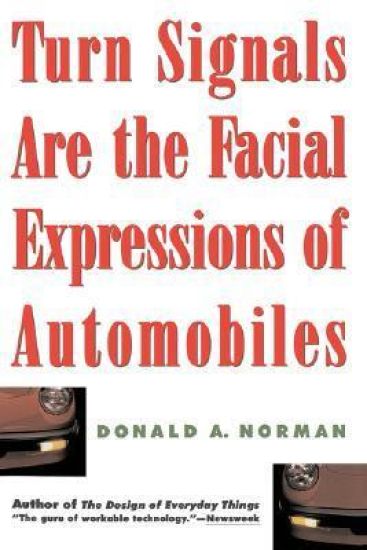
Turn Signals Are the Facial Expressions of Automobiles
From water faucets and airplane cockpits to the concept of "real time" and the future of memory, this wide-ranging tour through technology provides a new understanding of how the gadgets that surround us affect our lives. Donald Norman explores the plight of humans living in a world ruled by a technology that seems to exist for its own sake, oblivious to the needs of the people who create it. Turn Signals is an intelligent, whimsical, curmudgeonly look at our love/hate relationship with machines, as well as a persuasive call for the humanization of modern design.