Kirjojen hintavertailu – 12 876 342 kirjaa ja 26 kauppaa

Kirjailija

Donald Davidson

Kirjat ja teokset yhdessä paikassa: 35 kirjaa, julkaisuja vuosilta 1966–2026, suosituimpiin kuuluu The Philosophical Papers of Alan Donagan. Vertaile teosten hintoja ja tarkista saatavuus suomalaisista kirjakaupoista.

35 kirjaa

Kirjojen julkaisuvuodet: 1966–2026.

The Philosophical Papers of Alan Donagan

The Philosophical Papers of Alan Donagan

Alan Donagan; Donald Davidson

University of Chicago Press
1995
sidottu
Alan Donagan is known for his theories on the history of philosophy and the nature of morality. The two volumes of his "Philosophical Papers" collect 28 of Donagan's most important and best-known essays on historical understanding and ethics from 1957 to 1991, including two never-before-published papers on the history of philosophy as a discipline, and on Ryle and Wittgenstein's nature of philosophy. Volume 1 includes papers on Spinoza, Descartes, Bradley, Collingwood, Russell and Moore, and Popper. They are linked by Donagan's commitment to the central importance of history for philosophy and his interest in problems of historical understanding. Volume 2 addresses issues in the philosophy of action and moral theory. With papers on Kant, von Wright, Sellars, and Chisholm, this volume also covers a range of questions in applied ethics - from the morality of Truman's decision to drop atomic bombs on Hiroshima and Nagasaki to ethical questions in medicine and law. Together, these books provide an overview of the major philosophical achievements of an original and sensitive thinker.
The Big Ballad Jamboree

The Big Ballad Jamboree

Donald Davidson

University Press of Mississippi
2008
nidottu
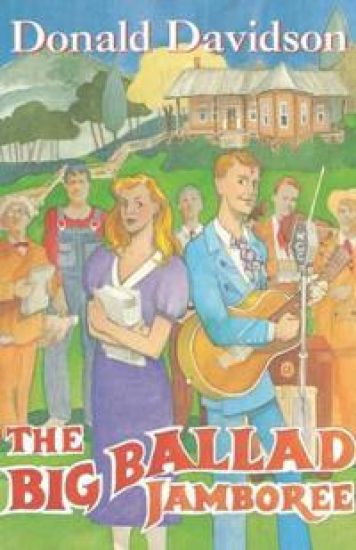
Uproariously funny and filled with choice narration, The Big Ballad Jamboree is Donald Davidson's only novel. He set his story- the romance of hillbilly and country singer Danny MacGregor with folk singer and ballad scholar Cissy Timberlake- in the fictional western North Carolina town of Carolina City during the summer of 1949. The late forties, just after WWII and before the rise of national television, are great years for classic country music on live radio. Yet this Appalachian community is struggling to embrace a modern commercial economy without losing its folk heritage. In this setting Davidson draws lively satirical pictures: civic boosters allied with shameless politicians; a local sheriff, a barber, and a dean cooperating to protect the image of a college; a folklore professor seeking fame by promoting a ballad-singing bootlegger. Seen through the eyes of a country boy with a musical gift descended from mountain people, this novel is a highbrow art about memorable lowbrow characters. It is also a great read. Those who know Davidson as a poet and scholar may be surprised to learn that he wrote a novel about country music. Here his long romance with southern folk life and mountain balladry captures the evolution of hillbilly singers into Grand Ole Opery stars as he pursues vexing questions about folk authenticity in country music. Long thought lost, The Big Ballad Jamboree now is published for the first time. The famous teacher of young writers as Robert Penn Warren, Jesse Stuart, and Elizabeth Spencer never saw publication of his own novel. The mystery of its fate resolved at long last with the publication of the complete manuscript, discovered by a granddaughter in family files.
The Structure of Truth

The Structure of Truth

Donald Davidson

Oxford University Press
2020
sidottu
Donald Davidson was one of the most famous and influential philosophers of the twentieth century. The Structure of Truth presents his 1970 Locke Lectures in print for the first time. They comprise an invaluable historical document which illuminates how Davidson was thinking about the theory of meaning, the role of a truth theory therein, the ontological commitments of a truth theory, the notion of logical form, and so on, at a pivotal moment in the development of his thought. Unlike Davidson's previously published work, the lectures are written so as to be presented to an audience as a fully organized and coherent exposition of his program in the philosophy of language. Had they been widely available in the years following 1970, the reception of Davidson's work might have been very different. Given the systematic nature of their presentation of Davidson's semantic program, these lectures will be of interest to anyone working in the philosophy of language.
Regionalism and Nationalism in the United States
A quarter of a century before Lyndon B. Johnson popularized the slogan "The Great Society," Donald Davidson wrote his critique of Leviathan, the omnipotent nation-state, in terms that only recently have come to be appreciated. "Leviathan is the idea of the Great Society, organized under a single, complex, but strong and highly centralized national government, motivated ultimately by men's desire for economic welfare of a specific kind rather than their desire for personal liberty. " Originally published as The Attack on Leviathan, this eloquent volume is an attack on state centralism and an affirmation of regional identity. Davidson's work is a special sort of intellectual as well as social history. It reveals an extraordinary mastery of the literature on regionalism in the United States, with special emphasis on the work on Rupert Vance and Howard Odum in the social sciences. Davidson looks at regionalism in arts, literature, and education. He favors agriculture over industrialization, and "the hinterland" over cities, examining along the way varying historical memories, the dilemma of Southern liberals, and the choice of expedience or principles. His book is a forceful and commanding challenge to those who would push for central authority at the sacrifice of individual and regional identity. Davidson concludes with a devastating critique of nationalism leading to a supra-nationalism. Ultimately, the heterogeneity of human desires comes up against the uniformity of world systems and world states. Davidson offers instead a broad world of intellectual history and commentary in which individualism allies itself with communities as a means for stemming the tide of collectivism and its base in a world state. For Davidson, Leviathan, the monstrous state, is a devourer, not a savior. As several peoples rise to strike down their own Leviathans, this courageous book may be better understood now than it was in 1938. Donald Davidson was part of that movement in American letters known as the Southern Agrarians. He was a poet, critic, historian, and political analyst. He spent most of his life at Vanderbilt University, and was himself born in central Tennessee. He is best known as the author of The Tall Men (1927) and a collection of essays, Still Rebels, Still Yankees (1957).
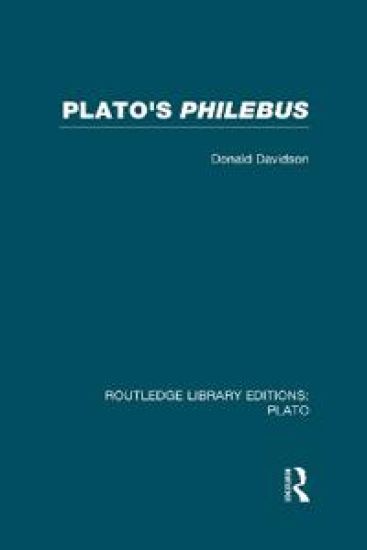
Plato's Philebus (RLE: Plato)

Plato's Philebus (RLE: Plato)

Donald Davidson

Routledge
2012
sidottu
The Philebus is hard to reconcile with standard interpretations of Plato’s philosophy and in this pioneering work Donald Davidson, seeks to take the Philebus at face value and to reassess Plato’s late philosophy in the light of the results. The author maintains that the approach to ethics in the Philebus represents a considerable return to the methodology of the earlier dialogues. He emphasizes Plato’s reversion to the Socratic elenchus and connects it with the startling reappearance of Socrates as the leading voice in the Philebus.
Southern Writers in the Modern World

Southern Writers in the Modern World

Donald Davidson; Malcolm Lester

Literary Licensing, LLC
2011
sidottu
Southern Writers In The Modern World: Eugenia Dorothy Blount Lamar Memorial Lectures, 1957 is a book written by Donald Davidson. It is a collection of lectures that were delivered by the author in 1957 in honor of Eugenia Dorothy Blount Lamar, a prominent figure in the literary world. The book focuses on the works of various Southern writers and their impact on the modern world. It explores the themes, styles, and techniques used by these writers to convey their message to readers. The book also delves into the cultural and historical context in which these writers lived and worked, providing readers with a deeper understanding of their works. Overall, Southern Writers In The Modern World is a comprehensive study of the literary contributions of Southern writers and their relevance in the modern world. This scarce antiquarian book is a facsimile reprint of the old original and may contain some imperfections such as library marks and notations. Because we believe this work is culturally important, we have made it available as part of our commitment for protecting, preserving, and promoting the world's literature in affordable, high quality, modern editions, that are true to their original work.
The Long Street: Poems

The Long Street: Poems

Donald Davidson; Theresa Sherrer Davidson

Literary Licensing, LLC
2011
sidottu
The Long Street is a collection of poems written by Donald Davidson. The book features a variety of poems that explore different themes and subjects, including nature, love, and the human experience. The poems are written in a lyrical and contemplative style, and they often incorporate vivid imagery and rich language. Some of the poems are inspired by Davidson's experiences growing up in the American South, while others draw on his travels and observations of the world around him. Overall, The Long Street is a thoughtful and engaging collection of poetry that offers readers a glimpse into the mind and heart of a talented writer. This scarce antiquarian book is a facsimile reprint of the old original and may contain some imperfections such as library marks and notations. Because we believe this work is culturally important, we have made it available as part of our commitment for protecting, preserving, and promoting the world's literature in affordable, high quality, modern editions, that are true to their original work.
Southern Writers in the Modern World

Southern Writers in the Modern World

Donald Davidson

University of Georgia Press
2010
pokkari
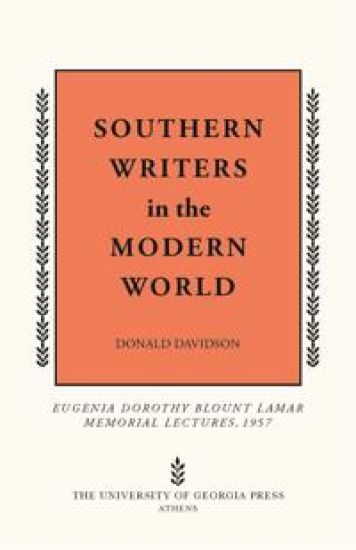
One of the most important of the Southern magazines in the 1920s was The Fugitive, a magazine of verse and brief commentaries on literature in general. Among its contributors were John Crowe Ransom, Allen Tate, Robert Penn Warren, Donald Davidson, and Merrill Moore. Publication began in April 1922 and ended in December 1925. Soon thereafter, the “Fugitive” writers and some others became profoundly concerned with the materialism of American life and its effect upon the South. The group became known as “Agrarians.” Their thinking and discussion culminated in a symposium, I’ll Take My Stand, published in 1930. In his first two lectures Davidson describes the underlying nature and aims of the Fugitive and Agrarian movements. He brings to the discussion his intimate and thorough knowledge of Southern life and letters. The third lecture deals with the place of the writer in the modern university, posing the questions of whether the writer needs the university and whether the university needs or wants the writer.
Truth and Predication

Truth and Predication

Donald Davidson

The Belknap Press
2008
nidottu
This brief book takes readers to the very heart of what it is that philosophy can do well. Completed shortly before Donald Davidson's death at 85, Truth and Predication brings full circle a journey moving from the insights of Plato and Aristotle to the problems of contemporary philosophy. In particular, Davidson, countering many of his contemporaries, argues that the concept of truth is not ambiguous, and that we need an effective theory of truth in order to live well. Davidson begins by harking back to an early interest in the classics, and an even earlier engagement with the workings of grammar; in the pleasures of diagramming sentences in grade school, he locates his first glimpse into the mechanics of how we conduct the most important activities in our life--such as declaring love, asking directions, issuing orders, and telling stories. Davidson connects these essential questions with the most basic and yet hard to understand mysteries of language use--how we connect noun to verb. This is a problem that Plato and Aristotle wrestled with, and Davidson draws on their thinking to show how an understanding of linguistic behavior is critical to the formulating of a workable concept of truth. Anchored in classical philosophy, Truth and Predication nonetheless makes telling use of the work of a great number of modern philosophers from Tarski and Dewey to Quine and Rorty. Representing the very best of Western thought, it reopens the most difficult and pressing of ancient philosophical problems, and reveals them to be very much of our day.
The Essential Davidson

The Essential Davidson

Donald Davidson

Oxford University Press
2006
nidottu
The Essential Davidson compiles the most celebrated papers of one of the twentieth century's greatest philosophers. It distils Donald Davidson's seminal contributions to our understanding of ourselves, from three decades of essays, into one thematically organized collection. A new, specially written introduction by Ernie Lepore and Kirk Ludwig, two of the world's leading authorities on his work, offers a guide through the ideas and arguments, shows how they interconnect, and reveals the systematic coherence of Davidson's worldview. Davidson's philosophical program is organized around two connected projects. The first is that of understanding the nature of human agency. The second is that of understanding the nature and function of language, and its relation to the world. Accordingly, the first part of the book presents Davidson's investigation of reasons, causes, and intentions, which revolutionized the philosophy of action. This leads to his notable doctrine of anomalous monism, the view that all mental events are physical events, but that the mental cannot be reduced to the physical. The second part of the book presents the famous essays in which Davidson set out his highly original and influential philosophy of language, which founds the theory of meaning on the theory of truth. These fifteen classic essays will be invaluable for anyone interested in the study of mind and language. Fascinating though they are individually, it is only when drawn together that there emerges a compelling picture of man as a rational linguistic animal whose thoughts, though not reducible to the material, are part of the fabric of the world, and whose knowledge of his own mind, the minds of others, and the world around him is as fundamental to his nature as the power of thought and speech itself.
The Essential Davidson

The Essential Davidson

Donald Davidson

Oxford University Press
2006
sidottu
The Essential Davidson compiles the most celebrated papers of one of the twentieth century's greatest philosophers. It distils Donald Davidson's seminal contributions to our understanding of ourselves, from three decades of essays, into one thematically organized collection. A new, specially written introduction by Ernie Lepore and Kirk Ludwig, two of the world's leading authorities on his work, offers a guide through the ideas and arguments, shows how they interconnect, and reveals the systematic coherence of Davidson's worldview. Davidson's philosophical program is organized around two connected projects. The first is that of understanding the nature of human agency. The second is that of understanding the nature and function of language, and its relation to the world. Accordingly, the first part of the book presents Davidson's investigation of reasons, causes, and intentions, which revolutionized the philosophy of action. This leads to his notable doctrine of anomalous monism, the view that all mental events are physical events, but that the mental cannot be reduced to the physical. The second part of the book presents the famous essays in which Davidson set out his highly original and influential philosophy of language, which founds the theory of meaning on the theory of truth. These fifteen classic essays will be invaluable for anyone interested in the study of mind and language. Fascinating though they are individually, it is only when drawn together that there emerges a compelling picture of man as a rational linguistic animal whose thoughts, though not reducible to the material, are part of the fabric of the world, and whose knowledge of his own mind, the minds of others, and the world around him is as fundamental to his nature as the power of thought and speech itself.
Truth, Language, and History

Truth, Language, and History

Donald Davidson

Clarendon Press
2005
sidottu
Truth, Language, and History is the much-anticipated final volume of Donald Davidson's philosophical writings. In four groups of essays, Davidson continues to explore the themes that occupied him for more than fifty years: the relations between language and the world; speaker intention and linguistic meaning; language and mind; mind and body; mind and world; mind and other minds. He asks: what is the role of the concept of truth in these explorations? And, can a scientific world view make room for human thought without reducing it to something material and mechanistic? Including a new introduction by his widow, Marcia Cavell, this volume completes Donald Davidson's colossal intellectual legacy.
Truth, Language, and History

Truth, Language, and History

Donald Davidson

Clarendon Press
2005
nidottu
Truth, Language, and History is the much-anticipated final volume of Donald Davidson's philosophical writings. In the four groups of essays that comprise it, Davidson continues to explore the themes that occupied him for more than fifty years: the relations between language and the world; speaker intention and linguistic meaning; language and mind; mind and body; mind and world; mind and other minds. He asks: what is the role of the concept of truth in these explorations? And, can a scientific world view make room for human thought without reducing it to something material and mechanistic? Davidson's underlying picture, which can be seen in many of these essays, is that we are acquainted directly with the world, not indirectly via some intermediary such as sense-data, representations, or language itself; that thought emerges in the first place through interpersonal communication in a shared material world, and continues to develop as we engage each other in dialogue; and that language depends on communication, not vice versa. This is the triangulating situation - two creatures communicating about a common world - about which Davidson has written elsewhere. As for the mind-body relation: our ontology need posit nothing more that material objects and events; but as explainers we require two mutually irreducible vocabularies: mind and body. In the last six essays Davidson finds interconnections between his own views and those of some of the major philosophers of the past. Including a new introduction by his widow, Marcia Cavell, this volume completes Donald Davidson's colossal intellectual legacy.