Kirjojen hintavertailu – 12 859 819 kirjaa ja 27 kauppaa

Kirjailija

Donald E. Lively

Kirjat ja teokset yhdessä paikassa: 10 kirjaa, julkaisuja vuosilta 1991–2008, suosituimpiin kuuluu Landmark Supreme Court Cases. Vertaile teosten hintoja ja tarkista saatavuus suomalaisista kirjakaupoista.

Nimi esiintyy myös muodoissa: Donald E Lively

10 kirjaa

Kirjojen julkaisuvuodet: 1991–2008.

Speaking of Race, Speaking of Sex

Speaking of Race, Speaking of Sex

Henry Louis Gates Jr.; Anthony P. Griffin; Donald E. Lively; Nadine Strossen

New York University Press
1996
pokkari
A provocative anthology on questions of hate speech and speech regulation designed to protect minorities At the University of Pennsylvania, a student is reprimanded for calling a group of African-American students water buffalo. Several prominent American law schools now request that professors abstain from discussing the legal aspects of rape for fear of offending students. As debates over multiculturalism and political correctness crisscross the land, no single issue has been more of a flash point in the ongoing culture wars than hate speech codes, which seek to restrict bigoted or offensive speech and punish those who engage in it. In this provocative anthology, a range of prominent voices argue that hate speech restrictions are not only dangerous, but counterproductive. The lessons of history indicate that speech regulation designed to protect minorities is destined to be used against them. Acknowledging the legitimacy of the concerns that prompt speech codes and combining support for civil liberties with an acute concern for civil tights issues, Speaking of Race, Speaking of Sex demonstrates that it is difficult, if not impossible, to draw the line between unprotected insults and protected ideas. Decrying such speech regulation as overly concerned with the symbols of racism rather than its realities, Speaking of Race, Speaking of Sex offers a balanced and well-reasoned perspective on one of the most controversial issues of our time.
Speaking of Race, Speaking of Sex

Speaking of Race, Speaking of Sex

Henry Louis Gates Jr.; Anthony P. Griffin; Donald E. Lively; Nadine Strossen

New York University Press
1995
sidottu
A provocative anthology on questions of hate speech and speech regulation designed to protect minorities At the University of Pennsylvania, a student is reprimanded for calling a group of African-American students water buffalo. Several prominent American law schools now request that professors abstain from discussing the legal aspects of rape for fear of offending students. As debates over multiculturalism and political correctness crisscross the land, no single issue has been more of a flash point in the ongoing culture wars than hate speech codes, which seek to restrict bigoted or offensive speech and punish those who engage in it. In this provocative anthology, a range of prominent voices argue that hate speech restrictions are not only dangerous, but counterproductive. The lessons of history indicate that speech regulation designed to protect minorities is destined to be used against them. Acknowledging the legitimacy of the concerns that prompt speech codes and combining support for civil liberties with an acute concern for civil tights issues, Speaking of Race, Speaking of Sex demonstrates that it is difficult, if not impossible, to draw the line between unprotected insults and protected ideas. Decrying such speech regulation as overly concerned with the symbols of racism rather than its realities, Speaking of Race, Speaking of Sex offers a balanced and well-reasoned perspective on one of the most controversial issues of our time.
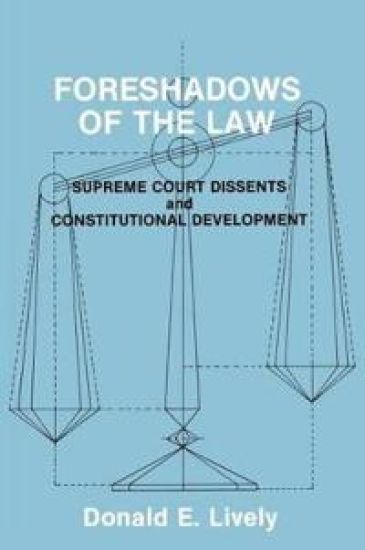
Foreshadows of the Law

Foreshadows of the Law

Donald E. Lively

Praeger Publishers Inc
1992
sidottu
The Supreme Court has final authority in determining what the Constitution means. The Court's findings have not, however, always been final. Lively focuses on several landmark dissenting opinions--resisted initially--later redefining the meaning of the Constitution. Each opinion arises from a rich historical context and involves constitutional issues of pointed significance. Vivid descriptions of some of the colorful personalities behind the opinions add appeal. Lively conveys the evolutionary and dynamic nature of the law demonstrating the relationship between present and past understanding of the Constitution. He describes the competitive nature of constitutional development and identifies the relevance of factors including subjective preference, values, vying theories, and ideologies. The role of the Court, is addressed as are the federal government's relationship to the states and their citizens; slavery; property rights; substantive due process; freedom of speech; and the right to be left alone. This is a clearly presented and highly instructive consideration of how the Constitution's interpretation has been fashioned over time with important insights relevant to today's Court and contemporary cases.
Foreshadows of the Law

Foreshadows of the Law

Donald E. Lively

Praeger Publishers Inc
1992
nidottu
The Supreme Court has final authority in determining what the Constitution means. The Court's findings have not, however, always been final. Lively focuses on several landmark dissenting opinions--resisted initially--later redefining the meaning of the Constitution. Each opinion arises from a rich historical context and involves constitutional issues of pointed significance. Vivid descriptions of some of the colorful personalities behind the opinions add appeal. Lively conveys the evolutionary and dynamic nature of the law demonstrating the relationship between present and past understanding of the Constitution. He describes the competitive nature of constitutional development and identifies the relevance of factors including subjective preference, values, vying theories, and ideologies. The role of the Court, is addressed as are the federal government's relationship to the states and their citizens; slavery; property rights; substantive due process; freedom of speech; and the right to be left alone. This is a clearly presented and highly instructive consideration of how the Constitution's interpretation has been fashioned over time with important insights relevant to today's Court and contemporary cases.
The Constitution and Race

The Constitution and Race

Donald E. Lively

Praeger Publishers Inc
1992
nidottu
Race, as this book demonstrates, has been a factor in the Constitution's framing, ratification, and development. Examined specifically and in detail are: * the accommodation of slavery to create a viable republic; * the Union's experience with and eventual undoing by slavery; * reconstruction of the nation pursuant to seminal principles of racial equality; * persisting efforts to limit or defeat constitutional provisions for equality and opportunity; * the desegregation mandate and its devolution; and * modern problems in accounting for a legacy of racial discrimination and disadvantage. The Constitution is the overarching statement of popular will and consent and thus an especially apt prism through which to discern racial truths and the context and values that influence them. Constitutional law affords a particularly useful departure point for acquiring perspective upon moral reality and legal possibility. This book is rich in its analysis of the Supreme Court's response to society's ambiguities, concerns, and conscience in the matters of race. In examining problems and issues which historically have engendered dispute and division, it suggests a potentially consensual basis of ascertaining the Constitution's still unfinished business. The nation's enduring ambivalence and the price it pays in less than consistent constitutional interpretations on racial questions is both enlightening and disturbing. The questions, of course, are at the heart of a democracy and involve personhood, citizenship, liberty, and equality. The Constitution and Race will be valuable to political scientists, historians, sociologists, lawyers, and students.

The Constitution and Race

The Constitution and Race

Donald E. Lively

Praeger Publishers Inc
1992
sidottu
Race, as this book demonstrates, has been a factor in the Constitution's framing, ratification, and development. Examined specifically and in detail are: * the accommodation of slavery to create a viable republic; * the Union's experience with and eventual undoing by slavery; * reconstruction of the nation pursuant to seminal principles of racial equality; * persisting efforts to limit or defeat constitutional provisions for equality and opportunity; * the desegregation mandate and its devolution; and * modern problems in accounting for a legacy of racial discrimination and disadvantage. The Constitution is the overarching statement of popular will and consent and thus an especially apt prism through which to discern racial truths and the context and values that influence them. Constitutional law affords a particularly useful departure point for acquiring perspective upon moral reality and legal possibility. This book is rich in its analysis of the Supreme Court's response to society's ambiguities, concerns, and conscience in the matters of race. In examining problems and issues which historically have engendered dispute and division, it suggests a potentially consensual basis of ascertaining the Constitution's still unfinished business. The nation's enduring ambivalence and the price it pays in less than consistent constitutional interpretations on racial questions is both enlightening and disturbing. The questions, of course, are at the heart of a democracy and involve personhood, citizenship, liberty, and equality. The Constitution and Race will be valuable to political scientists, historians, sociologists, lawyers, and students.
Essential Principles of Communications Law

Essential Principles of Communications Law

Donald E. Lively

Praeger Publishers Inc
1991
sidottu
Rapid changes in communications technology continue to characterize the industry and to necessitate repeated redefinition of the legal structures and issues which must respond to these changes. Donald E. Lively's in-depth study of communications law clarifies its basic concepts and principles. He provides a thorough survey of the press as it was originally perceived by the Constitution and how its profile has changed due to the sophisticated nature of today's media. The book shows how broadcasting, cable, and common carriage disperse a wide range of information--requiring continual monitoring to preserve the balance between responsibility and freedom of the press. This complex issue is first studied from a broad conceptual perspective that reviews the original constitutional and non-constitutional concerns of the first amendment, followed by an analysis of how the structures of the newspaper, broadcasting, cable and common carrier industries have been regulated, and concludes with a history and evaluation of the guidelines which restrict the quantity and quality of content. The identification of trends in the ownership of twentieth century information sources and the effect of the current decentralization of ownership on the public's access to information are fully examined, and the law's continually evolving attention to the changing dynamics within the industry evaluated for the present and projected for the future.
Modern Communications Law

Modern Communications Law

Donald E. Lively

Praeger Publishers Inc
1991
sidottu
Modern Communications Law provides the most comprehensive and contemporary coverage of communications law available, a subject characterized by rapidly expanding and changing horizons. The book is thorough, informative, and accessible. It is divided into three main sections that respectively consider the media's nature and context, structural governance of the communications industry, and content issues. Lively provides an in-depth study of telephone communications--an area which affects virtually the entire citizenry--as well as print, broadcasting, cable, and other new media. The book contains several structural innovations calculated to enhance the teaching and learning process. The selection and editing of cases and other primary materials reflect the author's experience with topics that facilitate animated discussion. Additionally, the text is extensively annotated with pinpoint citations which heighten the book's utility for research and reference purposes. A particularly notable feature is the introduction of case summaries preceding all major court opinions. The synopses are intended to familiarize readers with the basic arguments, issues and reasoning so that they derive more meaning from the cases themselves than ever before. The book is well-suited for law school courses and is appropriate for communications law courses in the graduate and undergraduate curricula. Legal practitioners, media industry professionals and government regulators and policy-makers will find Modern Communications Law an essential resource.