Kirjojen hintavertailu – 12 903 724 kirjaa ja 27 kauppaa

Kirjailija

Donald W. Black

Kirjat ja teokset yhdessä paikassa: 7 kirjaa, julkaisuja vuosilta 2013–2022, suosituimpiin kuuluu Study Guide to Introductory Psychiatry. Vertaile teosten hintoja ja tarkista saatavuus suomalaisista kirjakaupoista.

7 kirjaa

Kirjojen julkaisuvuodet: 2013–2022.

Study Guide to Introductory Psychiatry

Study Guide to Introductory Psychiatry

Donald W. Black; Jordan G. Cates

American Psychiatric Association Publishing
2021
pokkari
Readers of the best-selling Introductory Textbook of Psychiatry, Seventh Edition—the seminal primer on the field—can now test their knowledge with this companion study guide. With a format that replicates what medical students, psychiatric residents, and others might encounter in specialty certification exams, this guide is organized along the lines of DSM-5 and features detailed questions on topics that include • Diagnosis and classification• Interviewing and assessment• Neurobiology and genetics• All DSM-5 disorders• Legal issues• Psychotherapy• Somatic treatments Each multiple-choice question is linked to specific pages in the Textbook for ease of reference and includes plausible distractors. The answer guide includes explanations not only of the correct responses but also of why the other options are incorrect. Beyond mere rote memorization, the Study Guide to Introductory Psychiatry is designed to help learners truly assimilate and deeply encode the information in the Introductory Textbook of Psychiatry, Seventh Edition, so that they can recall it when it matters most—when speaking with the patients they treat.
DSM-5® Guidebook

DSM-5® Guidebook

Donald W. Black; Jon E. Grant

American Psychiatric Publishing
2014
pokkari
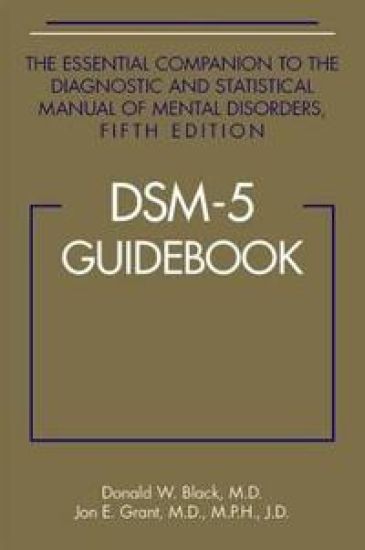
DSM-5 Guidebook: The Essential Companion to the Diagnostic and Statistical Manual of Mental Disorders, Fifth Edition is a user-friendly, supplementary guide for psychiatrists, psychologists, and other mental health practitioners who need to know how DSM-5 differs from its predecessor in terms of organizational structure, diagnostic categories, and the criteria themselves. While it does not replace the comprehensive and authoritative DSM-5, it illuminates its content by teaching mental health professionals how to use the revised diagnostic criteria and by providing a practical context for its clinical use. The book offers many valuable features, including: • An historical overview of the development of the DSM in general, and DSM-5 in particular, a progression that might be said to mirror the evolution of psychiatry as a whole. The material on the creation of DSM-5 includes coverage of dimensional assessment, reliability and field trials, and the controversies that arose during development of DSM-5.• An indispensable chapter on how to use DSM-5 that addresses coding, diagnostic certainty, the demise of the multiaxial system, and the key changes to each diagnostic category.• Full coverage of the significant reorganization from DSM-IV-TR to DSM-5, which is designed to incorporate advances in neuroscience, brain imaging and genetics. Chapters were reordered to reflect scientific advances in the understanding of psychiatric disorders, and the presumed etiological and the pathophysiological relationships among them.• Extensive coverage of the decision to integrate dimensional measures into DSM-5, which may enhance the clinician's ability to assess symptom variation and severity and aid in patient evaluation, treatment decisions, and outcome monitoring. The various measures are presented and their use discussed.• Finally, as the authors were not part of the revision process, they offer a fresh, down-to-earth perspective that will resonate with clinicians by focusing on the changes that will most significantly impact clinicians' professional lives. DSM-5 Guidebook provides a roadmap to the many changes in this living document, DSM-5, and will prove invaluable to psychiatrists, psychologists, psychiatric nurses, neurologists, social workers, and all who strive to understand mental illness as it is conceived today.
Bad Boys, Bad Men 3rd edition

Bad Boys, Bad Men 3rd edition

Donald W. Black

OXFORD UNIVERSITY PRESS INC
2022
nidottu
Whether called black sheep, sociopaths, felons, con men, or misfits, some break all the rules. They shirk responsibilities, abuse drugs and alcohol, take up criminal careers, and lash out at family members. In the worst cases they commit rape, murder, and other violent acts as though they lack a conscience. What makes these people behave the way they do? Bad Boys, Bad Men examines antisocial personality disorders, or ASPD, the mysterious and misunderstood mental condition that underlies a lifelong penchant for bad behavior. Black interweaves scientific data with stories drawn from his own work as a psychiatrist, current events, new research, and real-world case studies to explore antisocial behavior in men and to chart the history, nature, and treatment of a misunderstood disorder affecting nearly seven million Americans. Citing new evidence from genetics and neuroscience, Black argues that this condition is tied to biological causes, and that some people are simply born bad. The newly revised edition includes up to date information on the epidemiology, risk factors, pathophysiology, natural history, genetics, and treatment of ASPD. Black discusses the antisocial woman as well as narcissistic personality disorder, both of which often intertwine with ASPD. New vignettes demonstrating sociopathic and psychopathic behavior include Donald Trump, Jeffrey Epstein, Harvey Weinstein, Robert Durst, and Anna Sorkin. Examining compelling cases that read like medical detective stories, Black separates the lies these men tell from the facts that their lives reveal. His book not only describes the warning signs that predict which troubled children are more likely to become dangerous adults, but also details the progress toward treatment for ASPD. Written to help patients and family members, Bad Boys, Bad Men is essential reading for anyone interested in understanding antisocial and psychopathic behavior.
Introductory Textbook of Psychiatry

Introductory Textbook of Psychiatry

Donald W. Black; Nancy C. Andreasen

American Psychiatric Association Publishing
2020
pokkari
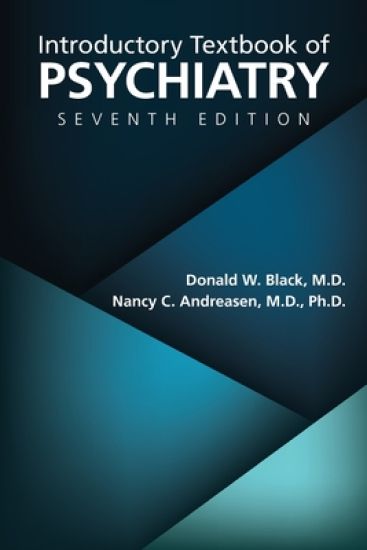
The prevalence of psychiatry in popular culture has coincided with the rise of amateur "armchair" psychiatrists—and this often serves to muddy the waters about what, exactly, the field entails. For all the misconceptions, though, psychiatry is an endlessly fascinating field, charged with defining and recognizing mental illnesses, identifying methods for treating them, and discovering their causes and developing measures to prevent them. Introductory Textbook of Psychiatry dispels common misunderstandings and delves into what makes this such an exciting discipline. Now in its seventh edition, this bestselling guide is organized along the lines of DSM-5 and has been updated to reflect changes to the manual, including new medications and therapies. Rigorous in scope, Introductory Textbook of Psychiatry is nevertheless accessible and conversational in tone. It employs fascinating case vignettes, clinical pearls, self-assessment questions, and tables and figures as it offers a summary of: • The DSM-5 diagnostic system• The neurobiological basis of psychiatry• Interviewing and assessment—including specific questions that patients can be asked• The various psychiatric disorders• Legal issues• Psychiatric emergencies• Treatment Initially developed for medical students and beginning residents, this guide is also a valuable reference for nurse practitioners, physician assistants, social workers, and psychologists. And because it has been edited to align with the Pocket Guide to Psychiatric Practice, it makes an excellent companion piece to that volume, as well.
Introductory Textbook of Psychiatry

Introductory Textbook of Psychiatry

Donald W. Black; Nancy C. Andreasen

American Psychiatric Association Publishing
2020
sidottu
The prevalence of psychiatry in popular culture has coincided with the rise of amateur “armchair” psychiatrists—and this often serves to muddy the waters about what, exactly, the field entails. For all the misconceptions, though, psychiatry is an endlessly fascinating field, charged with defining and recognizing mental illnesses, identifying methods for treating them, and discovering their causes and developing measures to prevent them. The Introductory Textbook of Psychiatry dispels common misunderstandings and delves into what makes this such an exciting discipline. Now in its seventh edition, this bestselling guide is organized along the lines of DSM-5® and has been updated to reflect changes to the manual, including new medications and therapies. Rigorous in scope, Introductory Textbook of Psychiatry is nevertheless accessible and conversational in tone. It employs fascinating case vignettes, clinical pearls, self-assessment questions, and tables and figures as it offers a summary of:The DSM-5® diagnostic systemThe neurobiological basis of psychiatryInterviewing and assessment—including specific questions that patients can be askedThe various psychiatric disordersLegal issuesPsychiatric emergenciesTreatmentInitially developed for medical students and beginning residents, this guide is also a valuable reference for nurse practitioners, physician assistants, social workers, and psychologists. And because it has been edited to align with the Pocket Guide to Psychiatric Practice, it makes an excellent companion piece to that volume, as well.
Pocket Guide to Psychiatric Practice

Pocket Guide to Psychiatric Practice

Donald W. Black

American Psychiatric Association Publishing
2018
pokkari
The long-awaited Pocket Guide to Psychiatric Practice is a portable and concise companion to its parent textbook, Introductory Textbook of Psychiatry, Sixth Edition, the preeminent introduction to psychiatry for residents, medical students, and other health professionals. The Pocket Guide is designed to be carried with them on clinical rotations and contains the information needed for patient assessment and clinical management in an easily accessible and convenient format. Mirroring the larger text, the guide takes as its premise that physicians—regardless of their ultimate role in medicine—should be able to define and recognize mental illnesses, to identify methods for treating them, and, for those few who become researchers, to help develop methods for discovering their causes and implementing preventive measures. This pocket version, compatible with DSM-5, includes criteria sets for the most common disorders that learners encounter and is organized to follow the developmental lifespan. The author, who co-edited the larger text, has retained many of the attributes that made the parent text successful, while adding new, user-friendly features: • Completely up-to-date information on all of the disorders and descriptions of newly released medications. • A writing style that is interesting, consistent, and highly accessible, with no redundancy. • A wealth of tables, lists, and other strategies for presenting information in a concise and easy-to-understand manner. • Content organized in parallel with the Introductory Textbook of Psychiatry to make it easier to locate additional learning resources—such as case vignettes, useful clinical "pearls," self-assessment questions, and a glossary of terms—as needed.• An emphasis on the satisfaction of working with psychiatric patients of all types and in all settings that will be appreciated by learners beginning their journey in the field. Pocket Guide to Psychiatric Practice is a highly readable, interesting, and useful resource. Although the book is written primarily for medical students and residents in their first years of training, it will prove useful for individuals seeking psychiatric training from the perspectives of other disciplines such as nursing or social work. The Pocket Guide can be combined with the larger and more detailed Introductory Textbook of Psychiatry and the student-oriented Study Guide to Introductory Psychiatry, to constitute a library of resources on psychiatric disorders and their assessment that sets the stage for lifelong learning.
Bad Boys, Bad Men

Bad Boys, Bad Men

Donald W. Black

Oxford University Press Inc
2013
nidottu
Several years after the first edition of Bad Boys, Bad Men was published, Donald W. Black, MD, brings us the Revised and Updated edition. Containing the same examination of antisocial personality disorder, Dr. Black continues to draw on case studies, scientific data, and current events to explore antisocial behavior in people. In this new edition, Dr. Black builds upon the succes of the previous volume and updates it with new research findings, including the genetic and biological determinants of antisocial personality disorder. Dr. Black also discusses the difference between, and overlap with, psychopathy. Several new cases have been added to Bad Boys, Bad Men including John Wayne Gacy, Mike Tyson, and Sadam Hussein. He also briefly discusses antisocial women, and provides a case example of Aileen Wuornos.