Kirjojen hintavertailu – 12 859 819 kirjaa ja 27 kauppaa

Kirjailija

Donatella della Porta

Kirjat ja teokset yhdessä paikassa: 45 kirjaa, julkaisuja vuosilta 1995–2025, suosituimpiin kuuluu Resisting the Backlash. Vertaile teosten hintoja ja tarkista saatavuus suomalaisista kirjakaupoista.

45 kirjaa

Kirjojen julkaisuvuodet: 1995–2025.

Movement Parties Against Austerity

Movement Parties Against Austerity

Donatella della Porta; Joseba Fernández; Hara Kouki; Lorenzo Mosca

Polity Press
2017
sidottu
The ascendance of austerity policies and the protests they have generated have had a deep impact on the shape of contemporary politics. The stunning electoral successes of SYRIZA in Greece, Podemos in Spain and the Movimento 5 Stelle (M5S) in Italy, alongside the quest for a more radical left in countries such as the UK and the US, bear witness to a new wave of parties that draws inspiration and strength from social movements. The rise of movement parties challenges simplistic expectations of a growing separation between institutional and contentious politics and the decline of the left. Their return demands attention as a way of understanding both contemporary socio-political dynamics and the fundamentals of political parties and representation. Bridging social movement and party politics studies, within a broad concern with democratic theories, this volume presents new empirical evidence and conceptual insight into these topical socio-political phenomena, within a cross-national comparative perspective.

Where Did the Revolution Go?

Where Did the Revolution Go?

Donatella Della Porta

Cambridge University Press
2016
sidottu
Where Did the Revolution Go? considers the apparent disappearance of the large social movements that have contributed to democratization. Revived by recent events of the Arab Spring, this question is once again paramount. Is the disappearance real, given the focus of mass media and scholarship on electoral processes and 'normal politics'? Does it always happen, or only under certain circumstances? Are those who struggled for change destined to be disappointed by the slow pace of transformation? Which mechanisms are activated and deactivated during the rise and fall of democratization? This volume addresses these questions through empirical analysis based on quantitative and qualitative methods (including oral history) of cases in two waves of democratization: Central Eastern European cases in 1989 as well as cases in the Middle East and Mediterranean region in 2011.
Where Did the Revolution Go?

Where Did the Revolution Go?

Donatella Della Porta

Cambridge University Press
2016
pokkari
Where Did the Revolution Go? considers the apparent disappearance of the large social movements that have contributed to democratization. Revived by recent events of the Arab Spring, this question is once again paramount. Is the disappearance real, given the focus of mass media and scholarship on electoral processes and 'normal politics'? Does it always happen, or only under certain circumstances? Are those who struggled for change destined to be disappointed by the slow pace of transformation? Which mechanisms are activated and deactivated during the rise and fall of democratization? This volume addresses these questions through empirical analysis based on quantitative and qualitative methods (including oral history) of cases in two waves of democratization: Central Eastern European cases in 1989 as well as cases in the Middle East and Mediterranean region in 2011.
The Hidden Order of Corruption

The Hidden Order of Corruption

Donatella Della Porta; Alberto Vannucci

Routledge
2016
nidottu
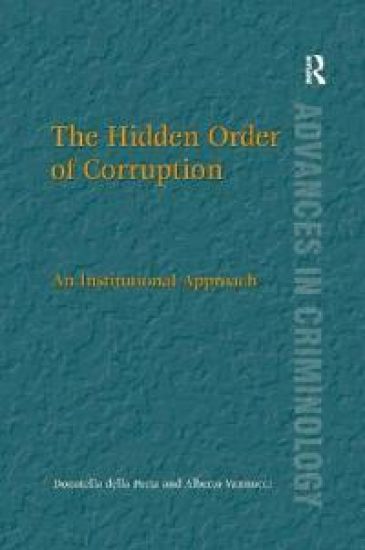
When corruption is exposed, unknown aspects are revealed which allow us to better understand its structures and informal norms. This book investigates the hidden order of corruption, looking at the invisible codes and mechanisms that govern and stabilize the links between corrupters and corruptees. Concentrating mainly on democratic regimes, this book uses a wide range of documentation, including media and judicial sources from Italy and other countries, to locate the internal equilibria and dynamics of corruption in a broad and comparative perspective. It also analyses the Transparency International Annual Reports and the daily survey of international news to present evidence on specific cases of corruption within an institutional theory framework.
Late Neoliberalism and its Discontents in the Economic Crisis

Late Neoliberalism and its Discontents in the Economic Crisis

Donatella Della Porta; Massimiliano Andretta; Tiago Fernandes; Francis O'Connor; Eduardo Romanos; Markos Vogiatzoglou

Springer International Publishing AG
2016
sidottu
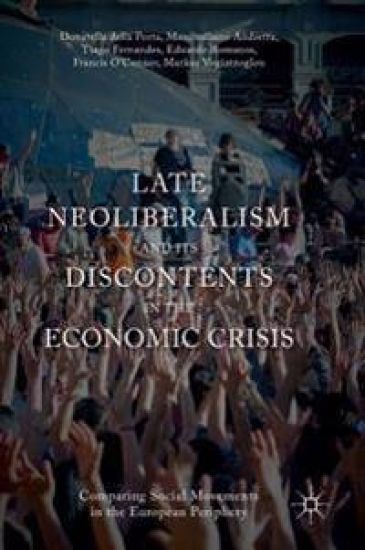
This book analyses protests against the Great Recession in the European periphery. While social movements have long been considered as children of affluent times - or at least of times of opening opportunities - these protests defy such expectations, developing instead in moments of diminishing opportunities in both the economic and the political realms. Can social movement studies still be useful to understanding these movements of troubled times? The authors offer a positive answer to this question, although specify the need to bridge contentious politics with other fields, including political economy. They highlight differences in the social movements’ strength and breadth and attempt to understand them in terms of three sets of dimensions: a) the specific characteristics of the socio-economic crisis and its consequences in terms of mobilization potential; b) the political reactions to it, in what we can define as political opportunities and threats; and c) the social movement cultures and structures that characterize each country. The book discusses these topics through a contextualized analysis of anti-austerity protest in the European periphery.
Social Movements in Times of Austerity: Bringing Capitalism Back Into Protest Analysis
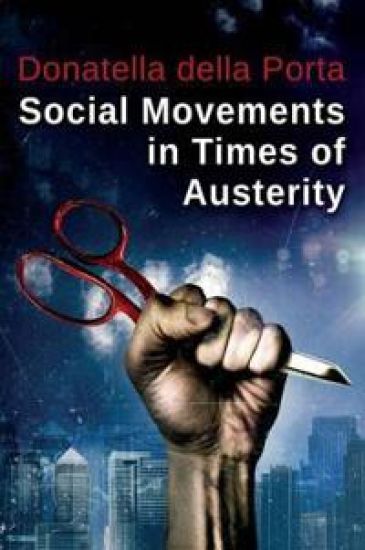
Recent years have seen an enormous increase in protests across the world in which citizens have challenged what they see as a deterioration of democratic institutions and the very civil, political and social rights that form the basis of democratic life. Beginning with Iceland in 2008, and then forcefully in Egypt, Tunisia, Spain, Greece and Portugal, or more recently in Peru, Brazil, Russia, Bulgaria, Turkey and Ukraine, people have taken to the streets against what they perceive as a rampant and dangerous corruption of democracy, with a distinct focus on inequality and suffering. This timely new book addresses the anti-austerity social movements of which these protests form part, mobilizing in the context of a crisis of neoliberalism. Donatella della Porta shows that, in order to understand their main facets in terms of social basis, strategy, and identity and organizational structures, we should look at the specific characteristics of the socioeconomic, cultural and political context in which they developed. The result is an important and insightful contribution to understanding a key issue of our times, which will be of interest to students and scholars of political and economic sociology, political science and social movement studies, as well as political activists.
Global Democracy and the World Social Forums

Global Democracy and the World Social Forums

Jackie Smith; Marina Karides; Marc Becker; Dorval Brunelle; Christopher Chase-Dunn; Donatella Della Porta

Paradigm
2014
nidottu
The World Social Forum quickly became the largest political gathering in human history and continues to offer a direct challenge to the extreme inequities of corporate-led globalisation. It has expanded its presence and continues to be an exciting experiment in global and participatory democracy. The book's contributors have participated in World Social Forums around the globe. Recounting dozens of dramatic firsthand experiences, they draw on their knowledge of global politics to introduce the process, its foundations and relevance to ongoing transnational efforts toward democracy. This second edition of Global Democracy shows how the Forums have developed since their inception in 2001 and how they are now connected with other global movements including Occupy, the Arab Spring and beyond.
Global Democracy and the World Social Forums

Global Democracy and the World Social Forums

Jackie Smith; Marina Karides; Marc Becker; Dorval Brunelle; Christopher Chase-Dunn; Donatella Della Porta

Paradigm
2014
sidottu
The World Social Forum quickly became the largest political gathering in human history and continues to offer a direct challenge to the extreme inequities of corporate-led globalisation. It has expanded its presence and continues to be an exciting experiment in global and participatory democracy. The book's contributors have participated in World Social Forums around the globe. Recounting dozens of dramatic firsthand experiences, they draw on their knowledge of global politics to introduce the process, its foundations and relevance to ongoing transnational efforts toward democracy. This second edition of Global Democracy shows how the Forums have developed since their inception in 2001 and how they are now connected with other global movements including Occupy, the Arab Spring and beyond.
Mobilizing for Democracy

Mobilizing for Democracy

Donatella Della Porta

Oxford University Press
2014
sidottu
Strangely enough, while the pictures used to illustrate the most recent wave of protests for democracy in North Africa represent mass protest, research on social movements and democratization have rarely interacted. This volume aims to fill this gap by looking at episodes of democratization through the lens of social movement studies. Without assuming that democratization is always produced from below, the author singles out different paths of democratization by looking at the ways in which the masses interact with the elites, and protest with bargaining: eventful democratization, participated pacts and troubled democratization. The main focus is on the first of the paths: eventful democratization, that is cases in which authoritarian regimes break down following-often short but intense-waves of protest. Recognizing the particular power of some transformative events, the analysis locates them within the broader mobilization processes, including the multitude of less visible, but still important protests that surround them. Cognitive, affective and relational mechanisms are singled out as transforming the contexts in which dissidents act. In all three paths, mobilization of resources, framing processes and appropriation of opportunities will develop in action, in different combinations. The comparison of different cases within two waves of protests for democracy, in Central Eastern Europe in 1989 and in the Middle East and North Africa in 2011, allows the author to theorize about causal mechanisms and conditions as they emerge in mobilizations for democracy.
Clandestine Political Violence

Clandestine Political Violence

Donatella Della Porta

Cambridge University Press
2013
sidottu
Clandestine Political Violence compares four types of clandestine political violence: left-wing (in Italy and Germany), right-wing (in Italy), ethnonationalist (in Spain) and religious fundamentalist (in Islamist clandestine organizations). Oriented toward theory building, Della Porta develops her own definition of clandestine political violence. Building on the most recent developments in social movement studies, Della Porta proposes an original interpretative model. Using a unique research design, she singles out some common causal mechanisms at the onset, during the persistence and at the demise of clandestine political violence. The development of the phenomenon is located within the interactions among social movements, countermovements and the state. She pays particular attention to the ways different actors cognitively construct the reality they act upon. Based on original empirical research as well as existing research in many languages, this book is rich in empirical evidence on some of the most crucial cases of clandestine political violence.
Clandestine Political Violence

Clandestine Political Violence

Donatella Della Porta

Cambridge University Press
2013
pokkari
Clandestine Political Violence compares four types of clandestine political violence: left-wing (in Italy and Germany), right-wing (in Italy), ethnonationalist (in Spain) and religious fundamentalist (in Islamist clandestine organizations). Oriented toward theory building, Della Porta develops her own definition of clandestine political violence. Building on the most recent developments in social movement studies, Della Porta proposes an original interpretative model. Using a unique research design, she singles out some common causal mechanisms at the onset, during the persistence and at the demise of clandestine political violence. The development of the phenomenon is located within the interactions among social movements, countermovements and the state. She pays particular attention to the ways different actors cognitively construct the reality they act upon. Based on original empirical research as well as existing research in many languages, this book is rich in empirical evidence on some of the most crucial cases of clandestine political violence.
Can Democracy Be Saved?

Can Democracy Be Saved?

Donatella della Porta

Polity Press
2013
nidottu
Financial crisis, economic globalization and the strengthening of neoliberal policies present stark challenges to traditional conceptions of representative democracy. Yet, at the same time, new opportunities are emerging that propose alternative visions for the future of democracy. In this highly articulate book, Donatella della Porta analyses diverse conceptions and practices of participatory and deliberative democracy, building upon recent reflections in normative theory as well as original empirical research. As well as drawing on key historical examples, the book pays close attention to the current revitalization of social movements: the Arab Spring uprisings in processes of democratic transition; the potential of new technologies to develop so-called e-democracy in the Indignados and Occupy Wall Street protests; and proposals for cosmopolitan democracy found in recent campaigns for democratization of the European Union and United Nations. Alongside such social movements, the book also assesses institutional reactions, from the policing of protest to efforts at reform. This contribution to a critical contemporary debate, by a leading political sociologist and scholar of social movements, will be of great value to students and scholars of political sociology, political science and social movement studies, as well as anyone interested in the shape and development of democracy.
Can Democracy Be Saved?

Can Democracy Be Saved?

Donatella della Porta

Polity Press
2013
sidottu
Financial crisis, economic globalization and the strengthening of neoliberal policies present stark challenges to traditional conceptions of representative democracy. Yet, at the same time, new opportunities are emerging that propose alternative visions for the future of democracy. In this highly articulate book, Donatella della Porta analyses diverse conceptions and practices of participatory and deliberative democracy, building upon recent reflections in normative theory as well as original empirical research. As well as drawing on key historical examples, the book pays close attention to the current revitalization of social movements: the Arab Spring uprisings in processes of democratic transition; the potential of new technologies to develop so-called e-democracy in the Indignados and Occupy Wall Street protests; and proposals for cosmopolitan democracy found in recent campaigns for democratization of the European Union and United Nations. Alongside such social movements, the book also assesses institutional reactions, from the policing of protest to efforts at reform. This contribution to a critical contemporary debate, by a leading political sociologist and scholar of social movements, will be of great value to students and scholars of political sociology, political science and social movement studies, as well as anyone interested in the shape and development of democracy.
Mobilizing on the Extreme Right

Mobilizing on the Extreme Right

Manuela Caiani; Donatella della Porta; Claudius Wagemann

Oxford University Press
2012
sidottu
Research on the extreme right is rare, and the extreme right has even more rarely been analysed as a social movement. In this volume, the extreme right is compared in Italy, Germany, and the United States using concepts and methods developed in social movement studies. In particular, the book describes the discourse, action, and organizational structures of the extreme right, and explains these on the basis of the available discursive and political opportunities. Three main empirical methods are used in the research. Firstly, the frame analysis looks at the cognitive mechanisms that are relevant in influencing organizational and individual behaviour. Second, network analysis looks at the (inter-) organizational structural characteristics of right-wing organizations. Finally, protest event analysis allows for an empirical summary of the actions undertaken by right-wing extremists over the last decade. The substantive chapters address the organizational structure of the extreme right, their action repertoires, the framing of protest events, the definition of 'us', the struggle against modernity, old and new forms of racism, opposition to globalization, and populism.
The Hidden Order of Corruption

The Hidden Order of Corruption

Donatella della Porta; Alberto Vannucci

Ashgate Publishing Limited
2011
sidottu
When corruption is exposed, unknown aspects are revealed which allow us to better understand its structures and informal norms. This book investigates the hidden order of corruption, looking at the invisible codes and mechanisms that govern and stabilize the links between corrupters and corruptees. Concentrating mainly on democratic regimes, this book uses a wide range of documentation, including media and judicial sources from Italy and other countries, to locate the internal equilibria and dynamics of corruption in a broad and comparative perspective. It also analyses the Transparency International Annual Reports and the daily survey of international news to present evidence on specific cases of corruption within an institutional theory framework.
Social Movements and Europeanization

Social Movements and Europeanization

Donatella della Porta; Manuela Caiani

Oxford University Press
2011
nidottu
Are social movement organizations euro-sceptical, euro-pragmatic, or euro-opportunist? Or do they accept the EU as a new level of governance to place pressure on? Do they provide a critical capital, necessary for the political structuring of the EU, or do they disrupt the process of EU integration? This book includes surveys of activists at international protest events targeting the European Union (for a total of about 5000 interviews); a discourse analysis of documents and transcripts of debates on European politics and policies conducted during the four European social forums held between 2002 and 2006 and involving hundreds of social movement organizations and tens of thousands of activists from all European countries; about 320 interviews with representatives of civil society organizations in six EU countries (France, Germany, the United Kingdom, the Netherlands, Spain, and Italy) and one non-member state (Switzerland), and a systematic claims analysis of the daily press in selected years between 1990 and 2003. The empirical research shows the different paths of Europeanization taken by social movements and civil society organizations.
Social Movements and Europeanization

Social Movements and Europeanization

Donatella Della Porta; Manuela Caiani

Oxford University Press
2009
sidottu
Are social movement organizations euro-sceptical, euro-pragmatic, or euro-opportunist? Or do they accept the EU as a new level of governance to place pressure on? Do they provide a critical capital, necessary for the political structuring of the EU, or do they disrupt the process of EU integration? This book includes surveys of activists at international protest events targeting the European Union (for a total of about 5000 interviews); a discourse analysis of documents and transcripts of debates on European politics and policies conducted during the four European social forums held between 2002 and 2006 and involving hundreds of social movement organizations and tens of thousands of activists from all European countries; about 320 interviews with representatives of civil society organizations in six EU countries (France, Germany, the United Kingdom, the Netherlands, Spain, and Italy) and one non-member state (Switzerland), and a systematic claims analysis of the daily press in selected years between 1990 and 2003. The empirical research shows the different paths of Europeanization taken by social movements and civil society organizations.
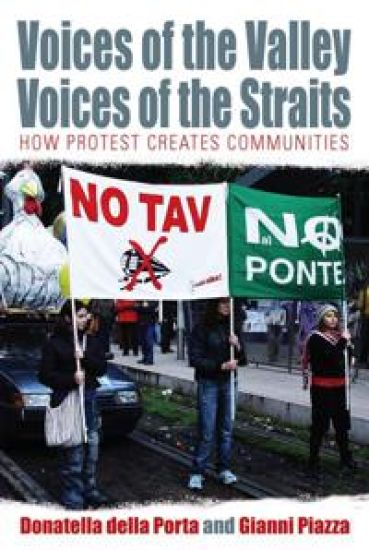
Voices of the Valley, Voices of the Straits

Voices of the Valley, Voices of the Straits

Donatella Della Porta; Gianni Piazza

Berghahn Books
2008
sidottu
Protest campaigns against large-scale public works usually take place within a local context. However, since the 1990s new forms of protest have been emerging. This book analyses two cases from Italy that illustrate this development: the environmentalist protest campaigns against the TAV (the building of a new high-speed railway in Val de Susa, close to the border with France), and the construction of the Bridge on the Messina Straits (between Calabria and Sicily). Such mobilizations emerge from local conflicts but develop as part of a global justice movement, often resulting in the production of new identities. They are promoted through multiple networks of different social and political groups, that share common claims and adopt various forms of protest action. It is during the protest campaigns that a sense of community is created.
Global Justice Movement

Global Justice Movement

Donatella Della Porta; Massimiliano Andretta; Angel Calle; Helene Combes; Nina Eggert; Marco G. Giugni; Jennifer Hadden; Manuel Jimenez; Raffaele Marchetti

Paradigm
2007
nidottu
"Della Porta has assembled a distinguished group of scholars who have made great strides in illuminating the early phases of the movement. The book includes especially keen analyses of the movement against global capitalism, particularly in its European manifestations." John D. McCarthy, Pennsylvania State University "Della Porta has skillfully coordinated a comparative study in six European countries and the US. Renowned scholars give testimony of the movement in their countries. [This is] the first attempt to document a genuine transnational movement." Bert Klandermans, Vrije Universiteit, Amsterdam You G-8, we 6 billion!" So went the chant at the international parade leading into the summit in Genoa, Italy. The global justice movement has led to a new wave of protest, building up transnational networks, inventing new strategies of action, constructing new images of democracy, and boldly asserting that "another world is possible". This book examines all this and more with case studies drawn from seven different countries, covering transnational networks and making cross-national comparisons. Leading European and American scholars analyze more than 300 organizations and 5,000 activists, looking at mobilizations that bridge old and new movements and bring politics back to the street. Contributors include: Massimiliano Andretta, Angel Calle, Helene Combes, Donatella della Porta, Nina Eggert, Marco Giugni, Jennifer Hadden, Manuel Jimenez, Raffaele Marchetti, Lorenzo Mosca, Mario Pianta, Herbert Reiter, Christopher Rootes, Dieter Rucht, Clare Saunders, Isabelle Sommier, Sidney Tarrow, Simon Teune, Mundo Yang.