Kirjojen hintavertailu – 12 859 828 kirjaa ja 27 kauppaa

Kirjailija

Donatien Hainaut

Kirjat ja teokset yhdessä paikassa: 5 kirjaa, julkaisuja vuosilta 2019–2023, suosituimpiin kuuluu Continuous Time Processes for Finance. Vertaile teosten hintoja ja tarkista saatavuus suomalaisista kirjakaupoista.

5 kirjaa

Kirjojen julkaisuvuodet: 2019–2023.

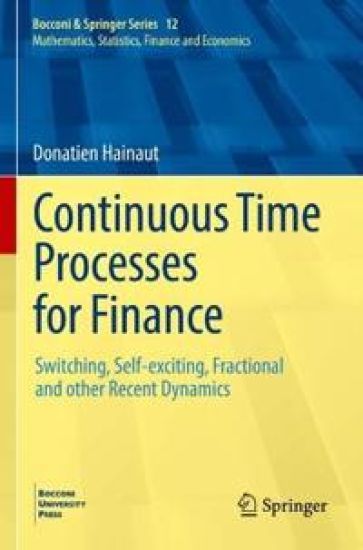
Continuous Time Processes for Finance

Continuous Time Processes for Finance

Donatien Hainaut

Springer International Publishing AG
2023
nidottu
This book explores recent topics in quantitative finance with an emphasis on applications and calibration to time-series. This last aspect is often neglected in the existing mathematical finance literature while it is crucial for risk management. The first part of this book focuses on switching regime processes that allow to model economic cycles in financial markets. After a presentation of their mathematical features and applications to stocks and interest rates, the estimation with the Hamilton filter and Markov Chain Monte-Carlo algorithm (MCMC) is detailed. A second part focuses on self-excited processes for modeling the clustering of shocks in financial markets. These processes recently receive a lot of attention from researchers and we focus here on its econometric estimation and its simulation. A chapter is dedicated to estimation of stochastic volatility models. Two chapters are dedicated to the fractional Brownian motion and Gaussian fields. After a summary of their features, we present applications for stock and interest rate modeling. Two chapters focuses on sub-diffusions that allows to replicate illiquidity in financial markets. This book targets undergraduate students who have followed a first course of stochastic finance and practitioners as quantitative analyst or actuaries working in risk management.
Continuous Time Processes for Finance

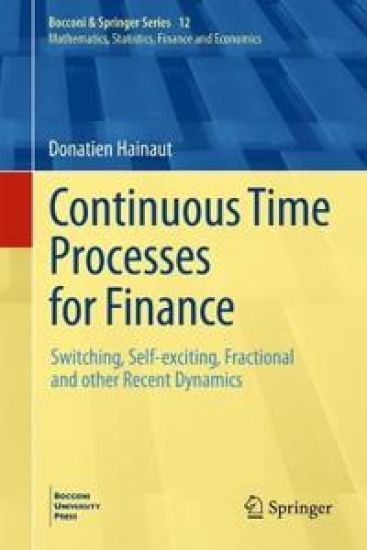
Continuous Time Processes for Finance

Donatien Hainaut

Springer International Publishing AG
2022
sidottu
This book explores recent topics in quantitative finance with an emphasis on applications and calibration to time-series. This last aspect is often neglected in the existing mathematical finance literature while it is crucial for risk management. The first part of this book focuses on switching regime processes that allow to model economic cycles in financial markets. After a presentation of their mathematical features and applications to stocks and interest rates, the estimation with the Hamilton filter and Markov Chain Monte-Carlo algorithm (MCMC) is detailed. A second part focuses on self-excited processes for modeling the clustering of shocks in financial markets. These processes recently receive a lot of attention from researchers and we focus here on its econometric estimation and its simulation. A chapter is dedicated to estimation of stochastic volatility models. Two chapters are dedicated to the fractional Brownian motion and Gaussian fields. After a summary of their features, we present applications for stock and interest rate modeling. Two chapters focuses on sub-diffusions that allows to replicate illiquidity in financial markets. This book targets undergraduate students who have followed a first course of stochastic finance and practitioners as quantitative analyst or actuaries working in risk management.
Effective Statistical Learning Methods for Actuaries II

Effective Statistical Learning Methods for Actuaries II

Michel Denuit; Donatien Hainaut; Julien Trufin

Springer Nature Switzerland AG
2020
nidottu
This book summarizes the state of the art in tree-based methods for insurance: regression trees, random forests and boosting methods. It also exhibits the tools which make it possible to assess the predictive performance of tree-based models. Actuaries need these advanced analytical tools to turn the massive data sets now at their disposal into opportunities. The exposition alternates between methodological aspects and numerical illustrations or case studies. All numerical illustrations are performed with the R statistical software. The technical prerequisites are kept at a reasonable level in order to reach a broad readership. In particular, master's students in actuarial sciences and actuaries wishing to update their skills in machine learning will find the book useful. This is the second of three volumes entitled Effective Statistical Learning Methods for Actuaries. Written by actuaries for actuaries, this series offers a comprehensive overview of insurancedata analytics with applications to P&C, life and health insurance.
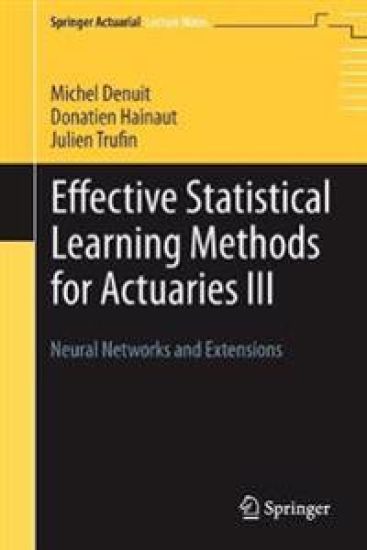
Effective Statistical Learning Methods for Actuaries III

Effective Statistical Learning Methods for Actuaries III

Michel Denuit; Donatien Hainaut; Julien Trufin

Springer Nature Switzerland AG
2019
nidottu
This book reviews some of the most recent developments in neural networks, with a focus on applications in actuarial sciences and finance. It simultaneously introduces the relevant tools for developing and analyzing neural networks, in a style that is mathematically rigorous yet accessible. Artificial intelligence and neural networks offer a powerful alternative to statistical methods for analyzing data. Various topics are covered from feed-forward networks to deep learning, such as Bayesian learning, boosting methods and Long Short Term Memory models. All methods are applied to claims, mortality or time-series forecasting. Requiring only a basic knowledge of statistics, this book is written for masters students in the actuarial sciences and for actuaries wishing to update their skills in machine learning. This is the third of three volumes entitled Effective Statistical Learning Methods for Actuaries. Written by actuaries for actuaries, this series offers a comprehensive overview of insurance data analytics with applications to P&C, life and health insurance. Although closely related to the other two volumes, this volume can be read independently.
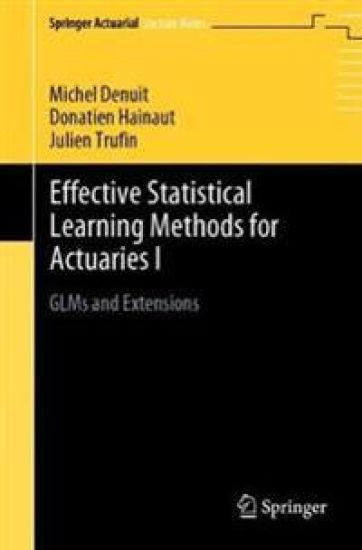
Effective Statistical Learning Methods for Actuaries I

Effective Statistical Learning Methods for Actuaries I

Michel Denuit; Donatien Hainaut; Julien Trufin

Springer Nature Switzerland AG
2019
nidottu
This book summarizes the state of the art in generalized linear models (GLMs) and their various extensions: GAMs, mixed models and credibility, and some nonlinear variants (GNMs). In order to deal with tail events, analytical tools from Extreme Value Theory are presented. Going beyond mean modeling, it considers volatility modeling (double GLMs) and the general modeling of location, scale and shape parameters (GAMLSS). Actuaries need these advanced analytical tools to turn the massive data sets now at their disposal into opportunities. The exposition alternates between methodological aspects and case studies, providing numerical illustrations using the R statistical software. The technical prerequisites are kept at a reasonable level in order to reach a broad readership. This is the first of three volumes entitled Effective Statistical Learning Methods for Actuaries. Written by actuaries for actuaries, this series offers a comprehensive overview of insurance data analytics with applications to P&C, life and health insurance. Although closely related to the other two volumes, this volume can be read independently.