Kirjojen hintavertailu – 12 903 724 kirjaa ja 27 kauppaa
Kirjailija
Dong Wei
Kirjat ja teokset yhdessä paikassa: 3 kirjaa, julkaisuja vuosilta 2023–2026, suosituimpiin kuuluu Metamaterial-Based Optical and Radio Frequency Sensing. Vertaile teosten hintoja ja tarkista saatavuus suomalaisista kirjakaupoista.
This book highlights the fundamentals and practical methods of metamaterials-based optical and radio frequency sensing. Combined with engineering practices, the book illustrates in detail wide frequency electromagnetic signal cloaking and the detection behavior of metasurfaces, including the structure of metasurfaces, electric-controlled behaviors, layout design and fabrication methods, and related experiment results. This book is expected to inspire the research and development of new optical and radio frequency detectors. It is suitable for researchers and engineers working on semiconductor devices, applied optics, and wide frequency signal detection. It is also a good reference for students in these areas.
This book highlights the fundamentals and practical methods of metamaterials-based optical and radio frequency sensing. Combined with engineering practices, the book illustrates in detail wide frequency electromagnetic signal cloaking and the detection behavior of metasurfaces, including the structure of metasurfaces, electric-controlled behaviors, layout design and fabrication methods, and related experiment results. This book is expected to inspire the research and development of new optical and radio frequency detectors. It is suitable for researchers and engineers working on semiconductor devices, applied optics, and wide frequency signal detection. It is also a good reference for students in these areas.
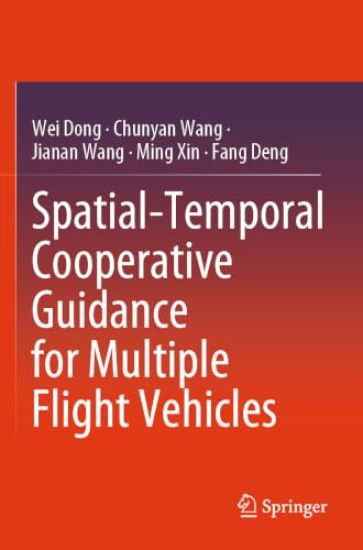
The spatial-temporal cooperative guidance problem for multiple flight vehicles has garnered significant attention in recent years due to its potential benefits in both military and civil fields. This book provides a concise but holistic introduction to this practical problem and presents a summative collection of the latest solutions to the concerned challenges, thereby providing some theoretical support for enhancing the synergism and applicability of cooperative guidance for multiple flight vehicles. This book consists of nine chapters. In Chapter 1, recent works on cooperative guidance are systematically recalled. Chapter 2 introduces the common formulation and unique challenges of the cooperative guidance problem from a practical viewpoint. In Chapter 3, a varying-gain proportional navigation guidance law with accurate time-to-go prediction is developed to realize precise control of the impact time. In Chapter 4, in response to the inherent finite-time property of the cooperative guidance problem, a fixed-time convergent error dynamic is proposed to design a 3D distributed cooperative guidance law with enhanced convergence. In Chapter 5, a command-decoupled design strategy is proposed to address the challenging spatial-temporal cooperative guidance problem through the derivation and combination of the coplanar cooperative guidance and planar pursuit guidance commands. In Chapter 6, an integrated design strategy based on rotational operations on spatial vectors is proposed to simultaneously satisfy the impact angle and time constraints. In Chapter 7, a multiple-stage cooperative guidance strategy is developed to satisfy the spatial-temporal constraints without relying on time-to-go information. In Chapter 8, a unified command augmentation method is proposed to prevent the seeker's FOV from exceeding the boundary throughout the cooperative guidance. Finally, Chapter 9 concludes this book and offers an instructive opinion on the future directions of the cooperative guidance problem in both academic and engineering investigations. Therefore, this book can not only serve as a reference for researchers who are interested in this field with systematic and inspirational perspectives, but also be a useful handbook for engineers engaged in cooperative guidance and control of multiple flight vehicles.