Kirjojen hintavertailu – 12 903 725 kirjaa ja 27 kauppaa

Kirjailija

Donna Youngs

Kirjat ja teokset yhdessä paikassa: 12 kirjaa, julkaisuja vuosilta 2003–2026, suosituimpiin kuuluu Profiling Violent Crime. Vertaile teosten hintoja ja tarkista saatavuus suomalaisista kirjakaupoista.

12 kirjaa

Kirjojen julkaisuvuodet: 2003–2026.

Geographical Offender Profiling

Geographical Offender Profiling

David Canter; Donna Youngs

Taylor Francis Ltd
2026
sidottu
‘Crime Hot-Spots’ and ‘Repeat Victimisation’ are eye-catching subjects in the wider study of where, and to a lesser extent when, individual criminals choose to commit their crimes. This field of work is now commonly referred to as ‘geographical profiling’ and throws light on the psychology of criminality, as well as offering various forms of support to many aspects of police investigations and the management of crime. This book brings together the disparate research and varied opinions that are relevant to an understanding of criminal spatial activity. Subjects covered include a review of: the historical development of geographical profiling, the concepts and theories that are fundamental to all considerations of human spatial behaviour, the sources of spatial and geographic information on which researchers and police investigators can draw for GOP, how the principles of GOP can be applied in practice, how development and change manifests itself in spatial behaviour and how this impacts on GOP, the computer-based tools available for GOP, recent developments in theory and practice. This book provides a perfect introduction to geographical profiling for graduate students taking courses in forensic and investigative psychology, criminal investigation and police and crime science.

Geographical Offender Profiling

Geographical Offender Profiling

David Canter; Donna Youngs

Taylor Francis Ltd
2026
nidottu
‘Crime Hot-Spots’ and ‘Repeat Victimisation’ are eye-catching subjects in the wider study of where, and to a lesser extent when, individual criminals choose to commit their crimes. This field of work is now commonly referred to as ‘geographical profiling’ and throws light on the psychology of criminality, as well as offering various forms of support to many aspects of police investigations and the management of crime. This book brings together the disparate research and varied opinions that are relevant to an understanding of criminal spatial activity. Subjects covered include a review of: the historical development of geographical profiling, the concepts and theories that are fundamental to all considerations of human spatial behaviour, the sources of spatial and geographic information on which researchers and police investigators can draw for GOP, how the principles of GOP can be applied in practice, how development and change manifests itself in spatial behaviour and how this impacts on GOP, the computer-based tools available for GOP, recent developments in theory and practice. This book provides a perfect introduction to geographical profiling for graduate students taking courses in forensic and investigative psychology, criminal investigation and police and crime science.

Profiling Violent Crime

Profiling Violent Crime

Donna Youngs

Ashgate Publishing Limited
2026
nidottu
The psychological processes underlying rape and murder are discussed in these new studies. Recent findings on serial killing, rape and murder are examined with implications for understanding the experience of victims, varieties of offender and the conduct of investigations.
Profiling Violent Crime

Profiling Violent Crime

Donna Youngs

Ashgate Publishing Limited
2024
sidottu
The psychological processes underlying rape and murder are discussed in these new studies. Recent findings on serial killing, rape and murder are examined with implications for understanding the experience of victims, varieties of offender and the conduct of investigations.
The Investigative Psychology of Serial Killing

The Investigative Psychology of Serial Killing

Donna Youngs; David (EDT) Canter

Ashgate Publishing Limited
2019
sidottu
Serial killing drove the initial fascination with 'profiling' and was the focus of the earliest 'offender profiling' works. In more recent years this 'offender profiling' task has become set within and defined by, the more scientifically rigorous frameworks of Investigative Psychology, which has identified the theoretical and conceptual challenges that are inherent to the profiling process. Central to these for serial killings are questions about the particular styles of serial killing behaviour and how these relate to distinct sets of offender characteristics. The papers collected in this book are organised around the core Actions-Characteristics framework, moving from the general to the specific. Thus the first section explores the range and diversity of serial killing behaviours (the Actions) - starting with an exploration of the various manifestations of serial killing, before moving to a more detailed consideration of the different psychological styles for committing this crime. The second section focuses on the offenders, examing the individuals who become serial killers, and then examines the different patterns of offending behaviour, as well as the psychological processes that underlie these relationships.
Investigative Psychology

Investigative Psychology

David V. Canter; Donna Youngs

John Wiley Sons Inc
2009
nidottu

Halvin toimitettuna 50,60 €

This ground-breaking text is the first to provide a detailed overview of Investigative Psychology, from the earliest work through to recent studies, including descriptions of previously unpublished internal reports. Crucially it provides a framework for students to explore this exciting terrain, combining Narrative Theory and an Action Systems framework. It includes empirically tested models for Offender Profiling and guidance for investigations, as well as an agenda for research in Investigative Psychology. Investigative Psychology features: The full range of crimes from fraud to terrorism, including burglary, serial killing, arson, rape, and organised crime. Important methodologies including multi-dimensional scaling and the Radex approach as well as Social Network Analysis. Geographical Offender Profiling, supported by detailed analysis of the underlying psychological processes that make this such a valuable investigative decision support tool. The full range of investigative activities, including effective information collection, detecting deception and the development of decision support systems. In effect, this text introduces an exciting new paradigm for a wide range of psychological contributions to all forms of investigation within and outside of law enforcement. Each chapter has actual cases and quotations from offenders and ends with questions for discussion and research, making this a valuable text for undergraduate and postgraduate courses in Applied and Forensic Psychology, Criminology, Socio-Legal Studies and related disciplines.
Investigative Psychology

Investigative Psychology

David V. Canter; Donna Youngs

John Wiley Sons Inc
2009
sidottu
This ground-breaking text is the first to provide a detailed overview of Investigative Psychology, from the earliest work through to recent studies, including descriptions of previously unpublished internal reports. Crucially it provides a framework for students to explore this exciting terrain, combining Narrative Theory and an Action Systems framework. It includes empirically tested models for Offender Profiling and guidance for investigations, as well as an agenda for research in Investigative Psychology. Investigative Psychology features: The full range of crimes from fraud to terrorism, including burglary, serial killing, arson, rape, and organised crime Important methodologies including multi-dimensional scaling and the Radex approach as well as Social Network Analysis Geographical Offender Profiling, supported by detailed analysis of the underlying psychological processes that make this such a valuable investigative decision support tool The full range of investigative activities, including effective information collection, detecting deception and the development of decision support systems. In effect, this text introduces an exciting new paradigm for a wide range of psychological contributions to all forms of investigation within and outside of law enforcement. Each chapter has actual cases and quotations from offenders and ends with questions for discussion and research, making this a valuable text for undergraduate and postgraduate courses in Applied and Forensic Psychology, Criminology, Socio-Legal Studies and related disciplines.
Principles of Geographical Offender Profiling

Principles of Geographical Offender Profiling

David Canter; Donna Youngs

Ashgate Publishing Limited
2008
nidottu
Geographical Offender Profiling (GOP) is the term that has emerged for the examination of where offences take place and the use of that examination to formulate views on the nature of the offender and where s/he might be based. As such, it has become the cornerstone of 'offender profiling'. By its nature, GOP bridges psychology, geography, criminology and forensic science and is of academic interest to all those disciplines as well as practical significance to police investigators. This book brings together a cross-section of the major papers published in the field that lay out the concepts and foundations of this area - including some widely quoted but difficult to obtain 'classic' papers - with an introduction that puts the papers into an overall context and a concluding extensive bibliography of the publications relevant to this rapidly growing area.
Principles of Geographical Offender Profiling

Principles of Geographical Offender Profiling

David Canter; Donna Youngs

Ashgate Publishing Limited
2008
sidottu
Geographical Offender Profiling (GOP) is the term that has emerged for the examination of where offences take place and the use of that examination to formulate views on the nature of the offender and where s/he might be based. As such, it has become the cornerstone of 'offender profiling'. By its nature, GOP bridges psychology, geography, criminology and forensic science and is of academic interest to all those disciplines as well as practical significance to police investigators. This book brings together a cross-section of the major papers published in the field that lay out the concepts and foundations of this area - including some widely quoted but difficult to obtain 'classic' papers - with an introduction that puts the papers into an overall context and a concluding extensive bibliography of the publications relevant to this rapidly growing area.
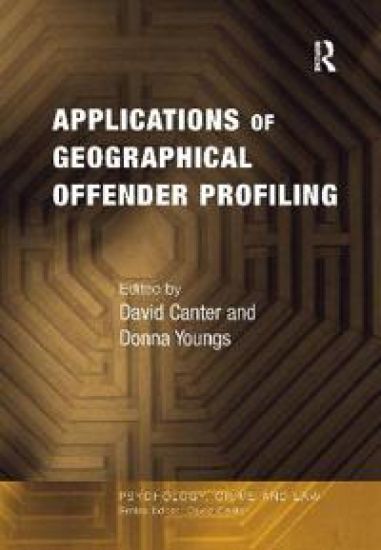
Applications of Geographical Offender Profiling

Applications of Geographical Offender Profiling

Donna Youngs

Ashgate Publishing Limited
2008
nidottu
Many law enforcement agencies are now analyzing where a crime is committed, to develop predictions on the offender, their location and other factors that could help with the investigation. Known as Geographical Offender Profiling (GOP), this approach relies on a combination of principles and methodologies drawn from many different disciplines, including psychology, geography, criminology and forensic science. This book brings together a cross-section of the major papers published in the field of GOP to explain the scope and application of GOP in different criminal contexts. For the first time some widely quoted but difficult to obtain 'classic' papers have been published together with an introduction that provides an up-to-the-minute context and an extensive bibliography of the most relevant publications in this burgeoning area of study.
Applications of Geographical Offender Profiling

Applications of Geographical Offender Profiling

Donna Youngs

Ashgate Publishing Limited
2008
sidottu
Many law enforcement agencies are now analyzing where a crime is committed, to develop predictions on the offender, their location and other factors that could help with the investigation. Known as Geographical Offender Profiling (GOP), this approach relies on a combination of principles and methodologies drawn from many different disciplines, including psychology, geography, criminology and forensic science. This book brings together a cross-section of the major papers published in the field of GOP to explain the scope and application of GOP in different criminal contexts. For the first time some widely quoted but difficult to obtain 'classic' papers have been published together with an introduction that provides an up-to-the-minute context and an extensive bibliography of the most relevant publications in this burgeoning area of study.
The Investigative Psychology of Serial Killing

The Investigative Psychology of Serial Killing

Donna Youngs

Ashgate Publishing Limited
2003
nidottu
Serial killing drove the initial fascination with 'profiling' and was the focus of the earliest 'offender profiling' works. In more recent years this 'offender profiling' task has become set within and defined by, the more scientifically rigorous frameworks of Investigative Psychology, which has identified the theoretical and conceptual challenges that are inherent to the profiling process. Central to these for serial killings are questions about the particular styles of serial killing behaviour and how these relate to distinct sets of offender characteristics. The papers collected in this book are organised around the core Actions-Characteristics framework, moving from the general to the specific. Thus the first section explores the range and diversity of serial killing behaviours (the Actions) - starting with an exploration of the various manifestations of serial killing, before moving to a more detailed consideration of the different psychological styles for committing this crime. The second section focuses on the offenders, examing the individuals who become serial killers, and then examines the different patterns of offending behaviour, as well as the psychological processes that underlie these relationships.