
Kirjojen hintavertailu – 12 903 735 kirjaa ja 27 kauppaa

Kirjailija

Donovan Wylie

Kirjat ja teokset yhdessä paikassa: 4 kirjaa, julkaisuja vuosilta 2014–2018, suosituimpiin kuuluu Rochester 585/716. Vertaile teosten hintoja ja tarkista saatavuus suomalaisista kirjakaupoista.

4 kirjaa

Kirjojen julkaisuvuodet: 2014–2018.

Rochester 585/716

Rochester 585/716

Jim Goldberg; Bruce Gilden; Susan Meiselas; Martin Parr; Paulo Pellegrin; Alessandra Sanguinetti; Alec Soth; Larry Towell; Alex Webb; Donovan Wylie

Aperture
2015
nidottu
In 2012, the Eastman Kodak Company declared bankruptcy. That same year, a group of ten photographers from Magnum Photos—Jim Goldberg, Bruce Gilden, Susan Meiselas, Martin Parr, Paolo Pellegrin, Alessandra Sanguinetti, Alec Soth, Larry Towell, Alex Webb, and Donovan Wylie, plus Chien-Chi Chang, who documented the process in audio and video—established a temporary base of operations in Rochester, New York, former home to the once-dominant manufacturer of photographic film. Their goal: to create both a documentary archive of that city’s culture and landscape, and a photo-based experience engaging its residents; and to investigate a community of picture-makers comprised not only of Eastman Kodak, but also the Visual Studies Workshop, George Eastman House, Rochester Institute of Technology, and the citizens of Rochester. Over the course of almost three weeks, photographers, students, faculty, and residents worked together to create a visual record of the city and its people at a time of significant transition. Nathan Lyons, founding director of the Visual Studies Workshop, describes the result as “not only a major documentary project, but a celebration of photography within the city that had for years been a center of imaging technologies.” Upon arrival in Rochester, Martin Parr gave each photographer the task of assembling one hundred photographs to form the basis of an archive. Rochester 585/716 presents all one thousand images, together with commentary by poets Cornelius Eady and Marie Howe, art historian and photo theorist Laura Wexler, and photographer and educator Nathan Lyons. Five sets of the images were printed as a portfolio, each of which now resides in major private and public collections. Two artist proof sets were also created, one of which will be dispersed via the one thousand copies of this publication. Each individual copy contains a single loose print, selected at random from this additional set.
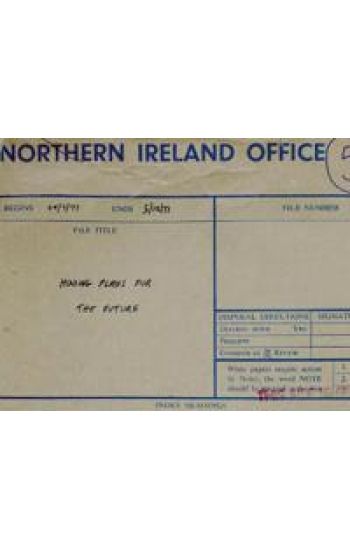
Donovan Wylie: Housing Plans for the Future
This is the latest of Donovan Wylie's (born 1971) books with Steidl that explore the architecture of the Northern Ireland conflict. While Wylie's earlier publications--including British Watchtowers and Maze--document disappearing military structures, Housing Plans for the Future focuses on the legacy of architectural containment in urban areas today. Wylie took these photos during walks through a number of social-housing neighborhoods in inner-city Belfast, which look eerily similar. While the built environments at first appear benign, even mundane, sustained looking reveals how they purposely control vision and movement. Walls block vehicle access, houses are inverted to face away from neighboring communities and minimize potential antagonism, and excessive street lighting ensures visibility. These defensive structures, built in the 1970s and '80s and still populated today, are a powerful and largely unrecognized legacy of the Northern Ireland conflict.
Donovan Wylie

Donovan Wylie

Donovan Wylie

Steidl Verlag
2014
sidottu
Donovan Wylie's The Tower Series, now available as a complete set in a custom slipcase, reveals the repetitive character of military conflict across diverse geographies and histories. The first book in the series is British Watchtowers (2007), which studies the lines of sight from surveillance posts along the Irish border, and reveals a kind of virtual environment that enveloped the border region of Northern Ireland. These towers, constructed in the mid-1980s primarily in the mountainous border region of South Armagh, were landmarks in a thirty-year conflict in and over Northern Ireland. The second book, Outposts (2011), charts NATO observation posts in Kandahar Province, Afghanistan. Built on natural promontories with multiple lines of sight, these outposts formed a protective visual architecture and were frequently positioned on defense locations established during earlier conflicts. North Warning System draws a close to The Tower Series. Surveying a radar station just inside the Canadian Arctic, Wylie examines the detection of invisible threats through unmanned observation posts in remote regions.
Donovan Wylie

Donovan Wylie

Donovan Wylie

Steidl Verlag
2014
sidottu
North Warning System is Donovan Wylie’s third and final book of photographs on the themes of vision and power in military architecture, and draws a close to his Tower Series. Surveying a radar station just inside the Canadian Arctic, Wylie examines the detection of invisible threats through unmanned observation posts in remote regions. The development of long-range bombers and missiles after the Second World War made Canada’s arctic frontier vulnerable to attack from the air. This forced Canada and the United States to jointly construct a matrix of short and longrange radar stations in the 1950s. Known as the Distant Early Warning Line, these stations provided electronic observation and surveillance capability across Canada’s northern frontier throughout the Cold War. In the 1990s, these stations were upgraded to form the North Warning System (NWS) which is increasingly active—as international maritime traffic develops throughout the north, so does military presence. In North Warning System, whiteness takes on the quality of a blank canvas, a metaphor for the sweep of history.