Kirjojen hintavertailu – 12 903 735 kirjaa ja 27 kauppaa

Kirjailija

Douglas C. Dildy

Kirjat ja teokset yhdessä paikassa: 15 kirjaa, julkaisuja vuosilta 2006–2022, suosituimpiin kuuluu Sea Harrier FRS 1 vs Mirage III/Dagger. Vertaile teosten hintoja ja tarkista saatavuus suomalaisista kirjakaupoista.

15 kirjaa

Kirjojen julkaisuvuodet: 2006–2022.

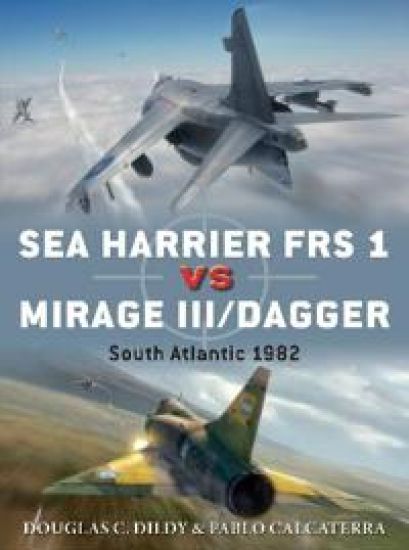
Sea Harrier FRS 1 vs Mirage III/Dagger

Sea Harrier FRS 1 vs Mirage III/Dagger

Douglas C. Dildy; Pablo Calcaterra

Osprey Publishing
2017
nidottu
Following Argentina's military operation to take possession of the Falkland Islands/Islas Malvinas, British Prime Minister Margaret Thatcher's government launched a major naval operation to return them to British rule. Defending the Royal Navy task force were two small squadrons totalling 20 Sea Harriers (SHARs). Initial clashes between SHARs and Argentine Mirages and Daggers on 1 May 1982 failed to eliminate the Sea Harrier defenders. FAA fighter-bomber pilots relied on daring and courageous ultra-low level attacks, frequently escaping the Sea Harrier’s limited capabilities, against Royal Navy warships and auxiliaries, causing considerable damage during Operation Corporate, the large-scale amphibious operation to repossess the islands. Publishing 35 years after the end of the conflict, this fully illustrated volume offers a balanced and objective examination of the SHAR and the Argentine Mirage and Dagger aircraft, highlighting the attributes of both and the skills and courage of the pilots flying them.
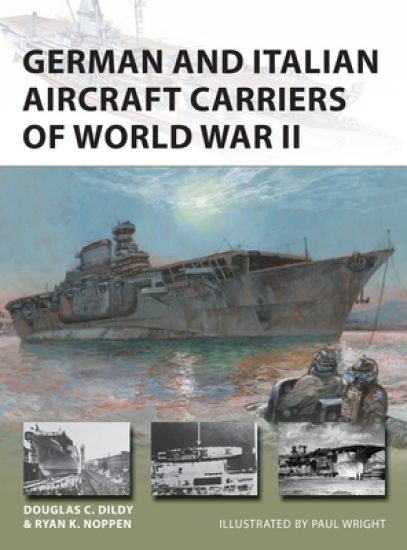
German and Italian Aircraft Carriers of World War II

German and Italian Aircraft Carriers of World War II

Ryan K. Noppen; Douglas C. Dildy

BLOOMSBURY PUBLISHING PLC
2022
nidottu
This fully illustrated study details Germany and Italy’s failed development of World War II aircraft carriers, and the naval aviation ships that the two Axis powers sent into action in their place. The quest for a modern aircraft carrier was the ultimate symbol of the Axis powers’ challenge to Allied naval might, but fully-fledged carriers proved either too difficult, expensive or politically unpopular for either to make operational. After the Anglo-German Naval Agreement of 1935, Hitler publicly stated his intention to build an aircraft carrier, the Graf Zeppelin, which was launched in 1938. A year later, the ambitious fleet-expansion Z-Plan, was unveiled with two additional aircraft carriers earmarked for production . However, by the beginning of World War II, Graf Zeppelin was not yet completed and work was halted. Further aircraft carrier designs and conversion projects such as the ocean liner Europa and heavy cruiser Seydlitz were considered but, in January 1943, all construction work on surface vessels ceased and naval resources were diverted to the U-boat Campaign. This book explains not only the history of Germany’s famous Graf Zeppelin fleet carrier and German carrier conversion projects but also Italy’s belated attempt to convert two of her ocean liners into carriers. It considers the role of naval aviation in the two countries’ rearmament programmes and describes how ultimately it was only Italian seaplane carriers and German ocean-going, catapult-equipped flying boat carriers that both Axis powers did eventually send into combat.
“Big Week” 1944

“Big Week” 1944

Douglas C. Dildy

Osprey Publishing
2022
nidottu
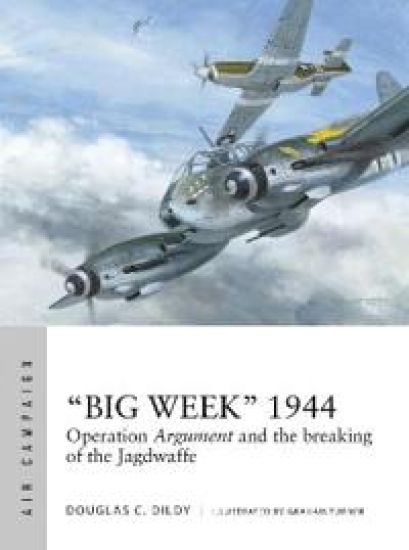
A rigorous new analysis of America's legendary 'Big Week' air campaign which enabled the Allies to gain air superiority before D-Day. The USAAF’s mighty World War II bomber forces were designed for unescorted, precision daylight bombing, but no-one foresaw the devastation that German radar-directed interceptors would inflict on them. Following the failures of 1943’s Schweinfurt-Regensburg raids, and with D-Day looming, the Allies urgently needed to crush the Luftwaffe’s ability to oppose the landings. In February 1944, the Allies conceived and fought history’s first-ever successful offensive counter­air (OCA) campaign, Operation Argument or “Big Week.” Attacking German aircraft factories with hundreds of heavy bombers, escorted by the new long-range P-51 Mustang, it aimed both to slash aircraft production and force the Luftwaffe into combat, allowing the new Mustangs to take their toll on the German interceptors. This expertly written, illustration-packed account explains how the Allies finally began to win air superiority over Europe, and how Operation Argument marked the beginning of the Luftwaffe’s fall.
To Defeat the Few

To Defeat the Few

Douglas C. Dildy; Paul F. Crickmore

Osprey Publishing
2020
sidottu

Halvin toimitettuna 32,40 €

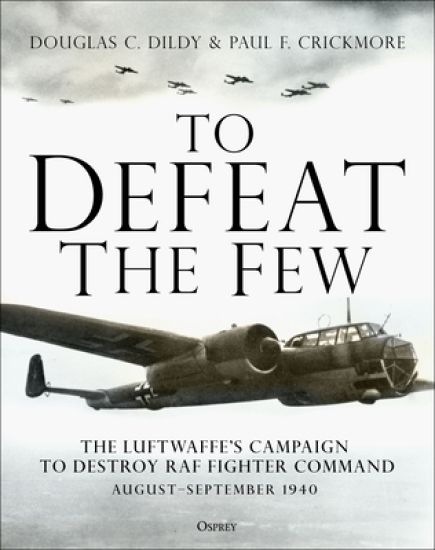
This history, based on an exhaustive study of German records, explores The Battle of Britain through the eyes of the Luftwaffe. Over the past 80 years, histories of the Battle of Britain have consistently portrayed the feats of ‘The Few’ (as they were immortalized in Churchill’s famous speech) as being responsible for the RAF’s victory in the epic battle. However, this is only part of the story. The results of an air campaign cannot be measured in terms of territory captured, cities occupied or armies defeated, routed or annihilated. Successful air campaigns are those that achieve their intended aims or stated objectives. Victory in the Battle of Britain was determined by whether the Luftwaffe achieved its objectives. The Luftwaffe, of course, did not, and this detailed and rigorous study explains why. Analysing the battle in its entirety in the context of what it was – history’s first independent offensive counter-air campaign against the world’s first integrated air defence system – Douglas C. Dildy and Paul F. Crickmore set out to re-examine this remarkable conflict. Presenting the events of the Battle of Britain in the context of the Luftwaffe’s campaign and RAF Fighter Command’s battles against it, this title is a new and innovative history of the battle that kept alive the Allies’ chances of defeating Nazi Germany.
Fury from the North

Fury from the North

Douglas C. Dildy

Helion Company
2019
nidottu
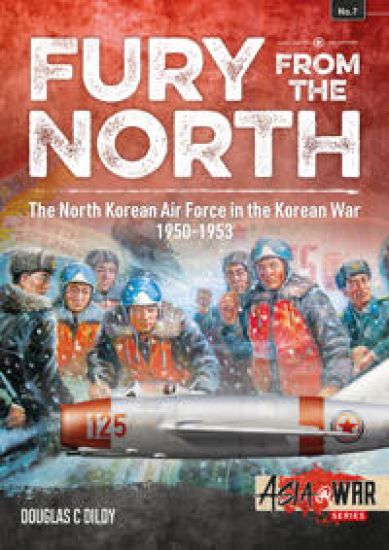
It was almost exactly 15.00 hours local time, on 25 June 1950, when nine Yakovlev Yak-9P fighters of the North Korea’s ‘Korean People’s Air Force’ (KPAF) simultaneously attacked Seoul International Airport and the Kimpo Airfield outside Seoul, the capitol of South Korea. In the course of their attacks, the Yaks shot up ground installations and strafed one of Douglas C-54 transports of the US Air Force involved in evacuation of US citizens from the war-stricken country. The Yaks returned to finish off the C-54 at Kimpo around 19.00. Thus began the aerial component of the Korean War, which was to last until mid-1953. While dozens of accounts about this air war have been published over the time, nearly all of these are concentrating on its most spectacular segment: air combats between jet fighters of two primary belligerents: North American F-86 Sabres of the US Air Force (USAF) and Mikoyan i Gurevich MiG-15s of the Soviet Air Force (V-VS). On the contrary, the story of KPAF’s coming into being and its involvement in the Korean War remain entirely unknown. Certainly enough, the small service was virtually wiped out of the skies in a matter of few weeks after the start of that conflict. Therefore, the impression is that it never took part in the Korean War again. Actually, the KPAF – backgrounds of which can be traced back to the times only three months after the Japanese capitulation that ended the World War II – was re-built and even made a come-back: re-equipped with piston-engined fighters of Soviet origin already by the end of 1950, it went a step further and converted to jets just a year later. This is a story of the – often problematic – coming into being of the KPAF. Clearly, building a modern, effective air force was always a daunting undertaking – even in the late 1940s when there was abundance of combat aircraft left over from the World War II. Nevertheless, the communist government of North Korea and its airmen never stopped trying. Surprisingly enough – especially for a military service of a staunchly communist and underdeveloped country of the 1940s – it was greatly bolstered by efforts of a single wealthy man that provided installations necessary for education of future pilots and ground personnel.
Battle of Britain 1940

Battle of Britain 1940

Douglas C. Dildy

Osprey Publishing
2018
nidottu
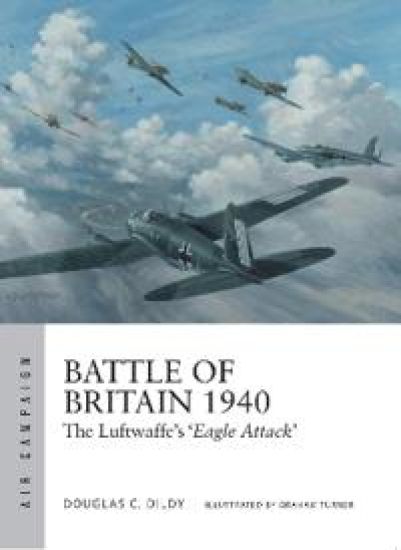
A new analysis of the Battle of Britain, told unusually from the perspective of the Luftwaffe, detailing its plans to crush Fighter Command and win the war with air power. In August 1940, the Luftwaffe began an operation to destroy or neutralize RAF Fighter Command, and enable Hitler to invade Britain that autumn. It was a new type of air warfare: the first ever offensive counter-air campaign against an integrated air defence system. Powerful, combat-proven and previously all-conquering, the German air force had the means to win the Battle of Britain. Yet it did not. This book is an original, rigorous campaign study of the Luftwaffe’s Operation Adlerangriff, researched in Germany’s World War II archives and using the most accurate data available. Doug Dildy explains the capabilities of both sides, sets the campaign in context, and argues persuasively that it was the Luftwaffe’s own mistakes and failures that led to its defeat, and kept alive the Allies’ chance to ultimately defeat Nazi Germany.
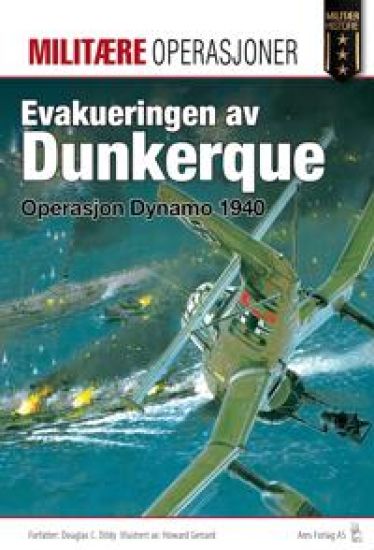
Evakueringen av Dunkerque

Evakueringen av Dunkerque

Douglas C. Dildy

Ares forlag
2017
nidottu
Mens kampene i Narvik pågikk, kjempet franske, britiske og belgiske soldater en desperat kamp mot tyske styrker i Frankrike. Nesten 400 000 allierte soldater ble angrepet fra tre kanter og trengt inn en lomme rundt havnebyen Dunkerque, ved kanalkysten. Tyskerne hadde de allierte i sitt jerngrep, men unnlot å knuse de allierte styrkene. Istedet klarte britiske og franske marinestyrker å evakuere over 329 000 soldater fra strendene i Frankrike og på den måten var britene i stand til å ta opp kampene mot Hitlers krigsmaskin senere i krigen. Boken gir også et en god forklaring og forståelse for hvorfor de britiske og franske styrkene ble evakuere fra Nord-Norge i juni 1940.
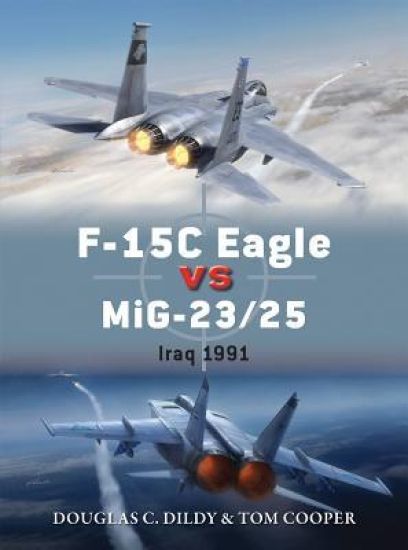
F-15C Eagle vs MiG-23/25

F-15C Eagle vs MiG-23/25

Douglas C. Dildy; Tom Cooper

Osprey Publishing
2016
nidottu
Following the relatively poor performance of America's multi-role fighters during the Vietnam War, the F-15 Eagle was designed as a dedicated air superiority fighter. But, instead of Soviet pilots, it came up against pilots of Saddam Hussein's Iraqi airforce. This book analyses the combat between the American and Soviet 'Cold War fighters' in a balanced manner, examining how the technical abilities of the aircraft combined with the different levels of training available to opposing pilots and groundcrews allowed the F-15s to destroy the Iraqi offensive abilities within weeks of the First Gulf War starting. Packed with artwork, illustrations and photographs, this book places the reader in the cockpit during one of the last major dogfighting air wars in modern history.
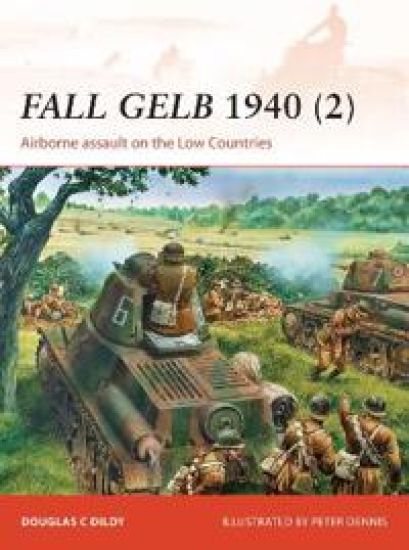
Fall Gelb 1940 (2)

Fall Gelb 1940 (2)

Douglas C. Dildy

Osprey Publishing
2015
nidottu
A highly illustrated account of the daring German assault by Heersgruppe A through Holland and Belgium in May 1940. The great blitzkrieg campaign of May/June 1940 saw German forces pour through Holland and Belgium to confront the French and British. The assault was audacious; it relied on speed, feinting and manoeuvre as much as superior force, and in the end these qualities were to prove decisive to German success. Featuring vivid illustrations, illuminative bird's eye views and maps, this book charts the unfolding of an unprecedented 'lightning war', which saw the first ever airborne assault at a strategic level, and the largest clash of armour to date. Never in the history of warfare had the clash between such large, powerful, and apparently equal forces been decided so swiftly and conclusively.
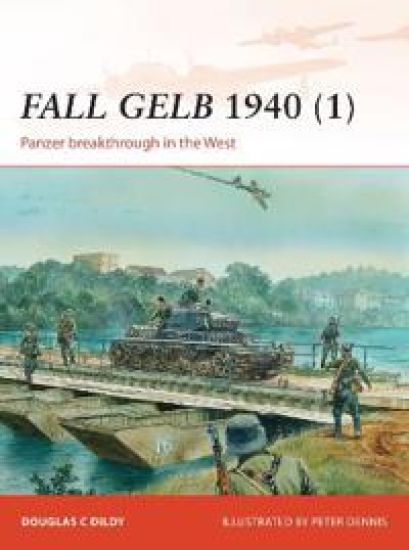
Fall Gelb 1940 (1)

Fall Gelb 1940 (1)

Douglas C. Dildy

Osprey Publishing
2014
nidottu
Never in the history of warfare has the clash between such great and apparently equal forces been decided so swiftly and conclusively as the German conquest of France and the Low Countries in May and June of 1940. Not deigning to spend itself against the extensive fortifications of France’s Maginot Lines, Hitler’s Wehrmacht planned to advance its 136 (of 157) divisions through Belgium and northern France in order to destroy the Allied forces there and gain territory from which to prosecute continued combat operations against France and England. Beginning on 10 May 1940, this title follows the fortunes of Heeresgruppe A as its three Panzer Korps moved stealthily through the dark, hilly, and thickly forested Ardennes in southern Belgium before forcing a passage across the river Meuse and racing through France to the Channel in one of the most daring campaigns in history.
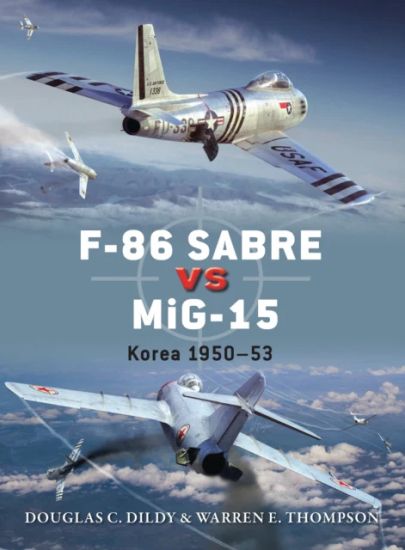
F-86 Sabre vs MiG-15

F-86 Sabre vs MiG-15

Douglas C. Dildy; Warren Thompson

Osprey Publishing
2013
nidottu
A fully objective, balanced description and appraisal of the air battles over the hotly-contested airspace above the North Korea-China border, with enlightening discussion of the relative merits of each type. As the routed North Korean People’s Army (NKPA) withdrew into the mountainous reaches of their country and the People’s Republic of China (PRC) funneled in its massive infantry formations in preparation for a momentous counter-offensive, both lacked adequate air power to challenge the US and UN. Reluctantly, Josef Stalin agreed to provide the requisite air cover, introducing the superior swept-wing MiG-15 to counter the American’s straight-wing F-80 jets. This in turn prompted the USAF to deploy its very best – the F-86A Sabre – to counter this threat. In this period, the unrelenting campaign for aerial superiority witnessed the introduction of successive models of these two revolutionary jets into combat. This meticulously researched study not only provides technical descriptions of the two types and their improved variants, complete with a “fighter pilot’s assessment” of these aircraft, but also chronicles the entire scope of their aerial duel in “MiG Alley” by employing the recollections of the surviving combatants – including Russian, Chinese, and North Korean pilots – who participated.
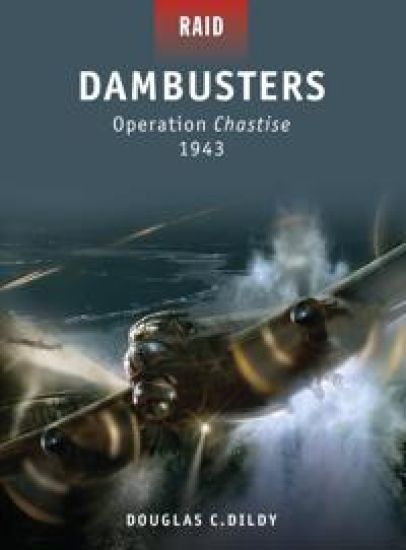
Dambusters

Dambusters

Douglas C. Dildy

Osprey Publishing
2010
nidottu
In May 1943, a specially established RAF squadron made its permanent imprint on military aviation history by flying a high-risk, low level, nighttime attack against German hydro-electric dams vital to the Nazi armaments industry in the Ruhr Valley. A comparatively tiny part of Air Chief Marshal Sir Arthur Harris' four-month-long Battle of the Ruhr, this one raid had an impact totally out of proportion to the small number of aircraft involved. It highlights the synergy of science and technology, weapons development and production, mission planning and practice, and the unflinching courage in the execution of a highly dangerous bombing raid. Furthermore, it established a legend that still resonates today.
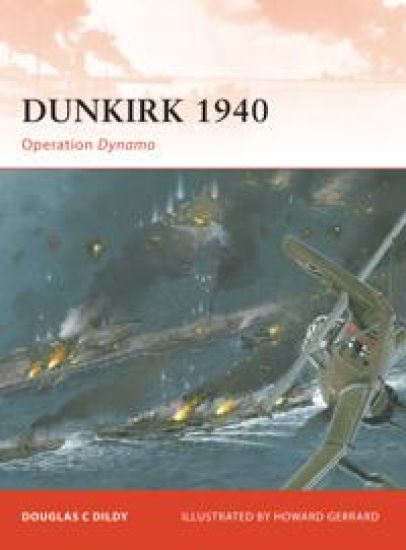
Dunkirk 1940

Dunkirk 1940

Douglas C. Dildy

Osprey Publishing
2010
nidottu
A comprehensive and thoughtful assessment of the operational events leading up to and during Operation Dynamo. The evacuation of the British Expeditionary Force (BEF) from Dunkirk is one of the most dramatic and famous episodes of the Second World War. Dunkirk 1940 assesses Operation Dynamo from start to finish, with reference to the plans, forces and operations involved. It is a unique and comprehensive compilation of all the facts with excellent illustrations, photographs and maps detailing every significant event in the Operation. For the first time in military literature, this title discusses the theory that the results of Dynamo largely depended on the results of an 'asymmetric' battle.
Denmark and Norway 1940

Denmark and Norway 1940

Douglas C. Dildy

Osprey Publishing
2007
nidottu
A compact history of the German invasion of Denmark and Norway, and how the subsequent developments resulted in Winston Churchill's premiership. On 9 April 1940, German forces invaded Denmark, and then Norway, in an attempt to guarantee security of Scandinavia's vital mineral resources for their war industry. This assault, Operation Weserübung, represented the first joint air-land-and-sea campaign in the history of warfare, and was the only such campaign planned by the Wehrmacht high command, including all three services of the Wehrmacht. This book describes the events of this tumultuous campaign that not only led to Winston Churchill's appointment as British Prime Minister, but also saw the crippling of the German Kriegsmarine as a fighting force.
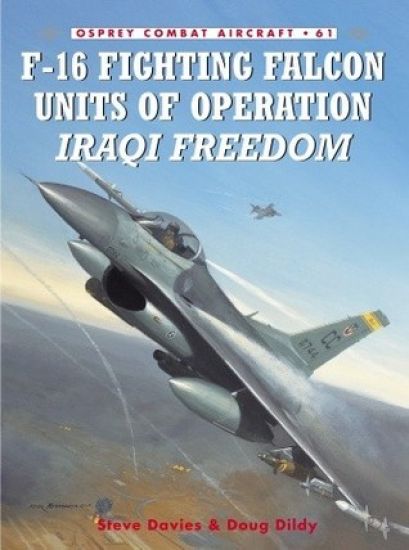
F-16 Fighting Falcon Units of Operation Iraqi Freedom

F-16 Fighting Falcon Units of Operation Iraqi Freedom

Douglas C. Dildy; Steve Davies

Osprey Publishing
2006
nidottu
When US President Bush ordered his forces into Iraq in March 2003, the F-16CJ was the second aircraft to enter Iraqi airspace-proper, sweeping the skies for electrons in a bid to find, identify and kill Iraq's comprehensive air defence system. With the mission fulfilled, hordes of other coalition fighters followed, including the F-16CG, which was used with great success to strike fixed and mobile-ground targets. The Viper was also employed in the more conventional strike role too, bombing targets ranging from Baath party HQ buildings in Baghdad to Republican Guard T-72 tanks of the Medina division around An Najaf.