
Kirjailija
Douglas M. Brown
Kirjat ja teokset yhdessä paikassa: 13 kirjaa, julkaisuja vuosilta 1991–2021, suosituimpiin kuuluu The Accidental Martyr: How and Why Sakine Cansiz Survived Torture, Led Women in Combat and Was Murdered for Kurdish Freedom. Vertaile teosten hintoja ja tarkista saatavuus suomalaisista kirjakaupoista.
Nimi esiintyy myös muodoissa: Douglas M Brown
13 kirjaa
Kirjojen julkaisuvuodet: 1991–2021.

The Accidental Martyr: How and Why Sakine Cansiz Survived Torture, Led Women in Combat and Was Murdered for Kurdish Freedom
Douglas M. Brown; Hamma Mirwaisi
Createspace Independent Publishing Platform
2017
nidottu
The life of Sakine Cansiz mirrors the history of the Kurdish People. To become known as an active champion of human rights, democracy and feminism, she had to be tortured, to receive more wounds as an active soldier in a vicious guerrilla war, ad to become an assassin's target. For the Kurds to get any attention, they've had to be gassed by Saddam Hussein or invaded by ISIS. Now the world can see them as the only effective fighters against ISIS, and see their success in establishing truly democratic communities in a region that knows only oppressive rulers. Who are they? What do they want? Why can't they have a country? "Kurdish-American writer Hamma Mirwaisi uses the 2013 execution-style murder of Kurdish feminist activist Sakine Cansiz in Paris as a launching point to explain Kurdish history, Kurdish aspirations, and the Kurds' insurgency against Turkey - a conflict measured not in decades but in centuries. Whatever one;s perspective, one thing is clear: neither the Kurds nor the PKK can be ignored any longer. The Accidental Martyr may infuriate Turkish nationalists and frustrate diplomats, but it is a must-read to understand where the PKK has been and where Syria and Turkey's Kurds may be going".(Michael Rubin, Resident Scholar, American Enterprise Institute).
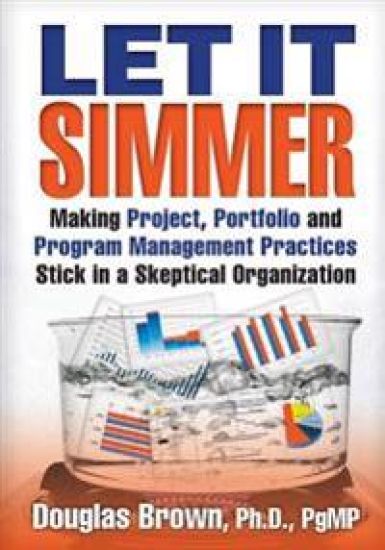
Let It Simmer: Making Project, Portfolio and Program Management Practices Stick in a Skeptical Organization
Douglas M. Brown
Createspace Independent Publishing Platform
2016
nidottu
Why can't most organizations seem to get project, portfolio and program management off the ground, despite all the books that are written these governance disciplines? Is there something you can do to make your organization one of those that do live up to expectations? Actually, the best practice books are right ... in the long-term; it's the initial approach that's often wrong. You can't cure a patient by administering an overdose. Right medicine, wrong treatment. Best practices are where you aspire to get, not where you start out. But how do you get organized enough to start thinking about best practices? Welcome to Let It Simmer, a step-by-step guide to implementing governance practices using The Simmer System SM. Dr. Douglas Brown developed the system during 20-plus years as a PMO Director and as a consultant in both public and private sectors, helping organizations set these management disciplines up or get them back on track. Introducing governance is a big change. People are always concerned about how change will impact them, and many senior managers see the arrival of management discipline as an attack on their freedom of action. The Simmer System shows you how to make this change happen with a minimum of conflict by helping your colleagues collaborate to help themselves, rather than attacking you for trying to make them do it. Let It Simmer explains how to implement the components, illustrates them with numerous case studies, and provides practical exercises that show you how to implement the system in your own organization (or your client's). The components are: -Four core principles of integration, transparency, integrity and purposeful service that will keep you on track when things get murky (and they will). -Seven lists of data you can gather that set the stage for collaborative actions without sending up red flags. -How to attain and keep top-level support, and what to do if you don't get it. This is the most essential task in determining the usefulness and staying power of your initiative (which in a process-averse organization is quite possible, at least at first). -Eight collaborative activities to bring your peer managers into the governance world by solving their problems. -How to identify the real decision-maker (i.e., a board or an individual), and how they can operate transparently without losing their autonomy. Implementing organizational change doesn't mean you need loads of experience. Sometimes too much experience makes you part of the problem. You may get handed the role because the organization wants a fresh face with innovative ideas, and you're the right person for the job. This step-by-step guide provides you the opportunity to achieve a dramatic transformation that lasts - but without pushing so hard that the organization decides to get rid of it instead. In less time that you might expect, your fellow leaders will have started adopting sound management practices and your organization will be noticeably more cohesive, collaborative and productive. You'll be amazed at how much gets done once it's not all about you. A word from Douglas Brown: People have asked, "What's with title, The Simmer System?" For instance, tough meat needs to cook over low heat to soften gristle and melt the fat. Cook your food over very high heat and you'll burn it. Turn the heat down to very low and it just sits there. I'm sharing the many lessons I've learned so you don't have to go through the aggravation of determining which correct "temperature" to use. I teach you how to simmer your programs, and end up with a well-run organization.
Distribution of Powers and Responsibilities in Federal Countries
Akhtar Majeed; Ronald L Watts; Douglas M Brown
McGill-Queen's University Press
2005
sidottu
A comparative analysis of eleven diverse federal countries through case studies illustrating federalism
Distribution of Powers and Responsibilities in Federal Countries
Akhtar Majeed; Ronald L Watts; Douglas M Brown
McGill-Queen's University Press
2005
nidottu
A comparative analysis of eleven diverse federal countries through case studies illustrating federalism

In today's culture of insatiable freedom, many believe that to be human is to be an insatiable self-actualizer. Yet insatiable is not sustainable. In order to solve today's crisis of environmental sustainability--and human sustainability--we must let go of our obsession to constantly be more. The desire to have all that we can have comes, Brown argues, from a cultural norm that has evolved to become an economic, social, and moral imperative-that To Be is to achieve more, improve more, and insatiably have more, to the point of planetary extinction. Incorporating the views of classic scholars--Aristotle, J. S. Mill, Marx, Thorstein Veblen--into his own unique interpretation, Brown traces human history from the earliest hunters and gatherers through the emergence of capitalism and the evolution to today's insatiable self and the culture of insatiable freedom. In conclusion, Brown argues cogently for the creation of a culture of sustainability, offering practical ways to achieve this goal.
In today's culture of insatiable freedom, many believe that to be human is to be an insatiable self-actualizer. Yet insatiable is not sustainable. In order to solve today's crisis of environmental sustainability--and human sustainability--we must let go of our obsession to constantly be more. The desire to have all that we can have comes, Brown argues, from a cultural norm that has evolved to become an economic, social, and moral imperative-that To Be is to achieve more, improve more, and insatiably have more, to the point of planetary extinction. Incorporating the views of classic scholars--Aristotle, J. S. Mill, Marx, Thorstein Veblen--into his own unique interpretation, Brown traces human history from the earliest hunters and gatherers through the emergence of capitalism and the evolution to today's insatiable self and the culture of insatiable freedom. In conclusion, Brown argues cogently for the creation of a culture of sustainability, offering practical ways to achieve this goal.
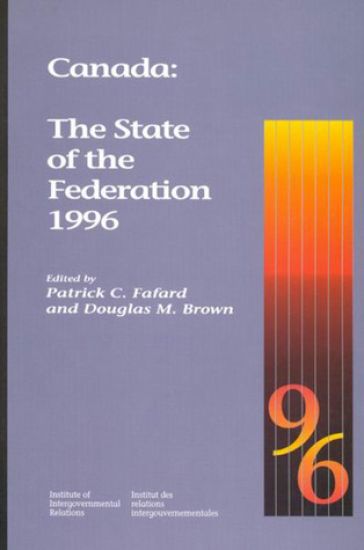
Canada: The State of the Federation 1996
Patrick C. Fafard; Douglas M Brown
Queen's University
1997
nidottu
Focusing on the aftermath of the 1995 Quebec referendum on sovereignty, Marc Desjardins (McGill/Government of Canada) evaluates the first six months of Lucien Bouchard's tenure as premier of Quebec, John Trent (Ottawa) provides a useful guide to the myriad of citizen groups that have sprung up since the referendum, and Douglas Brown (New South Wales) outlines how scholars outside Quebec have begun to think seriously about the "unthinkable" - a vote in favour of sovereignty in a future referendum. Examining the ongoing management of the Canadian federation, François Rocher (Carleton) and Christian Rouillard (Carleton) challenge the view that Canada is among the most decentralized federations in the world, Herman Bakvis (Dalhousie) analyses federal proposals to devolve labour market development to the provinces, Daniel Cohn (Carleton) assesses the final version of the Canada Health and Social Transfer, Robert Williams (Waterloo) surveys intergovernmental relations on cultural policy, Christopher McKee (UBC) provides a detailed analysis of the treaty-making process in British Columbia, and Patrick Fafard (Queen's) examines the overall state of the federation, likening it to a game of multidimensional chess. As always, the volume includes a chronology of events from July 1995 to June 1996, providing a useful reference to significant developments in Canadian federalism and intergovernmental relations.

Canada: The State of the Federation 1995
Douglas M. Brown; Jonathan W. Rose
Queen's University
1995
nidottu

Canada: The State of the Federation 1994
Douglas M. Brown; Janet L. Hiebert
Queen's University
1994
nidottu

The fiscal crisis facing Canadian governments, economic restructuring, and rapid change in labour markets are generating powerful pressures for reform of federal-provincial financial arrangements and the social programs they sustain. The Future of Fiscal Federalism brings together leading experts from across the country to explore current problems and suggest solutions.
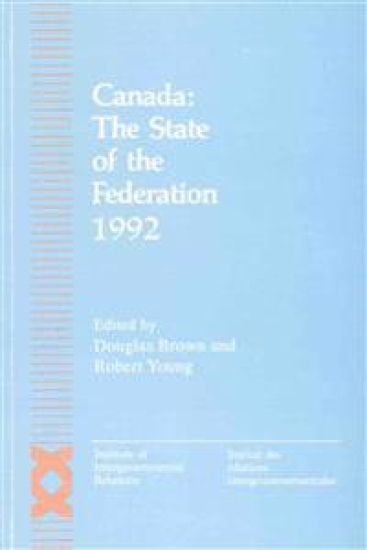
Canada: The State of the Federation 1992
Douglas M. Brown; Robert A. Young
Queen's University
1992
nidottu