Kirjojen hintavertailu – 12 903 725 kirjaa ja 27 kauppaa

Kirjailija

Douglas Walton

Kirjat ja teokset yhdessä paikassa: 49 kirjaa, julkaisuja vuosilta 1979–2026, suosituimpiin kuuluu خُطَاطات الحِجَاج في المنطق الظني - Argumentation Schemes in Presumptive Reasoning. Vertaile teosten hintoja ja tarkista saatavuus suomalaisista kirjakaupoista.

49 kirjaa

Kirjojen julkaisuvuodet: 1979–2026.

Fallacies Arising from Ambiguity

Fallacies Arising from Ambiguity

Douglas Walton

Springer
1996
sidottu
We are happy to present to the reader the first book of our Applied Logic Series. Walton's book on the fallacies of ambiguity is firmly at the heart of practical reasoning, an important part of applied logic. There is an increasing interest in artifIcial intelligence, philosophy, psychol­ ogy, software engineering and linguistics, in the analysis and possible mechanisation of human practical reasoning. Continuing the ancient quest that began with Aristotle, computer scientists, logicians, philosophers and linguists are vigorously seeking to deepen our understanding of human reasoning and argumentation. Significant communities of researchers are actively engaged in developing new approaches to logic and argumentation, which are better suited to the urgent needs of today's applications. The author of this book has, over many years, made significant contributions to the detailed analysis of practical reasoning case studies, thus providing solid foundations for new and more applicable formal logical systems. We welcome Doug Walton's new book to our series.
Argument Structure

Argument Structure

Douglas Walton

University of Toronto Press
1996
pokkari
The current difficulty with using argument diagramming as a teaching tool in courses designed to help students think more critically and criticize arguments more effectively is that the students are not able to carry out these tasks in a confident and definitive way, so that they are sure they have the right answer. The reason for this is that the various tests used in logic textbooks to carry out these tasks are often highly variable and contradictory. In many cases, either no real criteria at all are given, or else those given do not yield clear answers. For example, the same argument might be identified as linked according to the test advocated in one textbook, but as convergent according to another. Some textbooks tests even give results that appear intuitively wrong to students. Douglas Walton provides a systematic survey, clarification, and assessment of the different tests currently being used to carry out the tasks involved in argument identification. He tests the tests themselves, and develops new methods for determining missing premises, for determining whether an argument is linked or convergent, and for deciding whether a given test of discourse contain an argument or not. The result is a clearly expressed theory of argument structure that yields a precise and consistent method of argument diagramming, making the technique much more useful and easily applicable. Suitable for courses in informal logic, critical thinking, argumentation, and logical reasoning, the book will also be of interest to those in the fields of speech communication, rhetoric, discourse analysis, and education.
Argumentation Schemes for Presumptive Reasoning

Argumentation Schemes for Presumptive Reasoning

Douglas Walton

Routledge Member of the Taylor and Francis Group
1995
sidottu
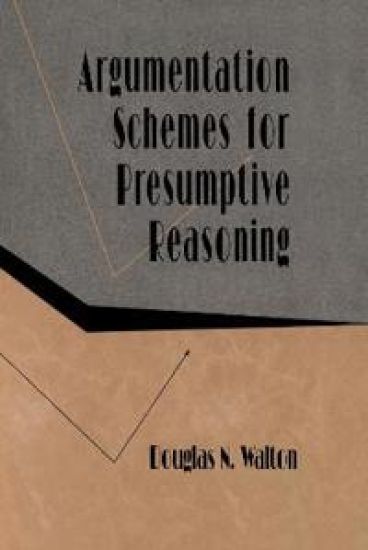
Recent concerns with the evaluation of argumentation in informal logic and speech communication center around nondemonstrative arguments that lead to tentative or defeasible conclusions based on a balance of considerations. Such arguments do not appear to have structures of the kind traditionally identified with deductive and inductive reasoning, but are extremely common and are often called "plausible" or "presumptive," meaning that they are only provisionally acceptable even when they are correct. How is one to judge, by some clearly defined standard, whether such arguments are correct or not in a given instance? The answer lies in what are called argumentation schemes -- forms of argument (structures of inference) that enable one to identify and evaluate common types of argumentation in everyday discourse. This book identifies 25 argumentation schemes for presumptive reasoning and matches a set of critical questions to each. These two elements -- the scheme and the questions -- are then used to evaluate a given argument in a particular case in relation to a context of dialogue in which the argument occurred. In recent writings on argumentation, there is a good deal of stress placed on how important argumentation schemes are in any attempt to evaluate common arguments in everyday reasoning as correct or fallacious, acceptable or questionable. However, the problem is that the literature thus far has not produced a precise and user-friendly enough analysis of the structures of the argumentation schemes themselves, nor have any of the documented accounts been as helpful, accessible, or systematic as they could be, especially in relation to presumptive reasoning. This book solves the problem by presenting the most common presumptive schemes in an orderly and clear way that makes them explicit and useful as precisely defined structures. As such, it will be an indispensable tool for researchers, students, and teachers in the areas of critical thinking, argumentation, speech communication, informal logic, and discourse analysis.
Argumentation Schemes for Presumptive Reasoning

Argumentation Schemes for Presumptive Reasoning

Douglas Walton

Routledge Member of the Taylor and Francis Group
1995
nidottu
Recent concerns with the evaluation of argumentation in informal logic and speech communication center around nondemonstrative arguments that lead to tentative or defeasible conclusions based on a balance of considerations. Such arguments do not appear to have structures of the kind traditionally identified with deductive and inductive reasoning, but are extremely common and are often called "plausible" or "presumptive," meaning that they are only provisionally acceptable even when they are correct. How is one to judge, by some clearly defined standard, whether such arguments are correct or not in a given instance? The answer lies in what are called argumentation schemes -- forms of argument (structures of inference) that enable one to identify and evaluate common types of argumentation in everyday discourse. This book identifies 25 argumentation schemes for presumptive reasoning and matches a set of critical questions to each. These two elements -- the scheme and the questions -- are then used to evaluate a given argument in a particular case in relation to a context of dialogue in which the argument occurred. In recent writings on argumentation, there is a good deal of stress placed on how important argumentation schemes are in any attempt to evaluate common arguments in everyday reasoning as correct or fallacious, acceptable or questionable. However, the problem is that the literature thus far has not produced a precise and user-friendly enough analysis of the structures of the argumentation schemes themselves, nor have any of the documented accounts been as helpful, accessible, or systematic as they could be, especially in relation to presumptive reasoning. This book solves the problem by presenting the most common presumptive schemes in an orderly and clear way that makes them explicit and useful as precisely defined structures. As such, it will be an indispensable tool for researchers, students, and teachers in the areas of critical thinking, argumentation, speech communication, informal logic, and discourse analysis.
Arguments from Ignorance

Arguments from Ignorance

Douglas Walton

Pennsylvania State University Press
1995
pokkari
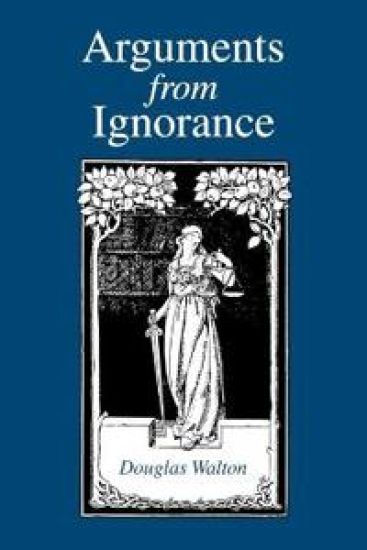
Arguments from Ignorance explores the situations in which the argument from ignorance (also known as the lack-of-knowledge inference, negative evidence, or default reasoning) functions as a respectable form of reasoning and those in which it is indeed fallacious. Douglas Walton draws on everyday conversations on all kinds of practical matters in which the argumentum ad ignorantiam is used quite appropriately to infer conclusions. He also discusses the inappropriate use of this kind of argument, referring to various major case studies, including the Salem witchcraft trials, the McCarthy hearings, and the Alger Hiss case. This book makes an original contribution in the areas of argumentation theory and informal logic, contending that, despite its traditional classification as a fallacy, the argument from ignorance is a genuine, very common, and legitimate type of argumentation with an identifiable structure. But the book is also interdisciplinary in scope, explaining many widely interesting and controversial subjects in artificial intelligence, medical education, philosophy of science, and philosophy of law in a clear way that makes it accessible to a broad range of readers.
The Place of Emotion in Argument

The Place of Emotion in Argument

Douglas Walton

Pennsylvania State University Press
1992
sidottu
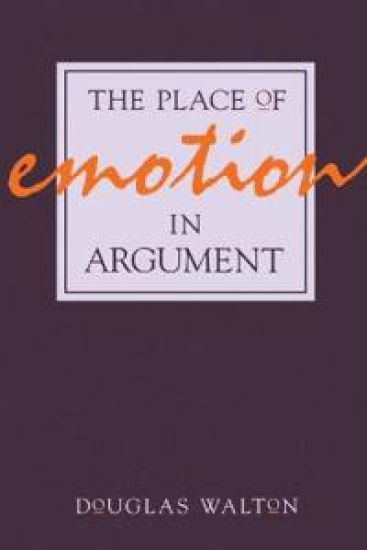
Appeals to emotion—pity, fear, popular sentiment, and ad hominem attacks—are commonly used in argumentation. Instead of dismissing these appeals as fallacious wherever they occur, as many do, Walton urges that each use be judged on its merits. He distinguished three main categories of evaluation. First, is it reasonable, even if not conclusive, as an argument? Second, is it weak and therefore open to critical questioning for argument? And third, is it fallacious? The third category is a strong charge that incurs a critical burden to back it up by citing evidence from the given text and context of dialogue. Walton uses fifty-six case studies to demonstrate that the problem of emotional fallacies is much subtler than has been previously believed. Ranging over commercial advertisements, political debates, union-management negotiations, and ethical disputes, the case studies reveal that these four types of appeals, while based on presumptive reasoning that are tentative and subject to default, are not always or necessarily fallacious types of argumentation.
The Place of Emotion in Argument

The Place of Emotion in Argument

Douglas Walton

Pennsylvania State University Press
1992
pokkari
Appeals to emotion—pity, fear, popular sentiment, and ad hominem attacks—are commonly used in argumentation. Instead of dismissing these appeals as fallacious wherever they occur, as many do, Walton urges that each use be judged on its merits. He distinguished three main categories of evaluation. First, is it reasonable, even if not conclusive, as an argument? Second, is it weak and therefore open to critical questioning for argument? And third, is it fallacious? The third category is a strong charge that incurs a critical burden to back it up by citing evidence from the given text and context of dialogue. Walton uses fifty-six case studies to demonstrate that the problem of emotional fallacies is much subtler than has been previously believed. Ranging over commercial advertisements, political debates, union-management negotiations, and ethical disputes, the case studies reveal that these four types of appeals, while based on presumptive reasoning that are tentative and subject to default, are not always or necessarily fallacious types of argumentation.
Slippery Slope Arguments

Slippery Slope Arguments

Douglas Walton

Clarendon Press
1992
sidottu
A `slippery slope argument' is a kind of argument which warns you that, if you take a first step, you will find yourself caught up in a sequence of consequences from which you will be unable to extricate yourself, and that eventually you will end up speeding ever faster towards some disastrous outcome. Many textbooks on informal logic and critical thinking treat the slippery slope argument as a fallacy. Douglas Walton argues that slippery slope arguments can be used correctly in some cases as a reasonable type of argument to shift a burden of proof in a critical discussion, while in other cases they are used incorrectly. In the four central chapters he identifies and analyses four types of slippery slope argument. In each chapter he presents guidelines that show how each type of slippery slope argument can be used correctly or incorrectly, using over fifty case studies of argumentation on controversial issues. These include abortion, medical research on human embryos, euthanasia, the decriminalization of marijuana, pornography and censorship, and whether or not the burning of the American flag should be banned.
On Defining Death

On Defining Death

Douglas Walton

McGill-Queen's University Press
1979
sidottu
In this book, Douglas Walton examines the philosophical nature of two issues currently associated with medical ethics. In order to work towards an analysis of the concept of death that could function as a target towards which the medical criteria of death could be directed, he proposes the foundations for a theory free of logical contradictions, paradoxes, and other perplexities. This is the "superlimiting theory" which introduces the notion of a "possible person." The connection of these philosophical ideas with medico-legal concerns like brain death and the Harvard criteria is discussed. Professor Walton then goes on to examine the difference between killing and letting die. Through a close study of the logic of action sentences, he develops a model that is discussed in the light of the ethical and jurisprudential realities of medical ethics to see if the distinction between bringing something about (actively) and letting something happen (passively) is one that makes a moral difference in the evaluation of actions. Numerous problematic conceptual snags are dealt with, and the author consistently supports the conceptual clarity and respectability of the distinction. Other relevant discriminations of an action-theoretic sort, such as that between "direct" and "indirect" euthanasia, are studied, and the concluding chapter applies the conceptual analysis to a philosophical discussion of attitudes towards death, asking, "Is it rational to fear death ?"