Kirjojen hintavertailu – 12 903 725 kirjaa ja 27 kauppaa

Kirjailija

Douglass C. North

Kirjat ja teokset yhdessä paikassa: 9 kirjaa, julkaisuja vuosilta 1976–2013, suosituimpiin kuuluu Gewalt und Gesellschaftsordnungen. Vertaile teosten hintoja ja tarkista saatavuus suomalaisista kirjakaupoista.

Nimi esiintyy myös muodoissa: Douglass C North

9 kirjaa

Kirjojen julkaisuvuodet: 1976–2013.

Gewalt und Gesellschaftsordnungen

Gewalt und Gesellschaftsordnungen

Douglass C North; John J. Wallis; Barry R. Weingast

Mohr Siebeck
2013
nidottu
Alle Gesellschaften müssen sich mit der Möglichkeit wie der Realität von Gewalt auseinandersetzen; sie tun das auf unterschiedliche Art. Douglass C. North, John Joseph Wallis und Barry R. Weingast stellen das Problem der Gewalt in einen größeren sozialwissenschaftlichen und historischen Zusammenhang und zeigen, wie eng wirtschaftliches und politisches Verhalten verbunden sind. Die meisten aus der Geschichte bekannten Gesellschaften, von den Autoren als natürliche Staaten bezeichnet, begrenzen Gewaltanwendung vorbeugend, indem sie durch politische Einflussnahme auf die Wirtschaftstätigkeit privilegierte Interessen schaffen. Diese Privilegien reduzieren den Einsatz von Gewalt von Seiten mächtiger Einzelner; es wird auf diese Weise jedoch die wirtschaftliche ebenso wie die politische Entwicklung solcher Staaten behindert. Denn für die große Mehrheit der Nicht-Privilegierten ist der Zugang zu Politik und Wirtschaft dadurch beschränkt. Im Unterschied hierzu schaffen moderne Gesellschaften Zugangsfreiheit zu wirtschaftlichen und politischen Organisationen (Unternehmen, Märkten, Parlamenten, hoheitlichen Einrichtungen) und fördern damit den politischen wie den wirtschaftlichen Wettbewerb und somit die gesellschaftliche Entwicklung. Das Buch bietet ein gedankliches Gerüst zum Verständnis der zwei Typen von Gesellschaftsordnungen, die es an historischen Beispielen von der römischen Antike bis ins 19. Jahrhundert veranschaulicht. Anhand dieses Konzepts wird erklärt, wieso Gesellschaften mit Zugangsfreiheit sowohl politisch wie wirtschaftlich höher entwickelt sind und auf welche Weise seit dem 19. Jahrhundert rund 25 Länder den Übergang vom einen Typus zum anderen geschafft haben.
Understanding the Process of Economic Change

Understanding the Process of Economic Change

Douglass C. North

Princeton University Press
2010
pokkari

Halvin toimitettuna 39,30 €

In this landmark work, a Nobel Prize-winning economist develops a new way of understanding the process by which economies change. Douglass North inspired a revolution in economic history a generation ago by demonstrating that economic performance is determined largely by the kind and quality of institutions that support markets. As he showed in two now classic books that inspired the New Institutional Economics (today a subfield of economics), property rights and transaction costs are fundamental determinants. Here, North explains how different societies arrive at the institutional infrastructure that greatly determines their economic trajectories. North argues that economic change depends largely on "adaptive efficiency," a society's effectiveness in creating institutions that are productive, stable, fair, and broadly accepted--and, importantly, flexible enough to be changed or replaced in response to political and economic feedback. While adhering to his earlier definition of institutions as the formal and informal rules that constrain human economic behavior, he extends his analysis to explore the deeper determinants of how these rules evolve and how economies change. Drawing on recent work by psychologists, he identifies intentionality as the crucial variable and proceeds to demonstrate how intentionality emerges as the product of social learning and how it then shapes the economy's institutional foundations and thus its capacity to adapt to changing circumstances. Understanding the Process of Economic Change accounts not only for past institutional change but also for the diverse performance of present-day economies. This major work is therefore also an essential guide to improving the performance of developing countries.
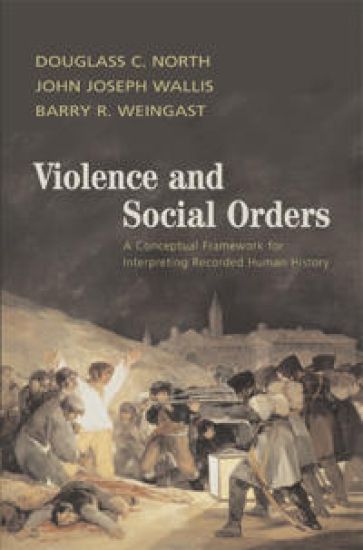
Violence and Social Orders

Violence and Social Orders

Douglass C. North; John Joseph Wallis; Barry R. Weingast

Cambridge University Press
2009
sidottu
All societies must deal with the possibility of violence, and they do so in different ways. This book integrates the problem of violence into a larger social science and historical framework, showing how economic and political behavior are closely linked. Most societies, which we call natural states, limit violence by political manipulation of the economy to create privileged interests. These privileges limit the use of violence by powerful individuals, but doing so hinders both economic and political development. In contrast, modern societies create open access to economic and political organizations, fostering political and economic competition. The book provides a framework for understanding the two types of social orders, why open access societies are both politically and economically more developed, and how some 25 countries have made the transition between the two types.
Institutional Change and American Economic Growth

Institutional Change and American Economic Growth

L. E. Davis; Douglass C. North

Cambridge University Press
2008
pokkari
This book presents a model for examining problems of institutional change and applies it to American economic development in the nineteenth and twentieth centuries. The authors develop their model of institutional change. They argue that if external economic factors make an increase in income possible but not attainable within the existing institutional structure, new organizations must be developed to achieve the potential in income. Their model is designed to explain the type and timing of these necessary changes in institutional organization. Individual, voluntary cooperative, and governmental arrangements are included in the discussion, although the latter differs considerably from the first two.
Institutions, Institutional Change and Economic Performance

Institutions, Institutional Change and Economic Performance

Douglass C. North

Cambridge University Press
1990
pokkari

Halvin toimitettuna 29,50 €

Continuing his groundbreaking analysis of economic structures, Douglass North develops an analytical framework for explaining the ways in which institutions and institutional change affect the performance of economies, both at a given time and over time. Institutions exist, he argues, due to the uncertainties involved in human interaction; they are the constraints devised to structure that interaction. Yet, institutions vary widely in their consequences for economic performance; some economies develop institutions that produce growth and development, while others develop institutions that produce stagnation. North first explores the nature of institutions and explains the role of transaction and production costs in their development. The second part of the book deals with institutional change. Institutions create the incentive structure in an economy, and organisations will be created to take advantage of the opportunities provided within a given institutional framework. North argues that the kinds of skills and knowledge fostered by the structure of an economy will shape the direction of change and gradually alter the institutional framework. He then explains how institutional development may lead to a path-dependent pattern of development. In the final part of the book, North explains the implications of this analysis for economic theory and economic history. He indicates how institutional analysis must be incorporated into neo-classical theory and explores the potential for the construction of a dynamic theory of long-term economic change. Douglass C. North is Director of the Center of Political Economy and Professor of Economics and History at Washington University in St. Louis. He is a past president of the Economic History Association and Western Economics Association and a Fellow, American Academy of Arts and Sciences. He has written over sixty articles for a variety of journals and is the author of The Rise of the Western World: A New Economic History (CUP, 1973, with R. P. Thomas) and Structure and Change in Economic History (Norton, 1981). Professor North is included in Great Economists Since Keynes edited by M. Blaug (CUP, 1988 paperback ed.)
Institutions, Institutional Change and Economic Performance

Institutions, Institutional Change and Economic Performance

Douglass C. North

Cambridge University Press
1990
sidottu
Continuing his groundbreaking analysis of economic structures, Douglass North develops an analytical framework for explaining the ways in which institutions and institutional change affect the performance of economies, both at a given time and over time. Institutions exist, he argues, due to the uncertainties involved in human interaction; they are the constraints devised to structure that interaction. Yet, institutions vary widely in their consequences for economic performance; some economies develop institutions that produce growth and development, while others develop institutions that produce stagnation. North first explores the nature of institutions and explains the role of transaction and production costs in their development. The second part of the book deals with institutional change. Institutions create the incentive structure in an economy, and organisations will be created to take advantage of the opportunities provided within a given institutional framework. North argues that the kinds of skills and knowledge fostered by the structure of an economy will shape the direction of change and gradually alter the institutional framework. He then explains how institutional development may lead to a path-dependent pattern of development. In the final part of the book, North explains the implications of this analysis for economic theory and economic history. He indicates how institutional analysis must be incorporated into neo-classical theory and explores the potential for the construction of a dynamic theory of long-term economic change. Douglass C. North is Director of the Center of Political Economy and Professor of Economics and History at Washington University in St. Louis. He is a past president of the Economic History Association and Western Economics Association and a Fellow, American Academy of Arts and Sciences. He has written over sixty articles for a variety of journals and is the author of The Rise of the Western World: A New Economic History (CUP, 1973, with R. P. Thomas) and Structure and Change in Economic History (Norton, 1981). Professor North is included in Great Economists Since Keynes edited by M. Blaug (CUP, 1988 paperback ed.)
Structure and Change in Economic History

Structure and Change in Economic History

Douglass C. North

WW Norton Co
1983
nidottu
At the core of Professor North's investigation is the question of property rights, the arrangements individuals and groups have made through history to deal with the fundamental economic problem of scarce resources. In six theoretical chapters, Professor North examines the structure of economic systems, outlines an economic theory of the state and the ideologies that undergird various modes of economic organization, and then explores the dynamic forces such as new technologies that cause institutions to adapt in order to survive. With this analytical framework in place, major phases in Western history come under careful reappraisal, from the origins of agriculture and the neolithic revolution through the political economy of the ancient and medieval worlds to the industrial revolution and the economic transformations of the twentieth century. Structure and Change in Economic History is a work that will reshape many established explanations of the growth of the west.
The Rise of the Western World

The Rise of the Western World

Douglass C. North; Robert Paul Thomas

Cambridge University Press
1976
pokkari

Halvin toimitettuna 32,30 €

A radically new interpretation, offering a unified explanation for the growth of Western Europe between 900 A. D. and 1700, provides a general theoretical framework for institutional change geared to the general reader.