Kirjojen hintavertailu – 12 903 724 kirjaa ja 27 kauppaa

Kirjailija

Dragan Milovanovic

Kirjat ja teokset yhdessä paikassa: 11 kirjaa, julkaisuja vuosilta 1995–2020, suosituimpiin kuuluu The French Connection in Criminology. Vertaile teosten hintoja ja tarkista saatavuus suomalaisista kirjakaupoista.

11 kirjaa

Kirjojen julkaisuvuodet: 1995–2020.

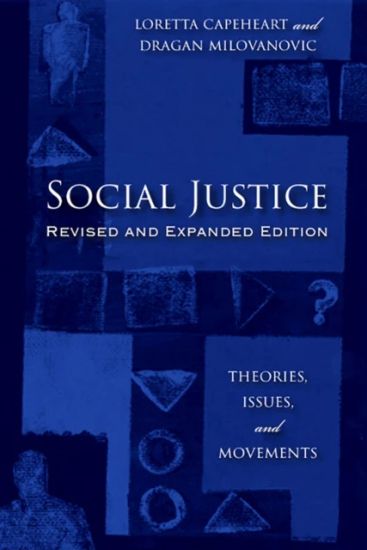
Social Justice

Social Justice

Loretta Capeheart; Dragan Milovanovic

Rutgers University Press
2020
nidottu
An eye for an eye, the balance of the scales – for centuries, these and other traditional concepts exemplified the public’s perception of justice. Today, popular culture, including television shows like Law and Order, informs the public’s vision. But do age-old symbols, portrayals in the media, and existing systems truly represent justice in all of its nuanced forms, or do we need to think beyond these notions? The second edition of Social Justice: Theories, Issues, and Movements responds to the need for a comprehensive introduction to these issues. Theories of social justice are presented in an accessible fashion to encourage engagement of students, activists, and scholars with these important lines of inquiry. Issues are analyzed utilizing various theories for furthering engagement in possibilities. Struggles for justice -- from legal cases to on the ground movements -- are presented for historical context and to inform the way forward.
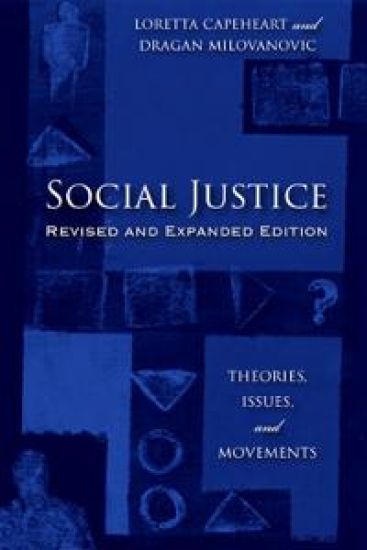
Social Justice

Social Justice

Loretta Capeheart; Dragan Milovanovic

Rutgers University Press
2020
sidottu
An eye for an eye, the balance of the scales – for centuries, these and other traditional concepts exemplified the public’s perception of justice. Today, popular culture, including television shows like Law and Order, informs the public’s vision. But do age-old symbols, portrayals in the media, and existing systems truly represent justice in all of its nuanced forms, or do we need to think beyond these notions? The second edition of Social Justice: Theories, Issues, and Movements responds to the need for a comprehensive introduction to these issues. Theories of social justice are presented in an accessible fashion to encourage engagement of students, activists, and scholars with these important lines of inquiry. Issues are analyzed utilizing various theories for furthering engagement in possibilities. Struggles for justice -- from legal cases to on the ground movements -- are presented for historical context and to inform the way forward.

Richard Quinney

Richard Quinney

Clemens Bartollas; Dragan Milovanovic

Springer Nature Switzerland AG
2019
sidottu
This book traces the life course of Richard Quinney, one of the most cited authors in the social sciences and a key figure in the development of critical criminology in the 70s, 80s and 90s. It provides a look into his personal thoughts in becoming a 'radical' criminologist and situates it in his various experiences, questioning, and shifts in his journey through life. Richard has contributed to a profound paradigm shift in criminology, beginning with his book, The Social Reality of Crime (1970), but also to peacemaking criminology as well as peace studies. He has also written several books via an autoethnography approach and has presented a number of photograph presentations for which he has received awards. It traces his early development on the family farm in Wisconsin to his travels in higher academe. It gives a personal perspective in becoming not only a radical criminologist, an accomplished writer in auto-ethnography, visual sociology, and photography but also how his continuous questioning of the meaning of it all came to fruition with profound insights about what it is to be human. The book will be inspirational to not only seasoned veterans in criminology, but also to emerging scholars, to undergrads and grads, showing them the struggles that come in 'making it'.
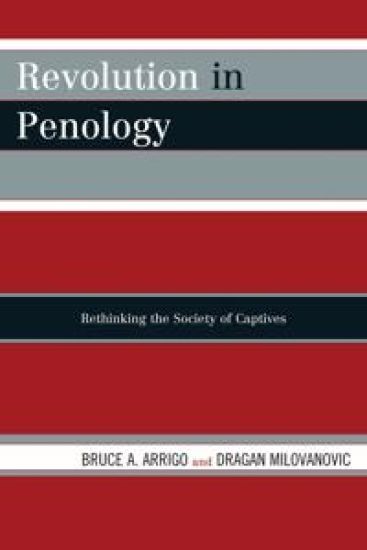
Revolution in Penology

Revolution in Penology

Bruce A. Arrigo; Dragan Milovanovic

Rowman Littlefield Publishers
2010
nidottu
Revolution in Penology is a thoroughly original and thought-provoking critique of penal harm, the recursive pains of imprisonment cycle, and the normalization of violence. Relying on selected insights derived from continental philosophy, cultural studies, and chaos theory, internationally renowned social theorists, Bruce A. Arrigo and Dragan Milovanovic, deconstruct the human agency/social structure duality that sustains the prison form, its parts and segments understood as correctional principles/practices, and the prison industrial complex that is informed by and stands above them all.
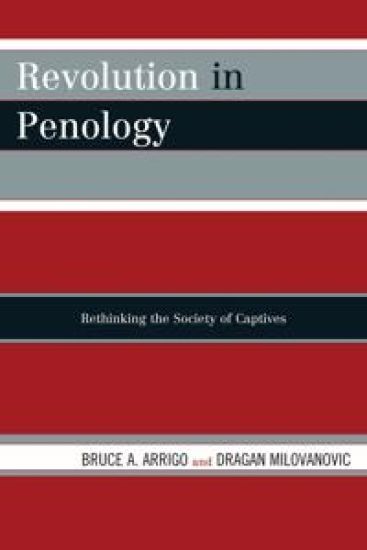
Revolution in Penology

Revolution in Penology

Bruce A. Arrigo; Dragan Milovanovic

Rowman Littlefield Publishers
2008
sidottu
Revolution in Penology is a thoroughly original and thought-provoking critique of penal harm, the recursive pains of imprisonment cycle, and the normalization of violence. Relying on selected insights derived from continental philosophy, cultural studies, and chaos theory, internationally renowned social theorists, Bruce A. Arrigo and Dragan Milovanovic, deconstruct the human agency/social structure duality that sustains the prison form, its parts and segments understood as correctional principles/practices, and the prison industrial complex that is informed by and stands above them all.
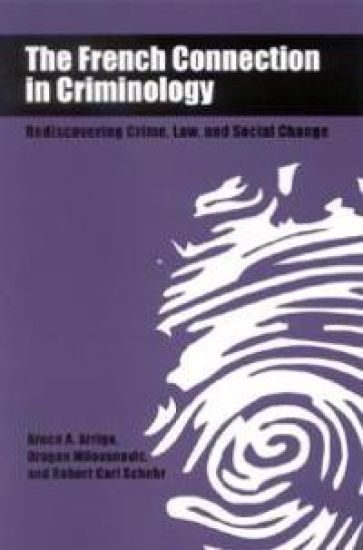
The French Connection in Criminology

The French Connection in Criminology

Bruce A. Arrigo; Dragan Milovanovic; Robert Carl Schehr

State University of New York Press
2005
pokkari
Brings the insights of postmodernism to the concerns of criminology and includes examples of how social theory can function in the real-world realm of criminal law. Winner of the 2005 Outstanding Book Award presented by the Crime and Juvenile Delinquency Division of the Society for the Study of Social Problems Winner of the 2005 Outstanding Book Award presented by the Crime and Juvenile Delinquency Division of the Society for the Study of Social Problems This is the first comprehensive, accessible, and integrative overview of postmodernism's contribution to law, criminology, and social justice. The book begins by reviewing the major contributions of eleven prominent figures responsible for the development of French postmodern social theory. This "first" wave includes Roland Barthes, Jean Baudrillard, Hélène Cixous, Gilles Deleuze, Jacques Derrida, Michel Foucault, Félix Guattari, Luce Irigaray, Julia Kristeva, Jacques Lacan, and Jean-François Lyotard. Their respective insights are then linked to "second" wave scholars who have appropriated their conceptualizations and applied them to pressing issues in law, crime, and social justice research. Compelling and concrete examples are provided for how affirmative and integrative postmodern inquiry can function meaningfully in the world of criminal justice. Topics explored include confinement law and prison resistance; critical race theory and a jurisprudence of color; media/literary studies and feminism; restorative justice and victim-offender mediation processes; and the emergence of social movements, including innocence projects and intentional communities.
Critical Criminology at the Edge

Critical Criminology at the Edge

Dragan Milovanovic

Praeger Publishers Inc
2002
sidottu
This study introduces key emerging perspectives in postmodern analysis and discusses how they might be integrated, synthesized, and applied in criminology, law, and social justice. Milovanovic first familiarizes readers with discourse analysis (Lacanian), chaos theory, catastrophe theory, and edgework theory. Next, he covers various practical applications through literature and film, in client-lawyer practices, etc. These new critical perspectives will be invaluable tools for scholars in law, criminology, criminal justice, sociology, and law enforcement. These theories shed light on how nonmaterially motivated forms of crime, those that provide adrenalin rushes or excitement, can be understood. They help to explain the development of sudden forms of violence, such as criminal acts by disgruntled workers, as well as how mediation practices can curtail such escalating violence. Milovanovic also demonstrates how constitutive theorizing can serve as an umbrella integrative theory, which provides sufficient space for various syntheses. A case-in-point is how edgework theory (adrenalin rush, excitement, visceral experiences) can be understood in criminology and in the establishment of social justice.
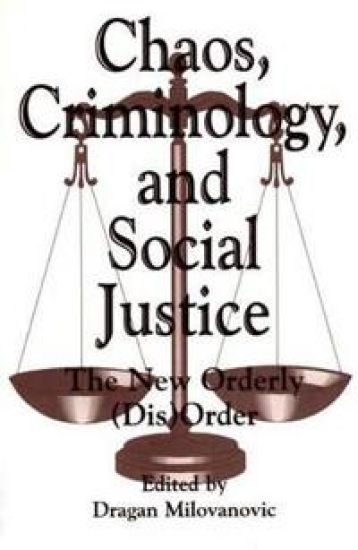
Chaos, Criminology, and Social Justice

Chaos, Criminology, and Social Justice

Dragan Milovanovic

Praeger Publishers Inc
1997
nidottu
Chaos theory challenges the presumption that the cosmos is orderly, linear, and predictable—but it does not imply pure randomness and chance events. Rather, chaos-informed postmodernist analysis introduces a new vision by celebrating unexpected, surprise, ironic, contradictory, and emergent elements. Scholars in many disciplines are taking this perspective as an alternative to the entrenched structural functionalism and empiricism rooted in linear science. In the early 1990s studies began to emerge applying chaos theory to criminology, law, and social change. This book brings together some of the key thinkers in these areas. Part I situates chaos theory as a constitutive thread in contemporary critical thought in criminology and law. It seeks to provide the reader with a sensitivity to how chaos theory fits within the postmodern perspective and an understanding of its conceptual tools. Part II comprises chapters on applying the chaos perspective to critical criminology and law and, beyond, to peacemaking. Part III presents studies in chaos-informed perspectives on new social movement theory, social change, and the development of social justice. While the book emphasizes the usefulness of the conceptual tools of chaos theory in critical criminology and law, its ultimate goal goes beyond theory-building to provide vistas for understanding the contemporary social scene and for the development of the new just society.
Chaos, Criminology, and Social Justice

Chaos, Criminology, and Social Justice

Dragan Milovanovic

Praeger Publishers Inc
1997
sidottu
Chaos theory challenges the presumption that the cosmos is orderly, linear, and predictable—but it does not imply pure randomness and chance events. Rather, chaos-informed postmodernist analysis introduces a new vision by celebrating unexpected, surprise, ironic, contradictory, and emergent elements. Scholars in many disciplines are taking this perspective as an alternative to the entrenched structural functionalism and empiricism rooted in linear science. In the early 1990s studies began to emerge applying chaos theory to criminology, law, and social change. This book brings together some of the key thinkers in these areas. Part I situates chaos theory as a constitutive thread in contemporary critical thought in criminology and law. It seeks to provide the reader with a sensitivity to how chaos theory fits within the postmodern perspective and an understanding of its conceptual tools. Part II comprises chapters on applying the chaos perspective to critical criminology and law and, beyond, to peacemaking. Part III presents studies in chaos-informed perspectives on new social movement theory, social change, and the development of social justice. While the book emphasizes the usefulness of the conceptual tools of chaos theory in critical criminology and law, its ultimate goal goes beyond theory-building to provide vistas for understanding the contemporary social scene and for the development of the new just society.
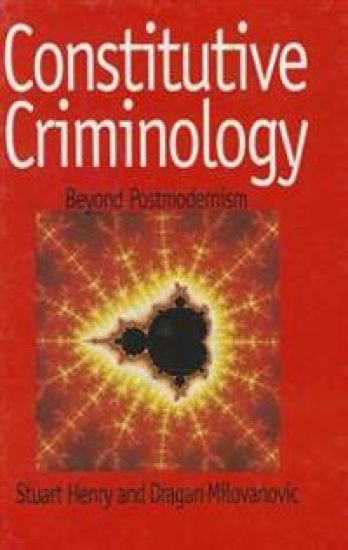
Constitutive Criminology

Constitutive Criminology

Stuart Henry; Dragan Milovanovic

SAGE Publications Ltd
1996
sidottu
Constitutive Criminology offers an affirmative, holistic approach to the study of crime. Taking as its starting point that individuals not only shape the world but are shaped by it, this book argues that the behaviours of those who offend and victimize others cannot be understood in isolation from the society of which they are a part. Instead of setting out to identify factors that cause offending, constitutive criminology examines the co-production of crime by human subjects and by the social and organizational structures that humans develop. The implications are, first, that crime must be deconstructed as a recurrent discursive process and, secondly, that conscious attempts must be made at reconstruction with a view to preventing recurrence. In constrast with the sceptical versions of postmodernism that pervade the social sciences and humanities Stuart Henry and Dragan Milovanovic focus on reconstruction and redirection. Drawing together disparate perspectives,they analyze a number of key themes, including: human nature and behaviour; society and social order; the role of the law; the definitions of crime; crime causation; and justice policy and practice.
Constitutive Criminology

Constitutive Criminology

Stuart Henry; Dragan Milovanovic

SAGE Publications Ltd
1995
nidottu
Constitutive Criminology offers an affirmative, holistic approach to the study of crime. Taking as its starting point that individuals not only shape the world but are shaped by it, this book argues that the behaviours of those who offend and victimize others cannot be understood in isolation from the society of which they are a part. Instead of setting out to identify factors that cause offending, constitutive criminology examines the co-production of crime by human subjects and by the social and organizational structures that humans develop. The implications are, first, that crime must be deconstructed as a recurrent discursive process and, secondly, that conscious attempts must be made at reconstruction with a view to preventing recurrence. In constrast with the sceptical versions of postmodernism that pervade the social sciences and humanities Stuart Henry and Dragan Milovanovic focus on reconstruction and redirection. Drawing together disparate perspectives,they analyze a number of key themes, including: human nature and behaviour; society and social order; the role of the law; the definitions of crime; crime causation; and justice policy and practice.