Kirjojen hintavertailu – 12 859 819 kirjaa ja 27 kauppaa

Kirjailija

Dumitru Baleanu

Kirjat ja teokset yhdessä paikassa: 8 kirjaa, julkaisuja vuosilta 2011–2022, suosituimpiin kuuluu Local Fractional Integral Transforms and Their Applications. Vertaile teosten hintoja ja tarkista saatavuus suomalaisista kirjakaupoista.

8 kirjaa

Kirjojen julkaisuvuodet: 2011–2022.

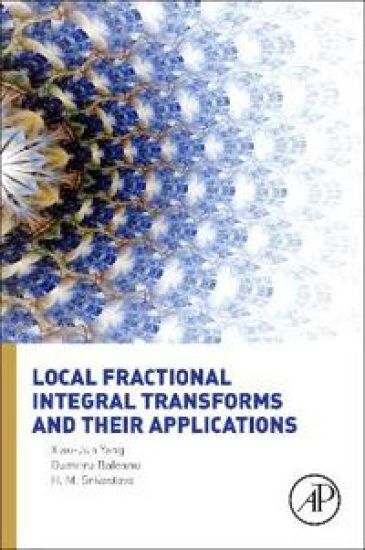
Local Fractional Integral Transforms and Their Applications

Local Fractional Integral Transforms and Their Applications

Xiao-Jun Yang; Dumitru Baleanu; Hari M Srivastava

Academic Press Inc
2015
sidottu
Local Fractional Integral Transforms and Their Applications provides information on how local fractional calculus has been successfully applied to describe the numerous widespread real-world phenomena in the fields of physical sciences and engineering sciences that involve non-differentiable behaviors. The methods of integral transforms via local fractional calculus have been used to solve various local fractional ordinary and local fractional partial differential equations and also to figure out the presence of the fractal phenomenon. The book presents the basics of the local fractional derivative operators and investigates some new results in the area of local integral transforms.
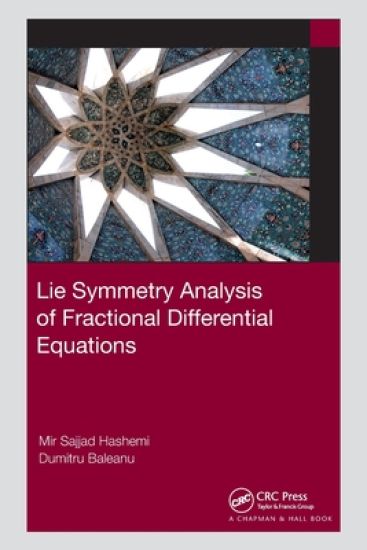
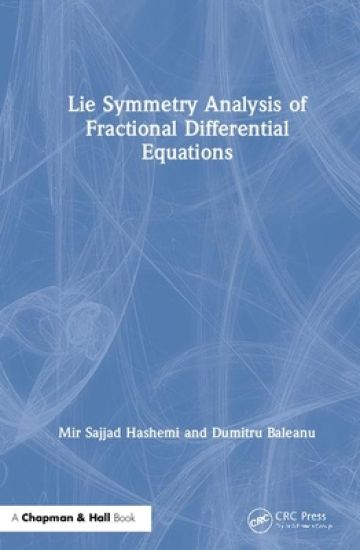
Lie Symmetry Analysis of Fractional Differential Equations

Lie Symmetry Analysis of Fractional Differential Equations

Mir Sajjad Hashemi; Dumitru Baleanu

TAYLOR FRANCIS LTD
2022
nidottu
The trajectory of fractional calculus has undergone several periods of intensive development, both in pure and applied sciences. During the last few decades fractional calculus has also been associated with the power law effects and its various applications. It is a natural to ask if fractional calculus, as a nonlocal calculus, can produce new results within the well-established field of Lie symmetries and their applications. In Lie Symmetry Analysis of Fractional Differential Equations the authors try to answer this vital question by analyzing different aspects of fractional Lie symmetries and related conservation laws. Finding the exact solutions of a given fractional partial differential equation is not an easy task, but is one that the authors seek to grapple with here. The book also includes generalization of Lie symmetries for fractional integro differential equations. Features Provides a solid basis for understanding fractional calculus, before going on to explore in detail Lie Symmetries and their applications Useful for PhD and postdoc graduates, as well as for all mathematicians and applied researchers who use the powerful concept of Lie symmetries Filled with various examples to aid understanding of the topics
Lie Symmetry Analysis of Fractional Differential Equations

Lie Symmetry Analysis of Fractional Differential Equations

Mir Sajjad Hashemi; Dumitru Baleanu

CRC Press
2020
sidottu
The trajectory of fractional calculus has undergone several periods of intensive development, both in pure and applied sciences. During the last few decades fractional calculus has also been associated with the power law effects and its various applications. It is a natural to ask if fractional calculus, as a nonlocal calculus, can produce new results within the well-established field of Lie symmetries and their applications. In Lie Symmetry Analysis of Fractional Differential Equations the authors try to answer this vital question by analyzing different aspects of fractional Lie symmetries and related conservation laws. Finding the exact solutions of a given fractional partial differential equation is not an easy task, but is one that the authors seek to grapple with here. The book also includes generalization of Lie symmetries for fractional integro differential equations. Features Provides a solid basis for understanding fractional calculus, before going on to explore in detail Lie Symmetries and their applications Useful for PhD and postdoc graduates, as well as for all mathematicians and applied researchers who use the powerful concept of Lie symmetries Filled with various examples to aid understanding of the topics
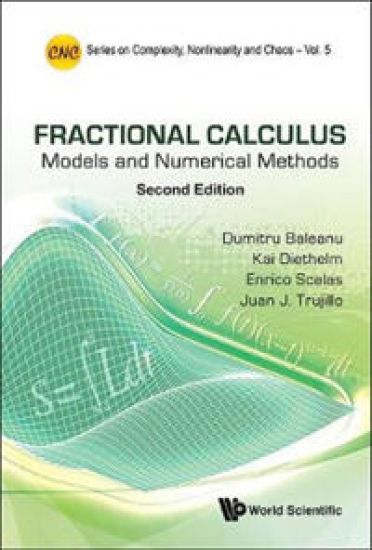
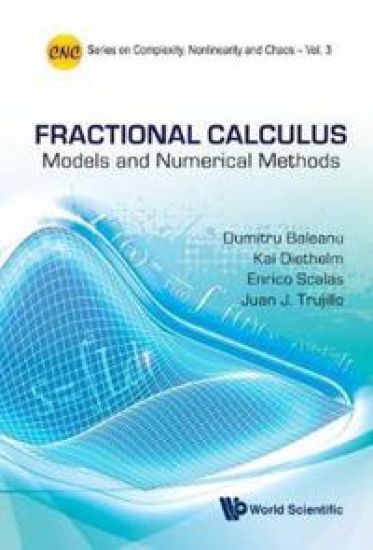
Fractional Calculus: Models And Numerical Methods

Fractional Calculus: Models And Numerical Methods

Juan J Trujillo; Enrico Scalas; Kai Diethelm; Dumitru Baleanu

World Scientific Publishing Co Pte Ltd
2016
sidottu
This book will give readers the possibility of finding very important mathematical tools for working with fractional models and solving fractional differential equations, such as a generalization of Stirling numbers in the framework of fractional calculus and a set of efficient numerical methods. Moreover, we will introduce some applied topics, in particular fractional variational methods which are used in physics, engineering or economics. We will also discuss the relationship between semi-Markov continuous-time random walks and the space-time fractional diffusion equation, which generalizes the usual theory relating random walks to the diffusion equation. These methods can be applied in finance, to model tick-by-tick (log)-price fluctuations, in insurance theory, to study ruin, as well as in macroeconomics as prototypical growth models. All these topics are complementary to what is dealt with in existing books on fractional calculus and its applications. This book will keep in mind the trade-off between full mathematical rigor and the needs of readers coming from different applied areas of science and engineering. In particular, the numerical methods listed in the book are presented in a readily accessible way that immediately allows the readers to implement them on a computer in a programming language of their choice. The second edition of the book has been expanded and now includes a discussion of additional, newly developed numerical methods for fractional calculus and a chapter on the application of fractional calculus for modeling processes in the life sciences.
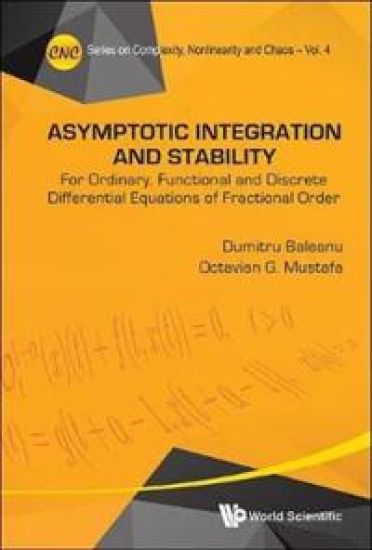
Asymptotic Integration And Stability: For Ordinary, Functional And Discrete Differential Equations Of Fractional Order
This volume presents several important and recent contributions to the emerging field of fractional differential equations in a self-contained manner. It deals with new results on existence, uniqueness and multiplicity, smoothness, asymptotic development, and stability of solutions. The new topics in the field of fractional calculus include also the Mittag-Leffler and Razumikhin stability, stability of a class of discrete fractional non-autonomous systems, asymptotic integration with a priori given coefficients, intervals of disconjugacy (non-oscillation), existence of Lp solutions for various linear, and nonlinear fractional differential equations.
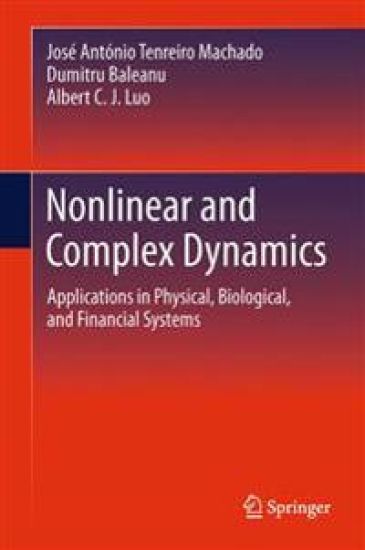
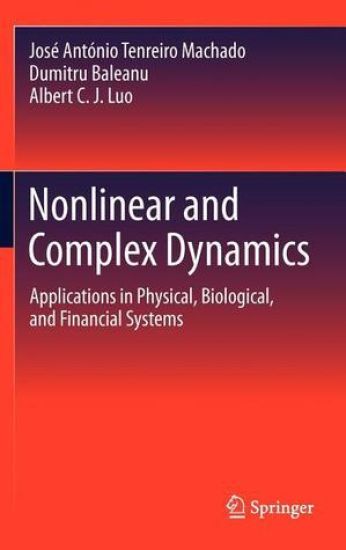
Nonlinear and Complex Dynamics

Nonlinear and Complex Dynamics

José António Tenreiro Machado; Dumitru Baleanu; Albert C. J. Luo

Springer-Verlag New York Inc.
2014
nidottu
Nonlinear Dynamics of Complex Systems describes chaos, fractal and stochasticities within celestial mechanics, financial systems and biochemical systems. Part I discusses methods and applications in celestial systems and new results in such areas as low energy impact dynamics, low-thrust planar trajectories to the moon and earth-to-halo transfers in the sun, earth and moon. Part II presents the dynamics of complex systems including bio-systems, neural systems, chemical systems and hydro-dynamical systems. Finally, Part III covers economic and financial systems including market uncertainty, inflation, economic activity and foreign competition and the role of nonlinear dynamics in each.
Fractional Calculus: Models And Numerical Methods

Fractional Calculus: Models And Numerical Methods

Dumitru Baleanu; Kai Diethelm; Enrico Scalas; Juan J Trujillo

World Scientific Publishing Co Pte Ltd
2012
sidottu
The subject of fractional calculus and its applications (that is, convolution-type pseudo-differential operators including integrals and derivatives of any arbitrary real or complex order) has gained considerable popularity and importance during the past three decades or so, mainly due to its applications in diverse fields of science and engineering. These operators have been used to model problems with anomalous dynamics, however, they also are an effective tool as filters and controllers, and they can be applied to write complicated functions in terms of fractional integrals or derivatives of elementary functions, and so on. This book will give readers the possibility of finding very important mathematical tools for working with fractional models and solving fractional differential equations, such as a generalization of Stirling numbers in the framework of fractional calculus and a set of efficient numerical methods. Moreover, we will introduce some applied topics, in particular fractional variational methods which are used in physics, engineering or economics. We will also discuss the relationship between semi-Markov continuous-time random walks and the space-time fractional diffusion equation, which generalizes the usual theory relating random walks to the diffusion equation. These methods can be applied in finance, to model tick-by-tick (log)-price fluctuations, in insurance theory, to study ruin, as well as in macroeconomics as prototypical growth models. All these topics are complementary to what is dealt with in existing books on fractional calculus and its applications. This book was written with a trade-off in mind between full mathematical rigor and the needs of readers coming from different applied areas of science and engineering. In particular, the numerical methods listed in the book are presented in a readily accessible way that immediately allows the readers to implement them on a computer in a programming language of their choice. Numerical code is also provided.
Nonlinear and Complex Dynamics

Nonlinear and Complex Dynamics

José António Tenreiro Machado; Dumitru Baleanu; Albert C. J. Luo

Springer-Verlag New York Inc.
2011
sidottu
Nonlinear Dynamics of Complex Systems describes chaos, fractal and stochasticities within celestial mechanics, financial systems and biochemical systems. Part I discusses methods and applications in celestial systems and new results in such areas as low energy impact dynamics, low-thrust planar trajectories to the moon and earth-to-halo transfers in the sun, earth and moon. Part II presents the dynamics of complex systems including bio-systems, neural systems, chemical systems and hydro-dynamical systems. Finally, Part III covers economic and financial systems including market uncertainty, inflation, economic activity and foreign competition and the role of nonlinear dynamics in each.