Kirjojen hintavertailu – 12 903 724 kirjaa ja 27 kauppaa

Kirjailija

Duncan Macrae

Kirjat ja teokset yhdessä paikassa: 3 kirjaa, julkaisuja vuosilta 1988–2016, suosituimpiin kuuluu Policies for America's Public Schools. Vertaile teosten hintoja ja tarkista saatavuus suomalaisista kirjakaupoista.

3 kirjaa

Kirjojen julkaisuvuodet: 1988–2016.

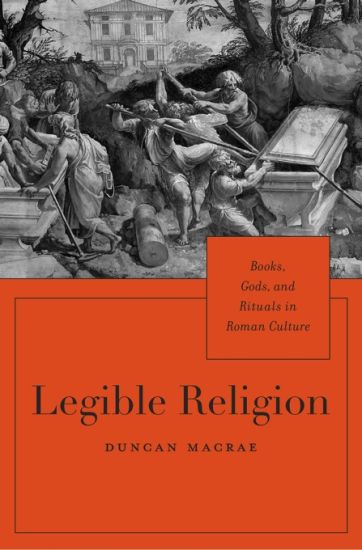
Legible Religion

Legible Religion

Duncan MacRae

Harvard University Press
2016
sidottu
Scholars have long emphasized the importance of scripture in studying religion, tacitly separating a few privileged “religions of the Book” from faiths lacking sacred texts, including ancient Roman religion. Looking beyond this distinction, Duncan MacRae delves into Roman religious culture to grapple with a central question: what was the significance of books in a religion without scripture? In the last two centuries BCE, Varro and other learned Roman authors wrote treatises on the nature of the Roman gods and the rituals devoted to them. Although these books were not sacred texts, they made Roman religion legible in ways analogous to scripture-based faiths such as Judaism and Christianity. Rather than reflect the astonishingly varied polytheistic practices of the regions under Roman sway, the contents of the books comprise Rome’s “civil theology”—not a description of an official state religion but one limited to the civic role of religion in Roman life. An extended comparison between Roman books and the Mishnah—an early Rabbinic compilation of Jewish practice and law—highlights the important role of nonscriptural texts in the demarcation of religious systems. Tracing the subsequent influence of Roman religious texts from the late first century BCE to early fifth century CE, Legible Religion shows how two major developments—the establishment of the Roman imperial monarchy and the rise of the Christian Church—shaped the reception and interpretation of Roman civil theology.
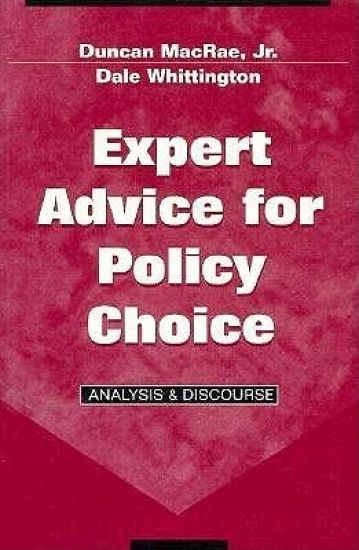
Expert Advice for Policy Choice

Expert Advice for Policy Choice

Duncan MacRae; Dale Whittington

Georgetown University Press
1997
pokkari
Economic reasoning has thus far dominated the field of public policy analysis. This new introduction to the field posits that policy analysis should have both a broader interdisciplinary base - including criteria from such fields as political science, sociology, law, and philosophy, as well as economics - and also a broader audience in order to foster democratic debate. To achieve these goals, MacRae and Whittington have organized their textbook around the construction of decision matrices using multiple criteria, exploring the uses of the decision matrix formulation more fully than other texts. They describe how to set up the matrix, fill in cells and combine criteria, and use it as an aid for decision making. They show how ethical assessment of the affects that alternatives have on various parties differs from political analysis, and then they extend the use of the decision matrix to consider alternatives by affected parties, periods of time, or combined factors. The authors also thoughtfully address the role of expert advice in the policy process, widening the scope of the field to describe a complex system for the creation and use of knowledge in a democracy. An extended case study of HIV/AIDS policy follows each chapter (in installments), immediately illustrating the application of the material. The book also contains a glossary. "Expert Advice for Policy Choice" provides a new basis for graduate education in public policy analysis and can also serve as a text in planning, evaluation research, or public administration. In addition, it will be of interest to students and professionals wishing to aid policy choice who work in such fields as sociology, political science, psychology, public health, and social work.
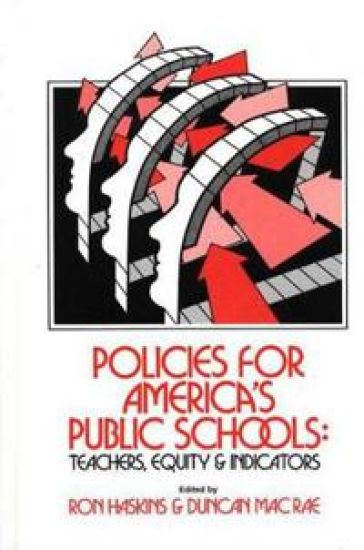
Policies for America's Public Schools

Policies for America's Public Schools

Ron Haskins; Duncan Macrae

Praeger Publishers Inc
1988
sidottu
This volume discusses teacher training, pay and incentives, equity and diversity among the student population, and the use of indicators to assess educational progress and to inform decision making. Chapters in each section emphasize policies that schools should adopt to address the respective issues.