Kirjojen hintavertailu – 12 903 725 kirjaa ja 27 kauppaa

Kirjailija

E. Bradford Burns

Kirjat ja teokset yhdessä paikassa: 5 kirjaa, julkaisuja vuosilta 1979–1993, suosituimpiin kuuluu Patriarch and Folk. Vertaile teosten hintoja ja tarkista saatavuus suomalaisista kirjakaupoista.

Nimi esiintyy myös muodoissa: E Bradford Burns

5 kirjaa

Kirjojen julkaisuvuodet: 1979–1993.

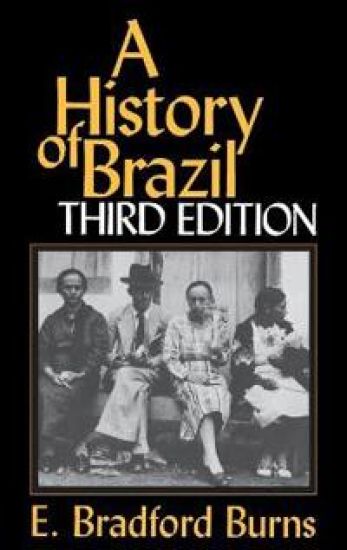
A History of Brazil

A History of Brazil

E. Bradford Burns

Columbia University Press
1993
pokkari
Here is a new edition of the book generally acclaimed as the best single-volume history of Brazil. It has been thoroughly revised and updated to include expanded treatment of intellectual, social, and popular history, and to provide increased coverage of labor, blacks, women, and the military in Brazilian history. Complete in breadth and chronological span, A History of Brazil is a panoramic interpretation of the Brazilian past from discovery to the present that treats the economic, social, cultural, and political evolution of Latin America's largest nation.
A History of Brazil

A History of Brazil

E. Bradford Burns

Columbia University Press
1993
sidottu
Here is a new edition of the book generally acclaimed as the best single-volume history of Brazil. It has been thoroughly revised and updated to include expanded treatment of intellectual, social, and popular history, and to provide increased coverage of labor, blacks, women, and the military in Brazilian history. Complete in breadth and chronological span, A History of Brazil is a panoramic interpretation of the Brazilian past from discovery to the present that treats the economic, social, cultural, and political evolution of Latin America's largest nation.
Patriarch and Folk

Patriarch and Folk

E Bradford Burns

Harvard University Press
1991
sidottu
The painful sixty-year process that brought Nicaragua from colonial status to incipient nation-state is the focus of this fresh examination of inner struggle in a key isthmian country. E. Bradford Burns shows how Nicaragua's elite was able to consolidate control of the state and form a stable government, resolving the bitter rivalry between the two cities Le&oacu;n and Granada, but at the same time began the destruction of the rich folk culture of the Indians, eventually reducing them to an impoverished and powerless agrarian proletariat. The history of this nation echoes that of other Latin American lands yet is peculiarly its own. Nicaragua emerged not from a war against Spain but rather from the violent interactions among the patriarchs of the dominant families, the communities of common people, and foreigners. Burns is eloquent on the subject of American adventurism in Nicaragua, which culminated in the outrageous expedition of the filibuster William Walker and his band of mercenaries in the 1850s. It was a major breach of the trust and friendship Nicaraguans had extended to the United States, and the Nicaraguans' subsequent victory over the foreign invaders helped forge their long-delayed sense of national unity. The decimation of Nicaraguan archives for the period prior to 1858 renders the study of early nineteenth-century history especially challenging, but Burns has made ingenious use of secondary sources and the few published primary materials available, including travelers' accounts and other memoirs, newspapers, government reports, and diplomatic correspondence. He provides valuable insight into Nicaraguan society of the time, of both the elite and the folk, including a perceptive section on the status and activities of women and the family in society. This book will appeal not only to professional historians but to general readers as well.

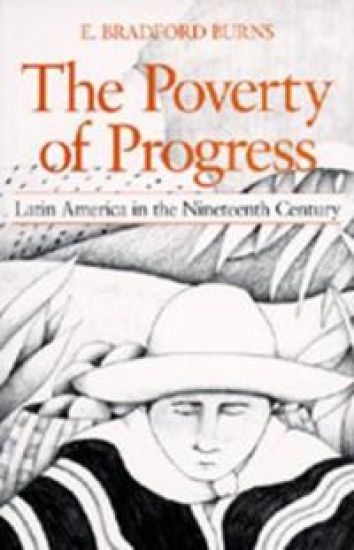
The Poverty of Progress

The Poverty of Progress

E. Bradford Burns

University of California Press
1983
pokkari
From the Preface by Bradford Burns:If this essay succeeds, it will open an interpretive window providing a different perspective of Latin America's recent past. At first glance, the view might seem to be of the conventional landscape of modernization, but I hope a steady gaze will reveal it to be far vaster and more complex. For one thing, rather than enumerating the benefits accruing to Latin America as modernization became a dominant feature of the social, economic, and political life of the region, this essay regards the imposition of modernization as the catalyst of a devastating cultural struggle and as a barrier to Latin America's development. Clearly if a window to the past is opened by this essay, then so too is a new door to controversy. After most of the nations of Latin America gained political independence, their leaders rapidly accelerated trends more leisurely under way since the closing decades of the eighteenth century: the importation of technology and ideas with their accompanying values from Western Europe north of the Pyrenees and the full entrance into the world's capitalistic marketplace. Such trends shaped those new nations more profoundly than their advocates probably had realized possible. Their promoters moved forward steadfastly within the legacy of some basic institutions bequeathed by centuries of Iberian rule. That combination of hoary institutions with newer, non-Iberian technology, values, and ideas forged contemporary Latin America with its enigma of overwhelming poverty amid potential plenty. This essay emphasizes that the victory of the European oriented ruling elites over the Latin American folk with their community values resulted only after a long and violent struggle, which characterized most of the nineteenth century. Whatever advantages might have resulted from the success of the elites, the victory also fastened two dominant and interrelated characteristics on contemporary Latin America: a deepening dependency and the declining quality of life for the majority.
Elites, Masses, and Modernization in Latin America, 1850–1930

Elites, Masses, and Modernization in Latin America, 1850–1930

E. Bradford Burns; Thomas E. Skidmore

University of Texas Press
1979
nidottu
The interactions between the elites and the lower classes of Latin America are explored from the divergent perspectives of three eminent historians in this volume. The result is a counterbalance of viewpoints on the urban and the rural, the rich and the poor, and the Europeanized and the traditional of Latin America during the late nineteenth and early twentieth centuries. E. Bradford Burns advances the view that two cultures were in conflict in nineteenth-century Latin America: that of the modernizing, European-oriented elite, and that of the “common folk” of mixed racial background who lived close to the earth. Thomas E. Skidmore discusses the emerging field of labor history in twentieth-century Latin America, suggesting that the historical roots of today’s exacerbated tensions lie in the secular struggle of army against workers that he describes. In the introduction, Richard Graham takes issue with both authors on certain basic premises and points out implications of their essays for the understanding of North American as well as Latin American history.