Kirjojen hintavertailu – 12 903 742 kirjaa ja 27 kauppaa

Kirjailija

E. J. Dionne

Kirjat ja teokset yhdessä paikassa: 10 kirjaa, julkaisuja vuosilta 2001–2025, suosituimpiin kuuluu The Election of 2000. Vertaile teosten hintoja ja tarkista saatavuus suomalaisista kirjakaupoista.

Nimi esiintyy myös muodoissa: E.J. Dionne, E J Dionne

10 kirjaa

Kirjojen julkaisuvuodet: 2001–2025.

The Election of 2000

The Election of 2000

E. J. Dionne; Gerald M. (EDT) Pomper; William G. Mayer

Chatham House Publishers Inc.,U.S.
2001
pokkari
Continuing a tradition of excellence in postelection analysis, Gerald M. Pomper leads a distinguished team of experts offering timely and insightful assessment of the first presidential election of the 21st century. After a relatively uneventful campaign season, the American electorate divided evenly between two similar candidates who raised and spent record sums of money. Election Day was followed by an unprecedented period of uncertainty that was finally resolved in a controversial judicial decision. How all this happened and why is discussed by this dynamic lineup of election specialists. Gerald M. Pomper (Rutgers University), author of Passions and Interests: Political Party Concepts of American Democracy. Anthony Corrado (Colby College), author of Campaign Finance Reform and Paying for Presidents. E. J. Dionne Jr. (Washington Post), author of Why Americans Hate Politics and They Only Look Dead. Kathleen A. Frankovic, Director of Surveys and producer, CBS News. Paul S. Herrnson (University of Maryland), author of Congressional Elections: Campaigning at Home and in WashingtonMarjorie Randon Hershey (Indiana University), author of Running for Office. William G. Mayer (Northeastern University), author of In Pursuit of the White House 2000: How We Choose Our Presidential Nominees. Monika L. McDermott, Manager of Surveys for CBS News for 2000 Election. Wilson Carey McWilliams (Rutgers University), author of Beyond the Politics of Disappointment: American Elections, 1980-1998.
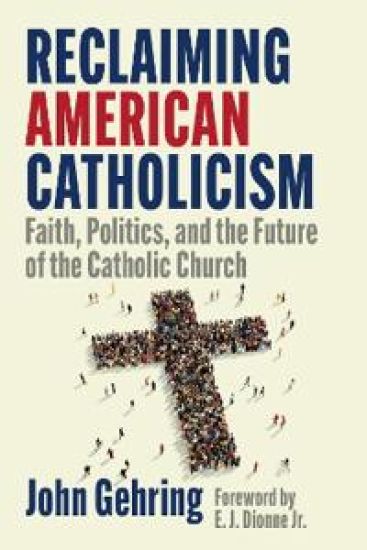
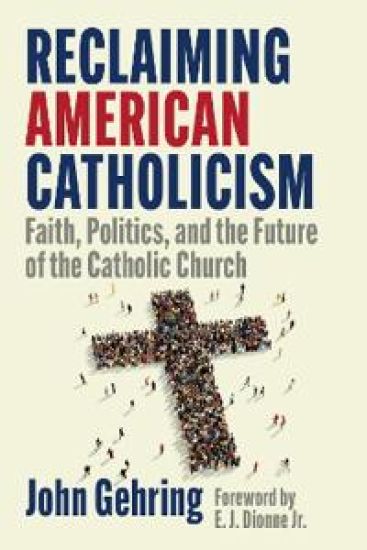
Reclaiming American Catholicism

Reclaiming American Catholicism

John Gehring; E. J. Dionne

GEORGETOWN UNIVERSITY PRESS
2025
sidottu
A rich portrait of American Catholicism at a crossroads between crisis and opportunity The most vocal leaders in the U. S. Catholic hierarchy today embrace a culture-war Catholicism. Reclaiming American Catholicism makes the argument that recalibrating the Church's engagement with politics and public life is vital for both the Church and the country. Gehring illuminates the Church that Pope Francis envisioned—"bruised, hurting and dirty because it has been out on the streets"—through stories of Catholic advocates working on the border, young Catholics who question Church teachings but are active in social justice campaigns, LGBTQ+ Catholics within a Church that does not accept their full humanity, and seminarians who work in the fields with migrants as part of their religious formation. This book offers a hopeful vision for the Church at a time when the Catholic social justice tradition is more relevant than ever.
Reclaiming American Catholicism

Reclaiming American Catholicism

John Gehring; E.J. Dionne

GEORGETOWN UNIVERSITY PRESS
2025
pokkari
A rich portrait of American Catholicism at a crossroads between crisis and opportunity The most vocal leaders in the US Catholic hierarchy today embrace a culture-war Catholicism that pits them against the pastoral priorities of Pope Francis and many Catholics in the pews. Reclaiming American Catholicism makes the argument that recalibrating the Church's engagement with politics and public life is vital for both the Church and the country. Gehring illuminates the Church that Pope Francis envisions—"bruised, hurting and dirty because it has been out on the streets"—through stories of Catholic advocates working on the border, young Catholics who question Church teachings but are active in social justice campaigns, LGBTQ+ Catholics within a Church that does not accept their full humanity, and seminarians who work in the fields with migrants as part of their religious formation. This book offers a hopeful vision for the Church at a time when the Catholic social justice tradition is more relevant than ever.
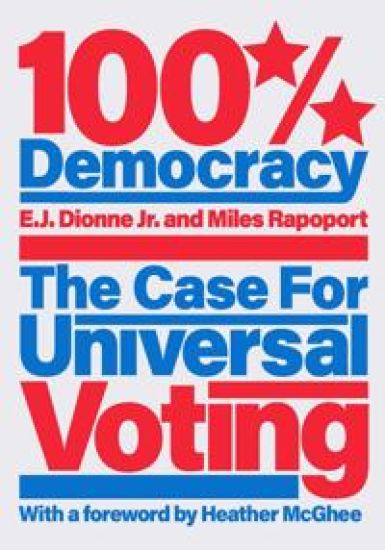
100% Democracy

100% Democracy

E.J. Dionne; Miles Rapoport; Heather McGhee

The New Press
2022
sidottu
A timely and paradigm-shifting argument that all members of a democracy must participate in elections, by a leading political expert and Washington Post journalist Americans are required to pay taxes, serve on juries, get their kids vaccinated, get driver’s licenses, and sometimes go to war for their country. So why not ask—or require—every American to vote? In 100% Democracy, E. J. Dionne and Miles Rapoport argue that universal participation in our elections should be a cornerstone of our system. It would be the surest way to protect against voter suppression and the active disenfranchisement of a large share of our citizens. And it would create a system true to the Declaration of Independence’s aspirations by calling for a government based on the consent of all of the governed. It’s not as radical or utopian as it sounds: in Australia, where everyone is required to vote (Australians can vote “none of the above,” but they have to show up), 91.9 percent of Australians voted in the last major election in 2019, versus 60.1 percent in America’s 2016 presidential race. Australia hosts voting-day parties and actively celebrates this key civic duty. It is time for the United States to take a major leap forward and recognize voting as both a fundamental civil right and a solemn civic duty required of every eligible U. S. citizen.
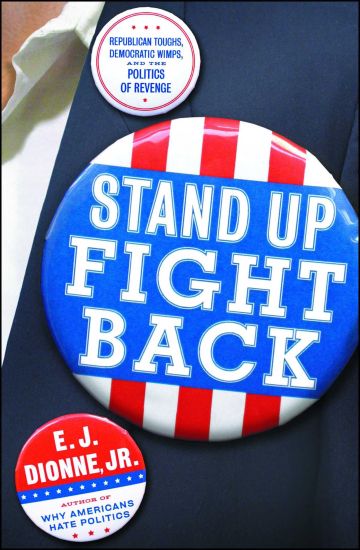
Stand Up Fight Back

Stand Up Fight Back

E J Dionne

SIMON SCHUSTER
2018
pokkari
One of our most visible, trenchant, and witty political commentators, the author of the bestselling Why Americans Hate Politics, offers a tough critique of President George W. Bush and the Democratic opposition on the eve of a landmark presidential election -- and points to a way out of cynicism and defeatism. With passion, clarity, and humor, E. J. Dionne describes today's political atmosphere as the bitterest he can remember. Never have Democrats been as frustrated by their inability to move the debate. The party of Roosevelt, Kennedy, and Clinton, Dionne says, is lost in pointless feuds, outdated strategies, and old arguments. Democrats have lost track of what they stand for so they don't know what they're fighting for and besides, they've forgotten how to fight back. In describing how Democrats, moderates, and liberals have failed to match Republicans and conservatives in commitment, resourcefulness, and clarity, Dionne invents what is likely to become a popular parlor game among the politically committed. In "The Wrong Stuff," he lists ten futile arguments -- big versus small government, for example -- that Democrats keep having with themselves. "The Right Stuff" focuses on ten arguments they should start making about taxes, business, and the role of government. Dionne zeroes in on how a floundering Bush administration used September 11 to politicize national security issues for partisan advantage. Enraged but intimidated by ruthless opponents, the Democratic party failed to find its voice on security issues and was soundly beaten in 2002. Drawing on some lessons from the 2004 primary campaigns, Dionne argues that anger and frustration have in fact awakened progressives to the need for innovation in organizing, in approaching an increasingly conservative media, and in formulating politically useful and plainly stated ideas. Learning from the conservative movement's successes, liberals have begun the work of reconstruction. The politics of revenge, Dionne argues persuasively, can give way to something better: a progressive patriotism built on hope and optimism about America's role in the world and its capacity to renew social justice at home.
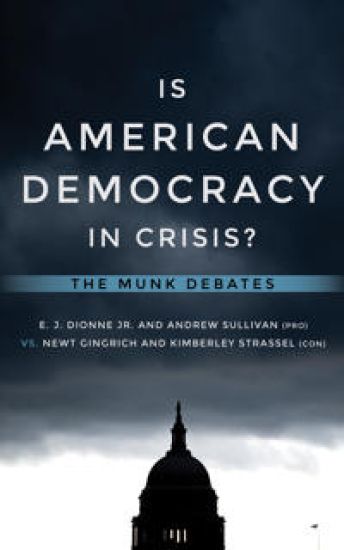
Is American Democracy in Crisis?

Is American Democracy in Crisis?

E.J. Dionne; Andrew Sullivan; Newt Gingrich; Kimberley Strassel

House of Anansi Press Ltd ,Canada
2018
pokkari
The twenty-first semi-annual Munk Debate pits award-winning journalist E. J. Dionne, Jr. and influential author and blogger Andrew Sullivan against former Speaker of the U. S. House of Representatives Newt Gingrich and bestselling author and editor Kimberley Strassel to debate the current crisis of American democracy.“Our country is now as close to crossing the line from democracy to autocracy as it has been in our lifetimes.” — E. J. Dionne, Jr. It is the public debate of the moment: is Donald Trump precipitating a crisis of American democracy? For some the answer is an emphatic “yes.” Trump’s disregard for the institutions and political norms of U. S. democracy is imperiling the Republic. The sooner his presidency collapses the sooner the healing can begin and the ship of state righted. For others Trump is not the villain in this drama. Rather, his young presidency is the conduit, not the cause, of Americans’ deep-seated anger towards a privileged and self-dealing Washington elite. Trump’s disruption of politics as usual is what America needs to start the process of restoring democracy by the people, for the people.
Why the Right Went Wrong: Conservatism--From Goldwater to Trump and Beyond
From the author of Why Americans Hate Politics, the New York Times bestselling and "notably fair-minded" (The New York Times Book Review), story of the GOP's fracturing--from the 1964 Goldwater takeover to the Trump spectacle. Why the Right Went Wrong offers an "up to the moment" (The Christian Science Monitor) historical view of the right since the 1960s. Its core contention is that American conservatism and the Republican Party took a wrong turn when they adopted Barry Goldwater's worldview during and after the 1964 campaign. The radicalism of today's conservatism is not the product of the Tea Party, Washington Post columnist E. J. Dionne writes. The Tea Partiers are the true heirs to Goldwater ideology. The purity movement did more than drive moderates out of the Republican Party--it beat back alternative definitions of conservatism. Since 1968, no conservative administration--not Nixon not Reagan not two Bushes--could live up to the rhetoric rooted in the Goldwater movement that began to reshape American politics fifty years ago. The collapse of the Nixon presidency led to the rise of Ronald Reagan, the defeat of George H. W. Bush, to Newt Gingrich's revolution. Bush initially undertook a partial modernization, preaching "compassionate conservatism" and a "Fourth Way" to Clinton's "Third Way." Conservatives quickly defined him as an advocate of "big government" and not conservative enough on spending, immigration, education, and Medicare. A return to the true faith was the only prescription on order. The result was the Tea Party, which Dionne says, was as much a reaction to Bush as to Obama. The state of the Republican party, controlled by the strictest base, is diminished, Dionne writes. It has become white and older in a country that is no longer that. It needs to come back to life for its own health and that of the country's, and in Why the Right Went Wrong, Dionne "expertly delineates where we are and how we got there" (Chicago Tribune)--and how to return.
Souled Out

Souled Out

E. J. Dionne

Princeton University Press
2009
pokkari
The religious and political winds are changing. Tens of millions of religious Americans are reclaiming faith from those who would abuse it for narrow, partisan, and ideological purposes. And more and more secular Americans are discovering common ground with believers on the great issues of social justice, peace, and the environment. In Souled Out, award-winning journalist and commentator E. J. Dionne explains why the era of the Religious Right--and the crude exploitation of faith for political advantage--is over. Based on years of research and writing, Souled Out shows that the end of the Religious Right doesn't signal the decline of evangelical Christianity but rather its disentanglement from a political machine that sold it out to a narrow electoral agenda of such causes as opposition to gay marriage and abortion. With insightful portraits of leading contemporary religious figures from Rick Warren and Richard Cizik to John Paul II and Benedict XVI, Dionne shows that our great religions have always preached a broad message of hope for more just human arrangements and refused to be mere props for the powers that be. Dionne also argues that the new atheist writers should be seen as a gift to believers, a demand that they live up to their proclaimed values and embrace scientific and philosophical inquiry in a spirit of "intellectual solidarity." Written in the tradition of Reinhold and H. Richard Niebuhr, Souled Out will help change how we think and talk about religion and politics in the post-Bush era.
Liberalism for a New Century

Liberalism for a New Century

E.J. Dionne

University of California Press
2007
pokkari
American liberalism today is in a state of confusion and disarray, with the 'L word' widely considered a term of derision. By examining both the historical past and the fractious present, "Liberalism for a New Century" restores a proud political tradition and carves out a formidable defense of its philosophical tenets. This manifesto for a New Liberalism issues an urgent and cogent call for the most important rethinking of its values since the late 1960s, when conservatives reenergized themselves after Barry Goldwater's infamous loss. The essays in this volume, most of them never before published, are written by a leading group of historians, journalists, and public intellectuals. Some of the nation's most highly respected liberal minds explore such topics as the classical liberal tradition, postmodernism's challenge to the American 'Enlightenment', the civil rights era, the influence of twentieth-century radicals on American liberalism, the 1950s, tolerance, the cold war, and whether liberalism should have a large and aggressive vision. One essay considers liberalism in Iran and what American liberals might learn from this movement. Fast-paced and encompassing such hot-button issues as the family and religion, here are ringside-seat arguments between people who don't often get to engage with one another: right-leaning liberals like Peter Berkowitz and John Patrick Diggins, and leftier liberals like Michael Tomasky and Mona Harrington. The result is a lively and stimulating collection that articulates a clear-minded alternative to the conservative ascendancy in American history and offers a timely and essential contribution to the growing national debate.
Why Americans Hate Politics

Why Americans Hate Politics

E. J. Dionne

Touchstone
2004
pokkari
One of our shrewdest political observers traces thirty years of volatile political history and finds that on point after point, liberals and conservatives are framing issues as a series of "false choices," making it impossible for politicians to solve problems, and alienating voters in the process.