Kirjojen hintavertailu – 12 876 103 kirjaa ja 26 kauppaa

Kirjailija

Eamonn A. O'Brien

Kirjat ja teokset yhdessä paikassa: 3 kirjaa, julkaisuja vuosilta 2005–2025, suosituimpiin kuuluu Handbook of Computational Group Theory. Vertaile teosten hintoja ja tarkista saatavuus suomalaisista kirjakaupoista.

3 kirjaa

Kirjojen julkaisuvuodet: 2005–2025.

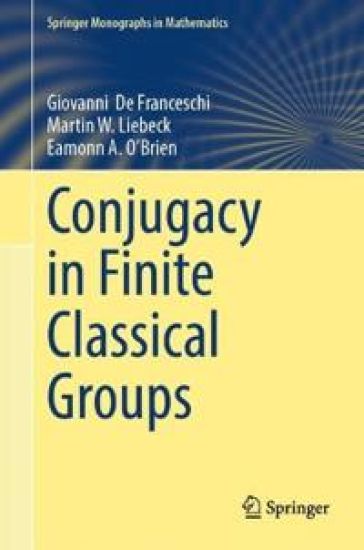
Conjugacy in Finite Classical Groups

Conjugacy in Finite Classical Groups

Giovanni De Franceschi; Martin W. Liebeck; Eamonn A. O'Brien

Springer International Publishing AG
2025
sidottu
This book provides a comprehensive coverage of the theory of conjugacy in finite classical groups. Given such a classical group G, the three fundamental problems considered are the following: to list a representative for each conjugacy class of G; to describe the centralizer of each representative, by giving its group structure and a generating set; and to solve the conjugacy problem in G—namely, given two elements of G, establish whether they are conjugate, and if so, find a conjugating element. The book presents comprehensive theoretical solutions to all three problems, and uses these solutions to formulate practical algorithms. In parallel to the theoretical work, implementations of these algorithms have been developed in Magma. These form a critical component of various general algorithms in computational group theory—for example, computing character tables and solving conjugacy problems in arbitrary finite groups.
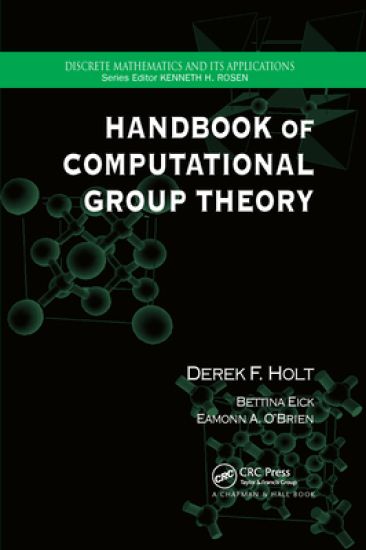
Handbook of Computational Group Theory

Handbook of Computational Group Theory

Derek F. Holt; Bettina Eick; Eamonn A. O'Brien

CRC Press
2020
nidottu
The origins of computation group theory (CGT) date back to the late 19th and early 20th centuries. Since then, the field has flourished, particularly during the past 30 to 40 years, and today it remains a lively and active branch of mathematics. The Handbook of Computational Group Theory offers the first complete treatment of all the fundamental methods and algorithms in CGT presented at a level accessible even to advanced undergraduate students. It develops the theory of algorithms in full detail and highlights the connections between the different aspects of CGT and other areas of computer algebra. While acknowledging the importance of the complexity analysis of CGT algorithms, the authors' primary focus is on algorithms that perform well in practice rather than on those with the best theoretical complexity. Throughout the book, applications of all the key topics and algorithms to areas both within and outside of mathematics demonstrate how CGT fits into the wider world of mathematics and science. The authors include detailed pseudocode for all of the fundamental algorithms, and provide detailed worked examples that bring the theorems and algorithms to life.
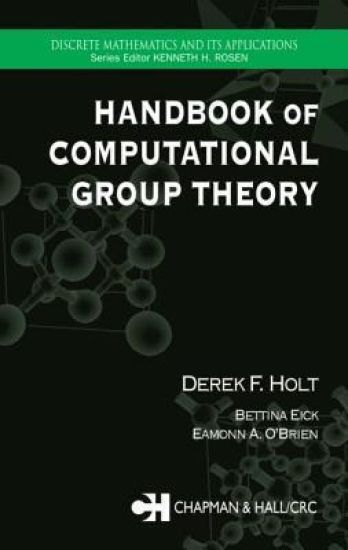
Handbook of Computational Group Theory

Handbook of Computational Group Theory

Derek F. Holt; Bettina Eick; Eamonn A. O'Brien

Chapman Hall/CRC
2005
sidottu
The origins of computation group theory (CGT) date back to the late 19th and early 20th centuries. Since then, the field has flourished, particularly during the past 30 to 40 years, and today it remains a lively and active branch of mathematics. The Handbook of Computational Group Theory offers the first complete treatment of all the fundamental methods and algorithms in CGT presented at a level accessible even to advanced undergraduate students. It develops the theory of algorithms in full detail and highlights the connections between the different aspects of CGT and other areas of computer algebra. While acknowledging the importance of the complexity analysis of CGT algorithms, the authors' primary focus is on algorithms that perform well in practice rather than on those with the best theoretical complexity. Throughout the book, applications of all the key topics and algorithms to areas both within and outside of mathematics demonstrate how CGT fits into the wider world of mathematics and science. The authors include detailed pseudocode for all of the fundamental algorithms, and provide detailed worked examples that bring the theorems and algorithms to life.