Kirjojen hintavertailu – 12 859 828 kirjaa ja 27 kauppaa

Kirjailija

Ed Dubinsky

Kirjat ja teokset yhdessä paikassa: 9 kirjaa, julkaisuja vuosilta 1993–2015, suosituimpiin kuuluu APOS Theory. Vertaile teosten hintoja ja tarkista saatavuus suomalaisista kirjakaupoista.

9 kirjaa

Kirjojen julkaisuvuodet: 1993–2015.

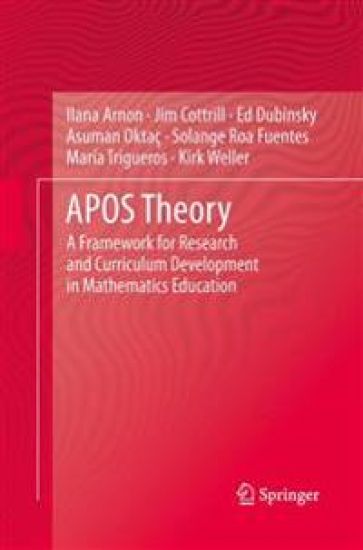
APOS Theory

APOS Theory

Ilana Arnon; Jim Cottrill; Ed Dubinsky; Asuman Oktaç; Solange Roa Fuentes; Maria Trigueros; Kirk Weller

Springer-Verlag New York Inc.
2015
nidottu
In spite of the fact that APOS Theory has been used extensively in numerous scholarly publications, in the design of textbooks, and in teaching practice, there is no single references that contains all the relevant information about its components, and provides guidance about its application. The goal of this book is to present the main elements of APOS theory. It should be useful for researchers who work with, or would like to learn more about, this theoretical approach, people who are interested in the way which mathematical conceptions are constructed according to this theory, Mathematics Education researchers, graduate students in Mathematics Education, and Mathematics instructors.
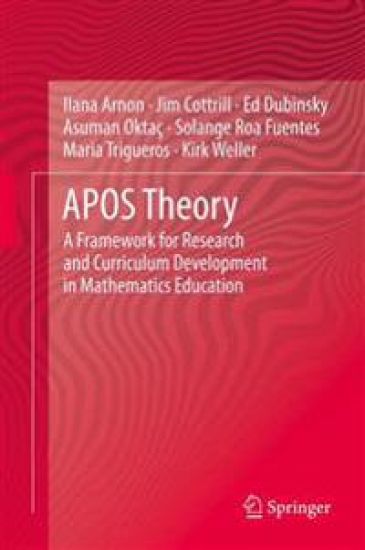
APOS Theory

APOS Theory

Ilana Arnon; Jim Cottrill; Ed Dubinsky; Asuman Oktaç; Solange Roa Fuentes; Maria Trigueros; Kirk Weller

Springer-Verlag New York Inc.
2013
sidottu
In spite of the fact that APOS Theory has been used extensively in numerous scholarly publications, in the design of textbooks, and in teaching practice, there is no single references that contains all the relevant information about its components, and provides guidance about its application. The goal of this book is to present the main elements of APOS theory. It should be useful for researchers who work with, or would like to learn more about, this theoretical approach, people who are interested in the way which mathematical conceptions are constructed according to this theory, Mathematics Education researchers, graduate students in Mathematics Education, and Mathematics instructors.
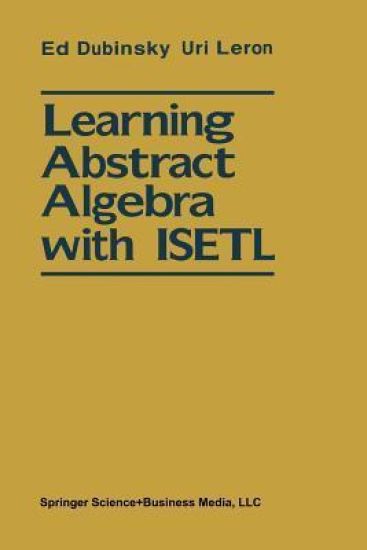
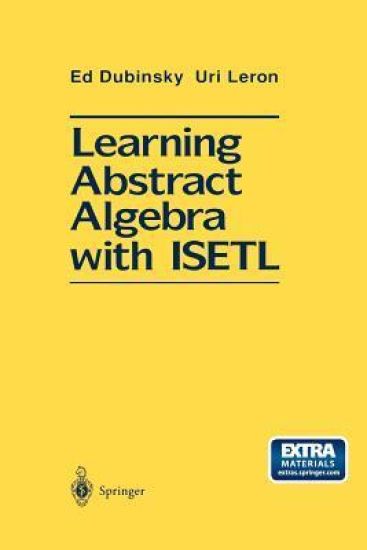
Learning Abstract Algebra with ISETL

Learning Abstract Algebra with ISETL

Ed Dubinsky; Uri Leron

Springer-Verlag New York Inc.
2014
nidottu
This book is based on the belief that, before students can make sense of any presentation of abstract mathematics, they need to be engaged in mental activities that will establish an experiential base for any future verbal explanations and to have the opportunity to reflect on their activities. This approach is based on extensive theoretical and empirical studies, as well as on the substantial experience of the authors in teaching Abstract Algebra. The main source of activities in this course is computer constructions, specifically, small programs written in the math-like programming language ISETL; the main tool for reflection is work in teams of two to four students, where the activities are discussed and debated. Because of the similarity of ISETL expressions to standard written mathematics, there is very little programming overhead: learning to program is inseparable from learning the mathematics. Each topic is first introduced through computer activities, which are then followed by a text section and exercises. The text section is written in an informal, discursive style, closely relating definitions and proofs to the constructions in the activities. Notions such as cosets and quotient groups become much more meaningful to the students than when they are presented in a lecture.
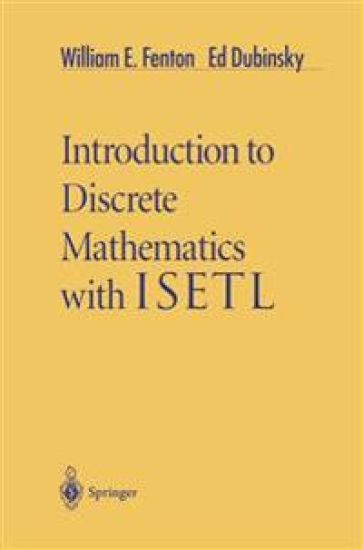
Introduction to Discrete Mathematics with ISETL

Introduction to Discrete Mathematics with ISETL

William E. Fenton; Ed Dubinsky

Springer-Verlag New York Inc.
2011
nidottu
Intended for first- or second-year undergraduates, this introduction to discrete mathematics covers the usual topics of such a course, but applies constructivist principles that promote - indeed, require - active participation by the student. Working with the programming language ISETL, whose syntax is close to that of standard mathematical language, the student constructs the concepts in her or his mind as a result of constructing them on the computer in the syntax of ISETL. This dramatically different approach allows students to attempt to discover concepts in a "Socratic" dialog with the computer. The discussion avoids the formal "definition-theorem" approach and promotes active involvement by the reader by its questioning style. An instructor using this text can expect a lively class whose students develop a deep conceptual understanding rather than simply manipulative skills. Topics covered in this book include: the propositional calculus, operations on sets, basic counting methods, predicate calculus, relations, graphs, functions, and mathematical induction.
Learning Abstract Algebra with ISETL

Learning Abstract Algebra with ISETL

Ed Dubinsky; Uri Leron

Springer-Verlag New York Inc.
2011
nidottu
Most students in abstract algebra classes have great difficulty making sense of what the instructor is saying. Moreover, this seems to remain true almost independently of the quality of the lecture. This book is based on the constructivist belief that, before students can make sense of any presentation of abstract mathematics, they need to be engaged in mental activities which will establish an experiential base for any future verbal explanation. No less, they need to have the opportunity to reflect on their activities. This approach is based on extensive theoretical and empirical studies as well as on the substantial experience of the authors in teaching astract algebra. The main source of activities in this course is computer constructions, specifically, small programs written in the mathlike programming language ISETL; the main tool for reflections is work in teams of 2-4 students, where the activities are discussed and debated. Because of the similarity of ISETL expressions to standard written mathematics, there is very little programming overhead: learning to program is inseparable from learning the mathematics. Each topic is first introduced through computer activities, which are then followed by a text section and exercises. This text section is written in an informed, discusive style, closely relating definitions and proofs to the constructions in the activities. Notions such as cosets and quotient groups become much more meaningful to the students than when they are preseted in a lecture.
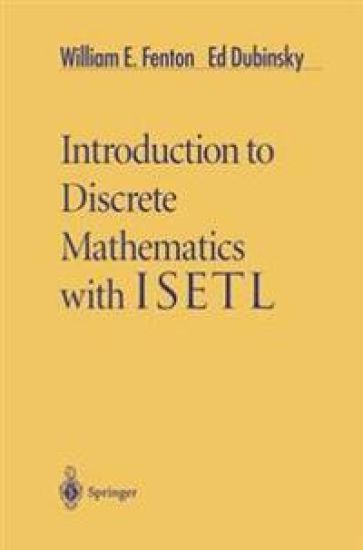
Introduction to Discrete Mathematics with ISETL

Introduction to Discrete Mathematics with ISETL

William E. Fenton; Ed Dubinsky

Springer-Verlag New York Inc.
1996
sidottu
Intended for first- or second-year undergraduates, this introduction to discrete mathematics covers the usual topics of such a course, but applies constructivist principles that promote - indeed, require - active participation by the student. Working with the programming language ISETL, whose syntax is close to that of standard mathematical language, the student constructs the concepts in her or his mind as a result of constructing them on the computer in the syntax of ISETL. This dramatically different approach allows students to attempt to discover concepts in a "Socratic" dialog with the computer. The discussion avoids the formal "definition-theorem" approach and promotes active involvement by the reader by its questioning style. An instructor using this text can expect a lively class whose students develop a deep conceptual understanding rather than simply manipulative skills. Topics covered in this book include: the propositional calculus, operations on sets, basic counting methods, predicate calculus, relations, graphs, functions, and mathematical induction.
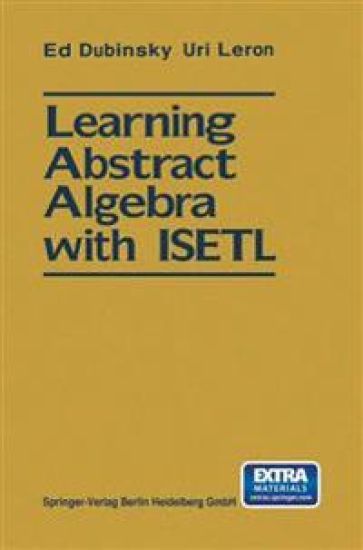
Learning Abstract Algebra with ISETL

Learning Abstract Algebra with ISETL

Ed Dubinsky; Uri Leron

Springer-Verlag Berlin and Heidelberg GmbH Co. K
1994
nidottu
This text is based on the belief that, before students can make sense of any presentation of abstract mathematics, they need to be engaged in mental activities that will establish an experiential base for any future verbal explanations and to have the opportunity to reflect on their activities. This approach is based on extensive theoretical and empirical studies, as well as on the substantial experience of the authors in teaching abstract algebra. The main source of activities in this course is computer constructions; specifically, small programs written in the math-like programming language ISETL. Work is encouraged to take place in teams of two to four students, where the activities are discussed and debated. Each topic is first introduced through computer activities, which are then followed by a text section and exercises. The text section is written in an informal, discursive style, closely relating definitions and proofs to the constructions in the activities.
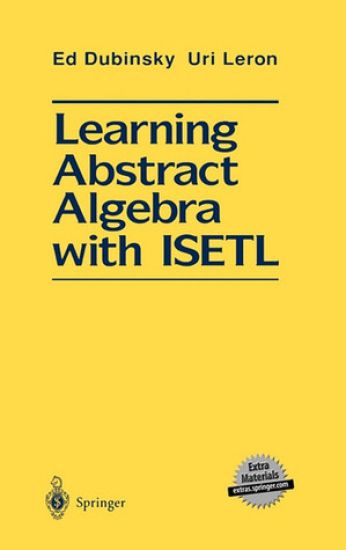
Learning Abstract Algebra with ISETL

Learning Abstract Algebra with ISETL

Ed Dubinsky; Uri Leron

Springer-Verlag New York Inc.
1993
sidottu
Most students in abstract algebra classes have great difficulty making sense of what the instructor is saying. Moreover, this seems to remain true almost independently of the quality of the lecture. This book is based on the constructivist belief that, before students can make sense of any presentation of abstract mathematics, they need to be engaged in mental activities which will establish an experiential base for any future verbal explanation. No less, they need to have the opportunity to reflect on their activities. This approach is based on extensive theoretical and empirical studies as well as on the substantial experience of the authors in teaching astract algebra. The main source of activities in this course is computer constructions, specifically, small programs written in the mathlike programming language ISETL; the main tool for reflections is work in teams of 2-4 students, where the activities are discussed and debated. Because of the similarity of ISETL expressions to standard written mathematics, there is very little programming overhead: learning to program is inseparable from learning the mathematics. Each topic is first introduced through computer activities, which are then followed by a text section and exercises. This text section is written in an informed, discusive style, closely relating definitions and proofs to the constructions in the activities. Notions such as cosets and quotient groups become much more meaningful to the students than when they are preseted in a lecture.