Kirjojen hintavertailu – 12 859 819 kirjaa ja 27 kauppaa

Kirjailija

Edgar Grande

Kirjat ja teokset yhdessä paikassa: 4 kirjaa, julkaisuja vuosilta 1989–2012, suosituimpiin kuuluu Political Conflict in Western Europe. Vertaile teosten hintoja ja tarkista saatavuus suomalaisista kirjakaupoista.

4 kirjaa

Kirjojen julkaisuvuodet: 1989–2012.

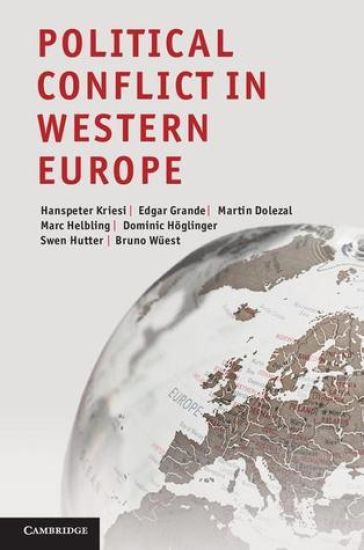
Political Conflict in Western Europe

Political Conflict in Western Europe

Hanspeter Kriesi; Edgar Grande; Martin Dolezal; Marc Helbling; Dominic Höglinger; Swen Hutter; Bruno Wüest

Cambridge University Press
2012
sidottu
What are the consequences of globalization for the structure of political conflicts in Western Europe? How are political conflicts organized and articulated in the twenty-first century? And how does the transformation of territorial boundaries affect the scope and content of political conflicts? This book sets out to answer these questions by analyzing the results of a study of national and European electoral campaigns, protest events and public debates in six West European countries. While the mobilization of the losers in the processes of globalization by new right populist parties is seen to be the driving force of the restructuring of West European politics, the book goes beyond party politics. It attempts to show how the cleavage coalitions that are shaping up under the impact of globalization extend to state actors, interest groups and social movement organizations, and how the new conflicts are framed by the various actors involved.
West European Politics in the Age of Globalization

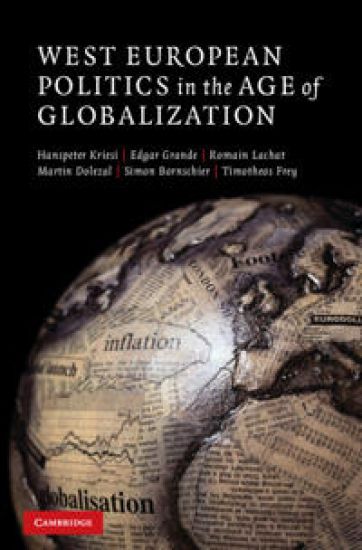
West European Politics in the Age of Globalization

Hanspeter Kriesi; Edgar Grande; Romain Lachat; Martin Dolezal; Simon Bornschier; Timotheos Frey

Cambridge University Press
2008
sidottu
Over the past three decades the effects of globalization and denationalization have created a division between 'winners' and 'losers' in Western Europe. This study examines the transformation of party political systems in six countries (Austria, France, Germany, the Netherlands, Switzerland and the UK) using opinion surveys, as well as newly collected data on election campaigns. The authors argue that, as a result of structural transformations and the strategic repositioning of political parties, Europe has observed the emergence of a tripolar configuration of political power, comprising the left, the moderate right, and the new populist right. They suggest that, through an emphasis on cultural issues such as mass immigration and resistance to European integration, the traditional focus of political debate - the economy - has been downplayed or reinterpreted in terms of this new political cleavage. This new analysis of Western European politics will interest all students of European politics and political sociology.
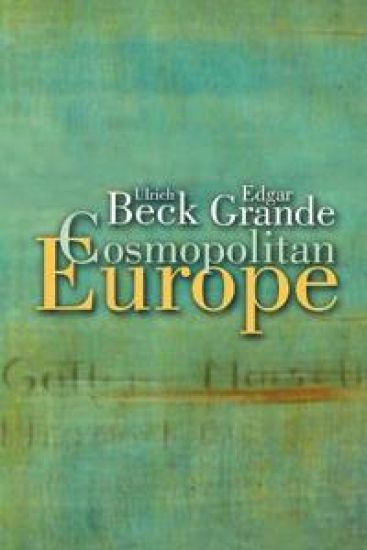
Cosmopolitan Europe

Cosmopolitan Europe

Ulrich Beck; Edgar Grande

Polity Press
2007
nidottu
Europe is Europe’s last remaining realistic political utopia. But Europe remains to be understood and conceptualized. This historically unique form of international community cannot be explained in terms of the traditional concepts of politics and the state, which remain trapped in the straightjacket of methodological nationalism. Thus, if we are to understand cosmopolitan Europe, we must radically rethink the conventional categories of social and political analysis. Just as the Peace of Westphalia brought the religious civil wars of the seventeenth century to an end through the separation of church and state, so too the separation of state and nation represents the appropriate response to the horrors of the twentieth century. And just as the secular state makes the exercise of different religions possible, so too cosmopolitan Europe must guarantee the coexistence of different ethnic, religious and political forms of life across national borders based on the principle of cosmopolitan tolerance. The task the authors have set themselves in this book is nothing less than to rethink Europe as an idea and a reality. It represents an attempt to understand the process of Europeanization in light of the theory of reflexive modernization and thereby to redefine it at both the theoretical and the political level. This book completes Ulrich Beck’s trilogy on ‘cosmopolitan realism’, the volumes of which complement each other and can be read independently. It is essential reading for anyone interested in the key social and political developments of our time.
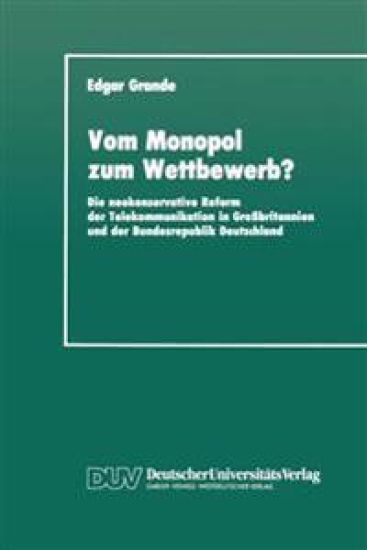
Vom Monopol zum Wettbewerb?

Vom Monopol zum Wettbewerb?

Edgar Grande

Deutscher Universitats-Verlag
1989
nidottu
Am Ende der siebziger und zu Beginn der achtziger Jahre sind in einigen der wich- tigsten kapitalistischen Demokratien neokonservative Regierungen mit der erkHir- ten Absicht angetreten, einen grundlegenden Kurswechsel in der Wirtschafts- und Sozialpolitik einzuleiten. GroBbritannien und die Bundesrepublik Deutschland waren zwei der spektakuliirsten Fiille solcher wirtschaftspolitischer "Wende"-Ver- suche. 1m Mittelpunkt der Regierungsprogramme stand die Zielsetzung, das be- stehende Niveau staatlicher Intervention in die Wirtschaft drastisch zu reduzieren und den Umfang wohlfahrtsstaatlicher Sicherung abzubauen. Kurz: Das Verhalt- nisses von Staat und Okonomie, das sich in beiden Liindern nach dem Zweiten Weltkrieg herausgebildet hatte, sollte substantiell verandert werden. Der Frage nach der Durchsetzungsfahigkeit eines solchen wirtschaftspolitischen Strategiewechsels wird hier exemplarisch im Fall der Telekommunikationspolitik nachgegangen. Fiir diese Fallauswahl gab es gute Griinde. Die Informations- und Kommunikationstechnologien gelten als "Schliisseltechnologien" filr die strukturelle Modernisierung kapitalistischer Okonomien. Eine politische Reform der Regulierungsstrukturen im Bereich der Telekommunikation hatte dernnach nicht nur sektorale Auswirkungen, sondern kann als Priifstein fUr die Erfolgschancen des neokonservativen Projekts in der Wirtschaftspolitik insgesamt gewertet werden. Die vorliegende empirische Untersuchung der neokonservativen Reform der Telekommunikation in GroBbritannien und der Bundesrepublik Deutschland entstand als Teil des Forschungsprojekts "Verlaufsmuster und Bedingungen von ordnungspolitischem Strategiewechsel im internationalen Vergleich" an der Fachgruppe Politik-/Verwaltungswissenschaft der Universitat Konstanz. Das Projekt wurde geleitet von Prof. Dr. Gerhard Lehmbruch und gefOrdert aus Mitteln der Stiftung Volkswagenwerk. Beiden ist der Verfasser zu besonderem Dank verpflichtet. Ohne sie ware diese Untersuchung nicht moglich gewesen.