Kirjailija
Edgar Rice Burroughs
Kirjat ja teokset yhdessä paikassa: 1 802 kirjaa, julkaisuja vuosilta 1913–2026, suosituimpiin kuuluu Tarzanin Poika. Vertaile teosten hintoja ja tarkista saatavuus suomalaisista kirjakaupoista.
Nimi esiintyy myös muodoissa: Edgar` Rice Burroughs
1 802 kirjaa
Kirjojen julkaisuvuodet: 1913–2026.
The Outlaw of Torn is a historical novel by Edgar Rice Burroughs, originally published as a five-part serial in New Story Magazine from January to May 1914, and first published in book form by A. C. McClurg in 1927. It was Burroughs' second novel, his first being the science fiction work A Princess of Mars. His third was Tarzan of the Apes. The Outlaw of Torn is one of only two historical novels Burroughs wrote. The other, I Am a Barbarian, set in the Rome of Caligula, was not published until 1967, seventeen years after his death. The story is set in 13th century England and concerns the fictional outlaw Norman of Torn, who purportedly harried the country during the power struggle between King Henry III and Simon de Montfort. Norman is the supposed son of the Frenchman de Vac, once the king's fencing master, who has a grudge against his former employer and raises the boy to be a simple, brutal killing machine with a hatred of all things English. His intentions are partially subverted by a priest who befriends Norman and teaches him his letters and chivalry towards women. Otherwise, all goes according to plan. By 17, Norman is the best swordsman in all of England; by the age of 18, he has a large bounty on his head, and by the age of 19, he leads the largest band of thieves in all of England. None can catch or best him. In his hatred for the king he even becomes involved in the civil war, which turns the tide in favor of de Montfort. In another guise, that of Roger de Conde, he becomes involved with de Montfort's daughter Bertrade, defending her against her and her father's enemies. She notes in him a curious resemblance to the king's son and heir Prince Edward. Finally brought to bay in a confrontation with both King Henry and de Montfort, Norman is brought down by the treachery of de Vac, who appears to kill him, though at the cost of his own life. As de Vac dies, he reveals that Norman is in fact Richard, long-lost son of King Henry and Queen Eleanor and brother to Prince Edward. The fencing master had kidnapped the prince as a child to serve as the vehicle of his vengeance against the king. Luckily, Norman/Richard turns out not to be truly dead, surviving to be reconciled to his true father and attain the hand of Bertrade. (wikipedia.org)
The People That Time Forgot is a fantasy novel by American writer Edgar Rice Burroughs. The novel begins with the organization of an expedition to rescue Bowen J. Tyler, Lys La Rue, and the other castaways marooned on the large Antarctic island of Caprona, whose tropical interior, known to its inhabitants as Caspak, is home to prehistoric fauna of all eras. Tyler's recovered manuscript detailing their ordeal is delivered to his family, and the relief effort is put together by Tom Billings, secretary of the Tyler shipbuilding business. The expedition's ship, the Toreador, locates Caprona, and while the bulk of the crew attempts to scale the encircling cliffs Billings flies over them in an aircraft. Billings' plane is attacked by flying reptiles and forced down in the interior of Caspak. He saves a native girl named Ajor from a large cat and a group of ape-men, and undertakes to accompany her back to her people, the fully human Galus, while she educates him in the language and mysteries of the island. They travel north, encountering various creatures of the Mesozoic and Cenozoic eras, as well as additional primitive subhuman races. They pass through the lands of the Neanderthal Bo-lu (club men) and the more advanced Sto-lu (hatchet men), who are easily cowed by gunfire. But in the country of the Band-lu (spear men) he is taken captive, and despairs until rescued in turn by Ajor. They resume their journey, re-encountering and befriending Tomar, a Band-lu newly become Kro-lu (bow man). Tomar and his mate So-al are the first examples Billings has actually seen of Caspakian evolutionary metamorphosis in action. After an interlude in which Ajor's back story is related the new friends separate. Billings and Ajor enter Kro-lu territory and save Chal-az, a Kro-lu warrior, from a group of Band-lu. Visiting the Kro-lu village as his guest, they are parted again when Billings is attacked through the machinations of the chief Du-seen, who has designs on Ajor. They escape individually, making for the Galu country. Du-seen goes after Ajor with some of his warriors. Billings catches and tames an ancestral horse, with the aid of which he rescues Ajor from Du-seen. Pursued, they resign themselves to death, but are relieved by a force consisting of Bowen Tyler, Galu warriors, and the rescue crew from the Toreador, which had successfully scaled the cliffs and entered Caspak after Billings' ill-fated airplane flight. All are reunited in the Galu village, where Tyler and Lys La Rue have been formally married by the captain of the Toreador. Billings and Ajor also desire to wed, but Ajor may not leave Caspak due to her status as cos-ata-lo - she was born a fully evolved Galu rather than attaining that form through metamorphosis, and hence is treasured by her people. Billings elects to remain in Caspak to be with her. (wikipedia.org)
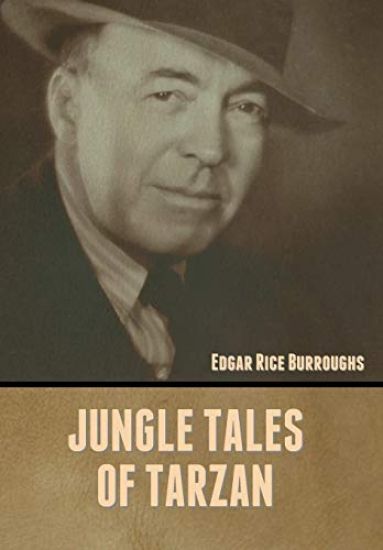
Jungle Tales of Tarzan is a collection of twelve loosely connected short stories by American writer Edgar Rice Burroughs, comprising the sixth book in order of publication in his series of twenty-four books about the title character Tarzan. Chronologically the events recounted in it occur within Chapter 11 of the first Tarzan novel, Tarzan of the Apes, between Tarzan's avenging of his ape foster mother's death and his becoming leader of his ape tribe. The stories ran monthly in Blue Book magazine, September 1916 through August 1917 before book publication in 1919. Erling B. Holtsmark explores these stories topically in Tarzan and Tradition along with the first five Tarzan novels. The book is indexed to provide help in locating the commentary on each story. Stan Galloway's The Teenage Tarzan: A Literary Analysis of Edgar Rice Burroughs' Jungle Tales of Tarzan provides the first extended study of this collection of short stories. The Teenage Tarzan explores each story, usually in the order of composition, with references to Tarzan of the Apes and other books written by Burroughs. The study includes reference to other media as well, where Tarzan is a character, and a particular interest in literary symbols at work in the stories. Galloway's book also contains a useful index. Both Holtsmark and Galloway approach the stories seriously and positively, providing a counter to a largely dismissive earlier reception. (wikipedia.org)
At the Earth's Core is a 1914 fantasy novel by American writer Edgar Rice Burroughs, the first in his series about the fictional "hollow earth" land of Pellucidar. It first appeared as a four-part serial in All-Story Weekly from April 4-25, 1914. It was first published in book form in hardcover by A. C. McClurg in July, 1922. Galaxy reviewer Floyd C. Gale, discussing the 1962 paperback edition, praised the novel; he said that "Burroughs's concepts are intriguing and his combat scenes gripping." Gale faulted the novel's style, noting that "the reader must wade at least twenty-five pages into the book before he can cease to be annoyed by the author's stilted and florid style", but promised that "by then he has reached the point of no return". The novel was filmed as At the Earth's Core (1976), directed by Kevin Connor and starring Doug McClure as David Innes and Peter Cushing as Abner Perry. When DC Comics gained the license to adapt the works of Edgar Rice Burroughs, they managed to adapt the first Pellucidar book, with Len Wein scripting, and various artists such as Mike Kaluta and Murphy Anderson on art. The adaptation started out Korak, Son of Tarzan #46, then moved to Weird Worlds, where it ran from #1-6. The 2008 movie Journey to Middle Earth also shares several similarities with the events and locations of the novel, although the film was intended as a loose adaptation of Journey to the Center of the Earth by Jules Verne. Other authors have been inspired by Burroughs' depiction of the strange subterranean world, most notably H. P. Lovecraft whose At the Mountains of Madness was heavily influenced by At the Earth's Core, particularly in the name of the Elder Things' slave race, the Shoggoths. Another and more direct homage to Burroughs' concept is Lin Carter's "Zanthodon" series, beginning with his novel Journey to the Underground World. Prolific manga artist Shotaro Ishinomori also loosely adapted the book for the final story arc of the original Cyborg 009 manga. (wikipedia.org)
Tarzan the Terrible is a novel by American writer Edgar Rice Burroughs, the eighth in his series of twenty-four books about the title character Tarzan. It was first published as a serial in the pulp magazine Argosy All-Story Weekly in the issues for February 12, 19, and 26 and March 5, 12, 19, and 26, 1921; the first book edition was published in June 1921 by A. C. McClurg. Its setting, Pal-ul-don, is one of the more thoroughly realized "lost civilizations" in Burroughs' Tarzan stories. The novel contains a map of the place as well as a glossary of its inhabitants' language. Two months have passed since the conclusion of the previous novel, Tarzan the Untamed, in which Tarzan spent many months wandering about Africa wreaking vengeance upon those who he believed brutally murdered Jane. At the end of that novel Tarzan learns that her death was a ruse, that she had not been killed at all. In attempting to track Jane, Tarzan has come to a hidden valley called Pal-ul-don filled with dinosaurs, notably the savage Triceratops-like Gryfs, which, unlike their prehistoric counterparts, are omnivorous and stand 20 feet tall at the shoulder. The lost valley is also home to two different adversarial races of tailed human-looking creatures: the hairless and white skinned, city-dwelling Ho-don and the hairy and black-skinned, hill-dwelling Waz-don. Tarzan befriends a Ho-don warrior, and the Waz-don chief, actuating some uncustomary relations. In this new world Tarzan becomes a captive but so impresses his captors with his accomplishments and skills that they name him "Tarzan-Jad-Guru" (Tarzan the Terrible). Having been brought there by her German captor, it turns out Jane is also being held captive in Pal-ul-don. She becomes a center-piece in a religious power struggle that consumes much of the novel until she escapes, after which her German captor becomes dependent on her due to his own lack of jungle survival skills. With the aid of his native allies, Tarzan continues to pursue his beloved, going through an extended series of fights and escapes to do so. In the end success seems beyond even his ability to achieve, until in the final chapter he and Jane are saved by their son Korak, who has been searching for Tarzan just as Tarzan has been searching for Jane. (wikipedia.org)
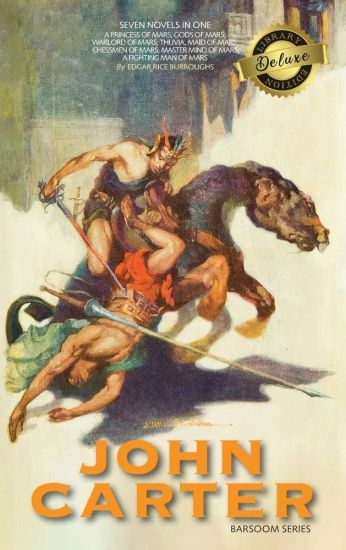
John Carter: Barsoom Series (7 Novels) A Princess of Mars; Gods of Mars; Warlord of Mars; Thuvia, Maid of Mars; Chessmen of Mars; M
Edgar Rice Burroughs
Engage Books
2022
sidottu
When John Carter goes to sleep in a mysterious cave in the Arizona dessert, he wakes up on the planet Mars. There he meets the fifteen foot tall, four armed, green men of mars, with horse-like dragons, and watch dogs like oversized frogs with ten legs. His adventures continue as he battles great white apes, fights plant men, defies the Goddess of Death, and braves the frozen wastes of Polar Mars. In other adventures, the Prince of Helium encounters a race of telepathic warriors, the Princess of Helium confronts the headless men of Mars, Captain Ulysses Paxton learns the secret of human immortality, and Tan Hadron's idealized notion of love is tested as he fights off gigantic spiders and cannibals. Edgar Rice Burroughs vision of Mars was loosely inspired by astronomical speculation of the time, especially that of Percival Lowell, who saw the red planet as a formerly Earth-like world now becoming less hospitable to life due to its advanced age. Burroughs predicted the invention of homing devices, radar, sonar, autopilot, collision detection, television, teletype, genetic cloning, living organ transplants, antigravity propulsion, and many other concepts that were well ahead of his time. The books in the Barsoom series were an early inspiration to many, including science fiction authors Robert A. Heinlein, Arthur C. Clarke and Ray Bradbury, they influenced renowned scientist Carl Sagan in his quest for extraterrestrial life, and were instrumental in the making of James Cameron's Avatar, and George Lucas' Star Wars. This edition includes 46 illustrations.