
Kirjailija
Edmund Burke
Kirjat ja teokset yhdessä paikassa: 582 kirjaa, julkaisuja vuosilta 1968–2026, suosituimpiin kuuluu The Portable Edmund Burke. Vertaile teosten hintoja ja tarkista saatavuus suomalaisista kirjakaupoista.
582 kirjaa
Kirjojen julkaisuvuodet: 1968–2026.
A Philosophical Inquiry Into The Origin Of Our Ideas Of The Sublime And Beautiful With Several Other Additions
Edmund Burke
Createspace Independent Publishing Platform
2018
nidottu
I have endeavoured to make this edition something more full and satisfactory than the first. I have sought with the utmost care, and read with equal attention, everything which has appeared in public against my opinions; I have taken advantage of the candid liberty of my friends; and if by these means I have been better enabled to discover the imperfections of the work, the indulgence it has received, imperfect as it was, furnished me with a new motive to spare no reasonable pains for its improvement. Though I have not found sufficient reason, or what appeared to me sufficient, for making any material change in my theory, I have found it necessary in many places to explain, illustrate, and enforce it. I have prefixed an introductory discourse concerning Taste: it is a matter curious in itself; and it leads naturally enough to the principal inquiry. This, with the other explanations, has made the work considerably larger; and by increasing its bulk, has, I am afraid, added to its faults; so that, notwithstanding all my attention, it may stand in need of a yet greater share of indulgence than it required at its first appearance.

Mr. Burke's Speech, in Westminster-Hall, on the 18th and 19th of February, 1788,
Edmund Burke
Createspace Independent Publishing Platform
2018
nidottu
Mr. Burke's Speech, in Westminster-Hall, on the 18th and 19th of February, 1788, with Explanatory Notes. with a Preface Edmund Burke The 18th century was a wealth of knowledge, exploration and rapidly growing technology and expanding record-keeping made possible by advances in the printing press. In its determination to preserve the century of revolution, Gale initiated a revolution of its own: digitization of epic proportions to preserve these invaluable works in the largest archive of its kind. Now for the first time these high-quality digital copies of original 18th century manuscripts are available in print, making them highly accessible to libraries, undergraduate students, and independent scholars. Delve into what it was like to live during the eighteenth century by reading the first-hand accounts of everyday people, including city dwellers and farmers, businessmen and bankers, artisans and merchants, artists and their patrons, politicians and their constituents. Original texts make the American, French, and Industrial revolutions vividly contemporary. We are delighted to publish this classic book as part of our extensive Classic Library collection. Many of the books in our collection have been out of print for decades, and therefore have not been accessible to the general public. The aim of our publishing program is to facilitate rapid access to this vast reservoir of literature, and our view is that this is a significant literary work, which deserves to be brought back into print after many decades. The contents of the vast majority of titles in the Classic Library have been scanned from the original works. To ensure a high quality product, each title has been meticulously hand curated by our staff. Our philosophy has been guided by a desire to provide the reader with a book that is as close as possible to ownership of the original work. We hope that you will enjoy this wonderful classic work, and that for you it becomes an enriching experience.
Maxims and Opinions, Moral, Political, and Economical, with Characters, from the Works of the Right Hon. Edmund Burke. Vol. II
Edmund Burke
Trieste Publishing
2018
nidottu
A Philosophical Enquiry into the Origin of Our Ideas of the Sublime and Beautiful is a 1757 treatise on aesthetics written by Edmund Burke. In short, the Beautiful, according to Burke, is what is well-formed and aesthetically pleasing, whereas the Sublime is what has the power to compel and destroy us. The preference for the Sublime over the Beautiful was to mark the transition from the Neoclassical to the Romantic era.
Regarded as a founder of modern conservatism, Edmund Burke (1729 97) proved an influential yet controversial writer and politician. Although sympathetic towards American colonists in their grievances against British rule, he was later appalled as the French Revolution unfolded. Published in 1790, when the Revolution was still young, this is Burke's most well-known work and remains a classic of Western political thought and rhetoric. He predicts the excesses that will follow the destruction of the institutions of civil society, and the inevitable rise of a corrupt and violent government rather than a protector of citizens. When she read the famous passage describing her flight from Versailles, Marie Antoinette was apparently moved to tears. Sparking a flurry of responses in defence of the Revolution and its ideals, including Thomas Paine's Rights of Man (also reissued in this series), Burke's polemic remains a crucial text in the history of modern political philosophy."

On the Sublime and Beautiful by: Edmund Burke
Edmund Burke
Createspace Independent Publishing Platform
2018
nidottu
Edmund Burke 12 January 1730 - 9 July 1797) was an Irish statesman born in Dublin, as well as an author, orator, political theorist and philosopher, who after moving to London in 1750 served as a member of parliament (MP) between 1766 and 1794 in the House of Commons with the Whig Party. Burke was a proponent of underpinning virtues with manners in society and of the importance of religion in moral life. These views were expressed in his A Vindication of Natural Society. Burke criticized British treatment of the American colonies, including through its taxation policies. He also supported the rights of the colonists to resist metropolitan authority, though he opposed the attempt to achieve independence. Burke is remembered for his support for Catholic emancipation, the impeachment of Warren Hastings from the East India Company and for his staunch opposition to the French Revolution. In his Reflections on the Revolution in France, Burke claimed that the revolution was destroying the fabric of good society, traditional institutions of state and society and condemned the persecution of the Catholic Church that resulted from it. This led to his becoming the leading figure within the conservative faction of the Whig Party, which he dubbed the "Old Whigs", as opposed to the pro-French Revolution "New Whigs", led by Charles James Fox
The Speeches of the Right Honourable Edmund Burke - on the impeachment of Warren Hastings: to which is added a selection of Burke's epistolary corespondence is an unchanged, high-quality reprint of the original edition of 1890. Hansebooks is editor of the literature on different topic areas such as research and science, travel and expeditions, cooking and nutrition, medicine, and other genres. As a publisher we focus on the preservation of historical literature. Many works of historical writers and scientists are available today as antiques only. Hansebooks newly publishes these books and contributes to the preservation of literature which has become rare and historical knowledge for the future.
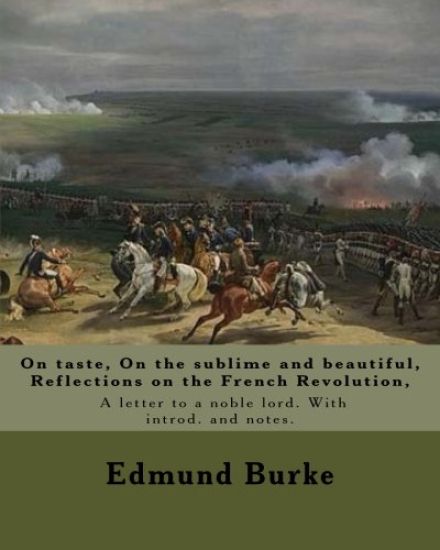
On taste, On the sublime and beautiful, Reflections on the French Revolution, A letter to a noble lord. With introd. and notes. By: Edmund Burke: Edmu
Edmund Burke
Createspace Independent Publishing Platform
2017
nidottu
Reflections on the Revolution in France is a political pamphlet written by the British statesman Edmund Burke and published in November 1790. One of the best-known intellectual attacks against the French Revolution, Reflections is a defining tract of modern conservatism as well as an important contribution to international theory. Above all else, it has been one of the defining efforts of Edmund Burke's transformation of "traditionalism into a self-conscious and fully conceived political philosophy of conservatism". 3] The pamphlet has not been easy to classify. Academics have had trouble identifying whether Burke, or his tract, can best be understood as "a realist or an idealist, Rationalist or a Revolutionist". Thanks to its thoroughness, rhetorical skill, and literary power, it has become one of the most widely known of Burke's writings and a classic text in political theory. In the twentieth century, it greatly influenced conservative and classical liberal intellectuals, who recast Burke's Whiggish arguments as a critique of communist and revolutionary-socialist programmes..... Edmund Burke (12 January - 1729 - 9 July 1797) was an Irish statesman born in Dublin, as well as an author, orator, political theorist, and philosopher who, after moving to London, served as a member of parliament (MP) for many years in the House of Commons with the Whig Party. Burke was a strong proponent of maintaining solid moral virtues in society, and of the importance of religion in attaining that virtue and keeping society together. These views were expressed in his A Vindication of Natural Society. Burke criticized British treatment of the American colonies, including through its taxation policies. He also supported the American Revolution, believing both that it couldn't affect British or European stability and would be an innovative experiment in political development because the Americas were so far away from Europe and thus could have little impact on England. Burke is remembered for his support for Catholic emancipation, the impeachment of Warren Hastings from the East India Company, and for his staunch opposition to the French Revolution. In his Reflections on the Revolution in France, Burke claimed that the revolution was destroying the fabric of good society, traditional institutions of state & society, and condemned the persecution of the Catholic Church that resulted from it. This led to his becoming the leading figure within the conservative faction of the Whig Party, which he dubbed the "Old Whigs", as opposed to the pro-French Revolution "New Whigs", led by Charles James Fox. In the nineteenth century Burke was praised by both conservatives and liberals. Subsequently, in the twentieth century, he became widely regarded as the philosophical founder of modern conservatismointed Inspector of the Imports and Exports in the Custom House, which he resigned to become Usher of the Exchequer, which gave him at first 3900 per annum but this increased over the years. Upon coming of age he became Comptroller of the Pipe and Clerk of the Estreats which gave him an income of 300 per annum. Walpole decided to go travelling with Thomas Gray and wrote a will whereby he left Gray all his belongings. In 1744 Walpole wrote in a letter to Conway that these offices gave him nearly 2,000 per annum; after 1745 when he was appointed Collectorship of Customs, his total income from these offices was around 3,400 per annum............
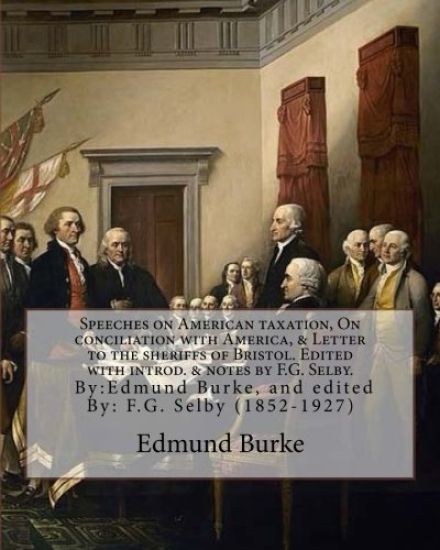
Speeches on American taxation, On conciliation with America, & Letter to the sheriffs of Bristol. Edited with introd. & notes by F.G. Selby. By: Edmun
F. G. Selby; Edmund Burke
Createspace Independent Publishing Platform
2017
nidottu
"On American Taxation" was a speech given by Edmund Burke in the British House of Commons on April 19, 1774, advocating the full repeal of the Townshend Revenue Act of 1767. Parliament had previously repealed five of the six duties of this revenue tax on the American colonies, but the tax on tea remained. The speech was given during the debates on the Coercive Acts, when Rose Fuller proposed that the Townshend duty on tea be repealed to decrease resistance to the new acts. Burke's speech was in support of this motion. According to historian Robert Middlekauff, "The speech is memorable for its wit and its brilliant reconstruction of the government's dismal efforts to bring order into colonial affairs without the advantage of a coherent policy." Edmund Burke was a British member of Parliament who by the 1770s had become an important part of the opposition. The Stamp Act was passed the same year he was first elected to Parliament, and this and ensuing revenue acts had generated significant resistance among American colonists. In general terms, Burke argued throughout these years that the resistance was a consequence of the inflexibility of British policy towards its colonies. His arguments were the ideas of an eminently practical man. Burke was more concerned with the actual functioning of government than with theory or history. By the spring of 1774, Burke had come to believe that affairs between Britain and the colonies were reaching an important moment. He did not believe that a break was imminent, but knew the situation was serious. When a debate was held in Parliament related to a motion to repeal the Tea Act, he took the opportunity to speak. He intended to give a general warning about British policy, but not necessarily to propose many specific remedies.... Edmund Burke (12 January - 1729 - 9 July 1797) was an Irish statesman born in Dublin, as well as an author, orator, political theorist, and philosopher who, after moving to London, served as a member of parliament (MP) for many years in the House of Commons with the Whig Party. Burke was a strong proponent of maintaining solid moral virtues in society, and of the importance of religion in attaining that virtue and keeping society together. These views were expressed in his A Vindication of Natural Society. Burke criticized British treatment of the American colonies, including through its taxation policies. He also supported the American Revolution, believing both that it couldn't affect British or European stability and would be an innovative experiment in political development because the Americas were so far away from Europe and thus could have little impact on England. Burke is remembered for his support for Catholic emancipation, the impeachment of Warren Hastings from the East India Company, and for his staunch opposition to the French Revolution. In his Reflections on the Revolution in France, Burke claimed that the revolution was destroying the fabric of good society, traditional institutions of state & society, and condemned the persecution of the Catholic Church that resulted from it. This led to his becoming the leading figure within the conservative faction of the Whig Party, which he dubbed the "Old Whigs", as opposed to the pro-French Revolution "New Whigs", led by Charles James Fox. In the nineteenth century Burke was praised by both conservatives and liberals. Subsequently, in the twentieth century, he became widely regarded as the philosophical founder of modern conservatismointed Inspector of the Imports and Exports in the Custom House, which he resigned to become Usher of the Exchequer, which gave him at first 3900 per annum but this increased over the years. Upon coming of age he became Comptroller of the Pipe and Clerk of the Estreats which gave him an income of 300 per annum....
Two letters addressed to a member of the present Parliament is an unchanged, high-quality reprint of the original edition of 1796. Hansebooks is editor of the literature on different topic areas such as research and science, travel and expeditions, cooking and nutrition, medicine, and other genres. As a publisher we focus on the preservation of historical literature. Many works of historical writers and scientists are available today as antiques only. Hansebooks newly publishes these books and contributes to the preservation of literature which has become rare and historical knowledge for the future.
A Reply to the Letter of Edmund Burke, Esq. to a Noble Lord
Edmund Burke; Gilbert Wakefield
Hansebooks
2017
pokkari
A Reply to the Letter of Edmund Burke, Esq. to a Noble Lord is an unchanged, high-quality reprint of the original edition of 1796. Hansebooks is editor of the literature on different topic areas such as research and science, travel and expeditions, cooking and nutrition, medicine, and other genres. As a publisher we focus on the preservation of historical literature. Many works of historical writers and scientists are available today as antiques only. Hansebooks newly publishes these books and contributes to the preservation of literature which has become rare and historical knowledge for the future.
A Letter from Mr. Burke, to a Member of the National Assembly - In Answer to Some Objections to His Book on French Affairs is an unchanged, high-quality reprint of the original edition of 1791. Hansebooks is editor of the literature on different topic areas such as research and science, travel and expeditions, cooking and nutrition, medicine, and other genres. As a publisher we focus on the preservation of historical literature. Many works of historical writers and scientists are available today as antiques only. Hansebooks newly publishes these books and contributes to the preservation of literature which has become rare and historical knowledge for the future.
Four Letters on the Proposals for Peace with the Regicide Directory of France
Edmund Burke; Edward John Payne
Hansebooks
2017
pokkari
A Compleat History of the Late War - Or Annual Register of its Rise, Progress, and Events, in Europe, Afia... Fourth Edition is an unchanged, high-quality reprint of the original edition of 1766. Hansebooks is editor of the literature on different topic areas such as research and science, travel and expeditions, cooking and nutrition, medicine, and other genres. As a publisher we focus on the preservation of historical literature. Many works of historical writers and scientists are available today as antiques only. Hansebooks newly publishes these books and contributes to the preservation of literature which has become rare and historical knowledge for the future.
A General Reply to the Several Answerers - A letter written to a noble lord, by the Right Honourable Edmund Burke is an unchanged, high-quality reprint of the original edition of 1796. Hansebooks is editor of the literature on different topic areas such as research and science, travel and expeditions, cooking and nutrition, medicine, and other genres. As a publisher we focus on the preservation of historical literature. Many works of historical writers and scientists are available today as antiques only. Hansebooks newly publishes these books and contributes to the preservation of literature which has become rare and historical knowledge for the future.
The Works of the Right Honorable Edmund Burke
Edmund Burke; America Project Making of
Hansebooks
2017
pokkari