Kirjojen hintavertailu – 12 903 725 kirjaa ja 27 kauppaa

Kirjailija

Eduard Cerny

Kirjat ja teokset yhdessä paikassa: 6 kirjaa, julkaisuja vuosilta 1998–2016, suosituimpiin kuuluu Verification Methodology Manual for SystemVerilog. Vertaile teosten hintoja ja tarkista saatavuus suomalaisista kirjakaupoista.

6 kirjaa

Kirjojen julkaisuvuodet: 1998–2016.

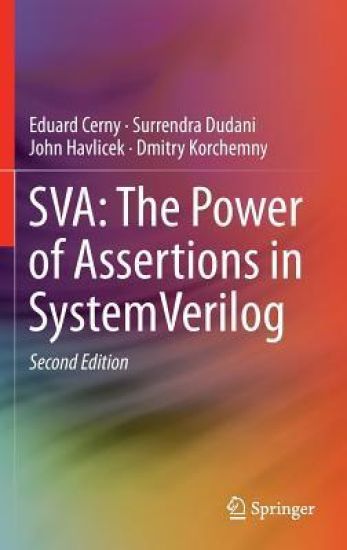
SVA: The Power of Assertions in SystemVerilog

SVA: The Power of Assertions in SystemVerilog

Eduard Cerny; Surrendra Dudani; John Havlicek; Dmitry Korchemny

Springer International Publishing AG
2016
nidottu
This book is a comprehensive guide to assertion-based verification of hardware designs using System Verilog Assertions (SVA). It enables readers to minimize the cost of verification by using assertion-based techniques in simulation testing, coverage collection and formal analysis. The book provides detailed descriptions of all the language features of SVA, accompanied by step-by-step examples of how to employ them to construct powerful and reusable sets of properties. The book also shows how SVA fits into the broader System Verilog language, demonstrating the ways that assertions can interact with other System Verilog components. The reader new to hardware verification will benefit from general material describing the nature of design models and behaviors, how they are exercised, and the different roles that assertions play. This second edition covers the features introduced by the recent IEEE 1800-2012. System Verilog standard, explaining in detail the new and enhanced assertion constructs. The book makes SVA usable and accessible for hardware designers, verification engineers, formal verification specialists and EDA tool developers. With numerous exercises, ranging in depth and difficulty, the book is also suitable as a text for students.

Verification Methodology Manual for SystemVerilog

Verification Methodology Manual for SystemVerilog

Janick Bergeron; Eduard Cerny; Alan Hunter; Andy Nightingale

Springer-Verlag New York Inc.
2014
nidottu
Functional verification remains one of the single biggest challenges in the development of complex system-on-chip (SoC) devices. Despite the introduction of successive new technologies, the gap between design capability and verification confidence continues to widen. The biggest problem is that these diverse new technologies have led to a proliferation of verification point tools, most with their own languages and methodologies. Fortunately, a solution is at hand. SystemVerilog is a unified language that serves both design and verification engineers by including RTL design constructs, assertions and a rich set of verification constructs. SystemVerilog is an industry standard that is well supported by a wide range of verification tools and platforms. A single language fosters the development of a unified simulation-based verification tool or platform. Consolidation of point tools into a unified platform and convergence to a unified language enable the development of a unified verification methodology that can be used on a wide range of SoC projects. ARM and Synopsys have worked together to define just such a methodology in the Verification Methodology Manual for SystemVerilog. This book is based upon best verification practices by ARM, Synopsys and their customers. Verification Methodology Manual for SystemVerilog is a blueprint for verification success, guiding SoC teams in building a reusable verification environment taking full advantage of design-for-verification techniques, constrained-random stimulus generation, coverage-driven verification, formal verification and other advanced technologies to help solve their current and future verification problems. This book is appropriate for anyone involved in the design or verification of a complex chip or anyone who would like to know more about the capabilities of SystemVerilog. Following the Verification Methodology Manual for SystemVerilog will give SoC development teams and project managers the confidence needed to tape out a complex design, secure in the knowledge that the chip will function correctly in the real world.
SVA: The Power of Assertions in SystemVerilog

SVA: The Power of Assertions in SystemVerilog

Eduard Cerny; Surrendra Dudani; John Havlicek; Dmitry Korchemny

Springer International Publishing AG
2014
sidottu
This book is a comprehensive guide to assertion-based verification of hardware designs using System Verilog Assertions (SVA). It enables readers to minimize the cost of verification by using assertion-based techniques in simulation testing, coverage collection and formal analysis. The book provides detailed descriptions of all the language features of SVA, accompanied by step-by-step examples of how to employ them to construct powerful and reusable sets of properties. The book also shows how SVA fits into the broader System Verilog language, demonstrating the ways that assertions can interact with other System Verilog components. The reader new to hardware verification will benefit from general material describing the nature of design models and behaviors, how they are exercised, and the different roles that assertions play. This second edition covers the features introduced by the recent IEEE 1800-2012. System Verilog standard, explaining in detail the new and enhanced assertion constructs. The book makes SVA usable and accessible for hardware designers, verification engineers, formal verification specialists and EDA tool developers. With numerous exercises, ranging in depth and difficulty, the book is also suitable as a text for students.
Hierarchical Annotated Action Diagrams

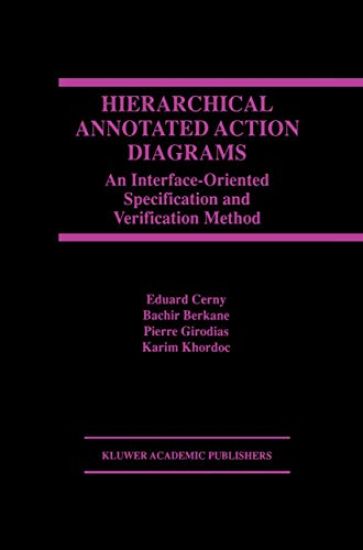
Hierarchical Annotated Action Diagrams

Eduard Cerny; Bachir Berkane; Pierre Girodias; Karim Khordoc

Springer-Verlag New York Inc.
2012
nidottu
Standardization of hardware description languages and the availability of synthesis tools has brought about a remarkable increase in the productivity of hardware designers. Yet design verification methods and tools lag behind and have difficulty in dealing with the increasing design complexity. This may get worse because more complex systems are now constructed by (re)using Intellectual Property blocks developed by third parties. To verify such designs, abstract models of the blocks and the system must be developed, with separate concerns, such as interface communication, functionality, and timing, that can be verified in an almost independent fashion. Standard Hardware Description Languages such as VHDL and Verilog are inspired by procedural `imperative' programming languages in which function and timing are inherently intertwined in the statements of the language. Furthermore, they are not conceived to state the intent of the design in a simple declarative way that contains provisions for design choices, for stating assumptions on the environment, and for indicating uncertainty in system timing. Hierarchical Annotated Action Diagrams: An Interface-Oriented Specification and Verification Method presents a description methodology that was inspired by Timing Diagrams and Process Algebras, the so-called Hierarchical Annotated Diagrams. It is suitable for specifying systems with complex interface behaviors that govern the global system behavior. A HADD specification can be converted into a behavioral real-time model in VHDL and used to verify the surrounding logic, such as interface transducers. Also, function can be conservatively abstracted away and the interactions between interconnected devices can be verified using Constraint Logic Programming based on Relational Interval Arithmetic. Hierarchical Annotated Action Diagrams: An Interface-Oriented Specification and Verification Method is ofinterest to readers who are involved in defining methods and tools for system-level design specification and verification. The techniques for interface compatibility verification can be used by practicing designers, without any more sophisticated tool than a calculator.
Verification Methodology Manual for SystemVerilog

Verification Methodology Manual for SystemVerilog

Janick Bergeron; Eduard Cerny; Alan Hunter; Andy Nightingale

Springer-Verlag New York Inc.
2005
sidottu
Functional verification remains one of the single biggest challenges in the development of complex system-on-chip (SoC) devices. Despite the introduction of successive new technologies, the gap between design capability and verification confidence continues to widen. The biggest problem is that these diverse new technologies have led to a proliferation of verification point tools, most with their own languages and methodologies. Fortunately, a solution is at hand. SystemVerilog is a unified language that serves both design and verification engineers by including RTL design constructs, assertions and a rich set of verification constructs. SystemVerilog is an industry standard that is well supported by a wide range of verification tools and platforms. A single language fosters the development of a unified simulation-based verification tool or platform. Consolidation of point tools into a unified platform and convergence to a unified language enable the development of a unified verification methodology that can be used on a wide range of SoC projects. ARM and Synopsys have worked together to define just such a methodology in the Verification Methodology Manual for SystemVerilog. This book is based upon best verification practices by ARM, Synopsys and their customers. Verification Methodology Manual for SystemVerilog is a blueprint for verification success, guiding SoC teams in building a reusable verification environment taking full advantage of design-for-verification techniques, constrained-random stimulus generation, coverage-driven verification, formal verification and other advanced technologies to help solve their current and future verification problems. This book is appropriate for anyone involved in the design or verification of a complex chip or anyone who would like to know more about the capabilities of SystemVerilog. Following the Verification Methodology Manual for SystemVerilog will give SoC development teams and project managers the confidence needed to tape out a complex design, secure in the knowledge that the chip will function correctly in the real world.
Hierarchical Annotated Action Diagrams

Hierarchical Annotated Action Diagrams

Eduard Cerny; Bachir Berkane; Pierre Girodias; Karim Khordoc

Springer
1998
sidottu
Standardization of hardware description languages and the availability of synthesis tools has brought about a remarkable increase in the productivity of hardware designers. Yet design verification methods and tools lag behind and have difficulty in dealing with the increasing design complexity. This may get worse because more complex systems are now constructed by (re)using Intellectual Property blocks developed by third parties. To verify such designs, abstract models of the blocks and the system must be developed, with separate concerns, such as interface communication, functionality, and timing, that can be verified in an almost independent fashion. Standard Hardware Description Languages such as VHDL and Verilog are inspired by procedural `imperative' programming languages in which function and timing are inherently intertwined in the statements of the language. Furthermore, they are not conceived to state the intent of the design in a simple declarative way that contains provisions for design choices, for stating assumptions on the environment, and for indicating uncertainty in system timing. Hierarchical Annotated Action Diagrams: An Interface-Oriented Specification and Verification Method presents a description methodology that was inspired by Timing Diagrams and Process Algebras, the so-called Hierarchical Annotated Diagrams. It is suitable for specifying systems with complex interface behaviors that govern the global system behavior. A HADD specification can be converted into a behavioral real-time model in VHDL and used to verify the surrounding logic, such as interface transducers. Also, function can be conservatively abstracted away and the interactions between interconnected devices can be verified using Constraint Logic Programming based on Relational Interval Arithmetic. Hierarchical Annotated Action Diagrams: An Interface-Oriented Specification and Verification Method is ofinterest to readers who are involved in defining methods and tools for system-level design specification and verification. The techniques for interface compatibility verification can be used by practicing designers, without any more sophisticated tool than a calculator.