Kirjojen hintavertailu – 12 859 827 kirjaa ja 27 kauppaa
Kirjailija
Edward Fitzgerald
Kirjat ja teokset yhdessä paikassa: 108 kirjaa, julkaisuja vuosilta 1993–2026, suosituimpiin kuuluu Omar Khayyam. Vertaile teosten hintoja ja tarkista saatavuus suomalaisista kirjakaupoista.
Edward Fitzgerald's Ruba�������Iyat Of Omar Khayyam: With Their Original Persian Sources (1899) is a book that presents the famous collection of poems by the Persian poet Omar Khayyam, translated into English by Edward Fitzgerald. The Ruba�������Iyat is a collection of quatrains, or four-line verses, that explore themes of love, mortality, and the meaning of life. This edition includes the original Persian text of the Ruba�������Iyat alongside Fitzgerald's translation, allowing readers to compare the two versions and gain a deeper understanding of the original work. The book also includes an introduction by Fitzgerald and a biographical sketch of Omar Khayyam, providing context and background for the poems. Overall, this book is a valuable resource for lovers of poetry and Persian literature, offering a unique glimpse into the work of one of the most celebrated poets of the Islamic world. This Is A New Release Of The Original 1899 Edition. This scarce antiquarian book is a facsimile reprint of the old original and may contain some imperfections such as library marks and notations. Because we believe this work is culturally important, we have made it available as part of our commitment for protecting, preserving, and promoting the world's literature in affordable, high quality, modern editions, that are true to their original work.
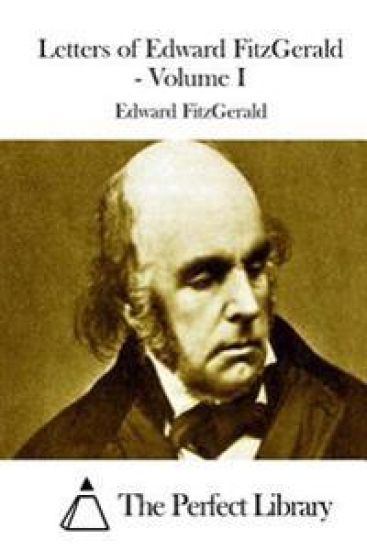
Bringing together more than a thousand unpublished letters as well as all the widely scattered published ones, these four volumes represent the first attempt at a complete edition of the letters of Edward Fitzgerald (1809-1883). Originally published in 1980. The Princeton Legacy Library uses the latest print-on-demand technology to again make available previously out-of-print books from the distinguished backlist of Princeton University Press. These editions preserve the original texts of these important books while presenting them in durable paperback and hardcover editions. The goal of the Princeton Legacy Library is to vastly increase access to the rich scholarly heritage found in the thousands of books published by Princeton University Press since its founding in 1905.
Bringing together more than a thousand unpublished letters as well as all the widely scattered published ones, these four volumes represent the first attempt at a complete edition of the letters of Edward Fitzgerald (1809-1883). Originally published in 1980. The Princeton Legacy Library uses the latest print-on-demand technology to again make available previously out-of-print books from the distinguished backlist of Princeton University Press. These editions preserve the original texts of these important books while presenting them in durable paperback and hardcover editions. The goal of the Princeton Legacy Library is to vastly increase access to the rich scholarly heritage found in the thousands of books published by Princeton University Press since its founding in 1905.
Bringing together more than a thousand unpublished letters as well as all the widely scattered published ones, these four volumes represent the first attempt at a complete edition of the letters of Edward Fitzgerald (1809-1883). Originally published in 1980. The Princeton Legacy Library uses the latest print-on-demand technology to again make available previously out-of-print books from the distinguished backlist of Princeton University Press. These editions preserve the original texts of these important books while presenting them in durable paperback and hardcover editions. The goal of the Princeton Legacy Library is to vastly increase access to the rich scholarly heritage found in the thousands of books published by Princeton University Press since its founding in 1905.
The Rub iy t of Omar Khayy m is the title that Edward FitzGerald gave to his translation of a selection of poems, originally written in Persian and numbering about a thousand, attributed to Omar Khayy m (1048-1131), a Persian poet, mathematician and astronomer. A ruba'i is a two-line stanza with two parts (or hemistichs) per line, hence the word rub iy t (derived from the Arabic language root for "four"), meaning "quatrains". Mystical interpretation "Wine of the Mystic" by Paramahansa Yogananda, is an illustrated interpretation of the FitzGerald translation. Each quatrain is accompanied with Persian text, a glossary of terms, Yoganada's spiritual interpretation, and practical interpretation. It won the 1994 Benjamin Franklin Award in the field of Religion. Yogananda makes an argument for the mystical basis of Khayyam's Rubaiyat. In Who is the Potter?, Abdullah Dougan, a Naqshbandi Sufi, provides a verse-by-verse commentary of the Rubaiyat. Dougan says that while Omar is a minor Sufi teacher compared to the giants - Rumi, Attar and Sana'i, for us he is a marvelous man because we can feel for him and understand his approach. The work is much more accessible than Sana'i's for instance; "Every line of the Rubaiyat has more meaning than almost anything you could read in Sufi literature". Dougan says that the many critics of Fitzgerald miss the point as he is only an instrument for what Allah wanted to happen - there have been many more literally correct translations, but Fitzgerald's is divine inspiration, something far superior, a miracle. In Dougan's opinion, while many read the Rubaiyat literally and hence see Omar as a materialist, he is in fact a spiritual teacher and is much maligned because people do not understand him. Abdullah Dougan says the work is deeply esoteric and "if you approach the quatrains with that in mind, the poem will have a tremendous impact on you as you try to understand it." Religious beliefs were deeply instilled in the people of the time, which gave much influence to the clergy, and the prosecution of poets who made statements contradictory to religious messages were prevalent, as was the case with Hafiz (whose house was raided several times, and was forced to burn some of his more liberal poems) and Ferdowsi (who was branded a heretic and was not permitted to be buried in the Muslims graveyard). The mystic interpretation of themes in poetry which were contrary to Islamic teachings became popular after the Safavid dynasty rise to power and the establishing of Twelver school of Shi'a Islam as the official religion of Iran. At this time poets such as Ferdowsi (who glorified the pre-Islamic Iran and patriotism), Hafiz (with his Epicurean view on life) and Khayyam (with openly agnostic themed poetry) had already found their roots among Iranian culture and their works were looked upon as masterpieces of Persian literature. In order to justify their popularity and lay "credence" to their messages, many Haram themes were interpreted as having hidden mystical meanings and parallels were drawn between verses and Shi'a themes and traditions. Some religious hardliners however repudiated Khayyam and the like altogether (and to a lesser extent still do today). Putting aside all this Khayyam never identified himself as a Sufi nor did anyone in his time. In fact on several occasions he mocks the devoutly religious who criticize the non religious.
Omar Khayy m was an eleventh and twelfth century Persian mathematician, scientist and poet who left over one thousand ruba'i, or quatrains, of a deeply philosophical nature. Through these short stanzas, Khayy m explored a variety of human themes including life and death, love, nature, beauty, and faith. In 1859, Edward FitzGerald translated, less literally than figuratively and structurally, seventy-five of these into English in the Rub iy t of Omar Khayy m. He continued to refine and expand his work over the course of five editions, issued through 1889. FitzGerald's romanticized translations were highly popular in Victorian England and led to widespread interest in Khayy m's works worldwide as well as newfound recognition of his contributions to science and mathematics. This collection presents FitzGerald's first edition text and annotations along with Edmund Sullivan's wonderfully stylized and romantic illustrations. Also included are full text versions of all FitzGerald editions as well as a stanza-by-stanza comparison of their evolution over the course of four decades.