Kirjojen hintavertailu – 12 903 725 kirjaa ja 27 kauppaa

Kirjailija

Edward G. Lengel

Kirjat ja teokset yhdessä paikassa: 9 kirjaa, julkaisuja vuosilta 2004–2023, suosituimpiin kuuluu The Battles of Connecticut Farms and Springfield, 1780. Vertaile teosten hintoja ja tarkista saatavuus suomalaisista kirjakaupoista.

9 kirjaa

Kirjojen julkaisuvuodet: 2004–2023.

Theaters of the American Revolution

Theaters of the American Revolution

James Kirby Martin; David Preston; Mark Edward Lender; Edward G. Lengel; Charles Neimeyer; Jim Piecuch

Westholme Publishing
2023
pokkari
Understanding the Course of the War for American independence through Geographical Regions Identifying discrete geographical areas in order to better understand a conflict that moves across hundreds of thou­sands of square miles of land and water, such as the American Civil War and World War II, has been a valuable historical method. During this time of greater study of the war that made America, the authors of Theaters of the American Revolution take this approach for the first time. The result is a stimulating volume that will allow readers to see how the war flowed from region to region from 1775 to 1781, beginning in the Northern colonies and Canada, through the dark months in the Middle colonies, to a shift to the South and culmination at Yorktown. Simultaneously, the war raged up and down the western frontier, with the Patriots working to keep the British and their Indian allies from disrupting the main battle armies to the east. Equally important was the war at sea, where American privateers and a fledgling navy attempted to harass the British; but with the entrance of France to the conflict, the control of the sea took a much more balanced--and important-- aspect. With specially commissioned maps and colorful descriptions of eighteenth century American terrain, settle­ments, and cities, as well as key battles, Theaters of the American Revolution provides an ideal introduction to understanding one of the most important wars in world history in its totality. Contents Introduction - James Kirby Martin and David L. Preston The Northern Theater - James Kirby Martin The Middle Theater - Edward G. Lengel and Mark Edward Lender The Southern Theater - Jim Piecuch The Western Theater - Mark Edward Lender The Naval Theater - Charles Neimeyer
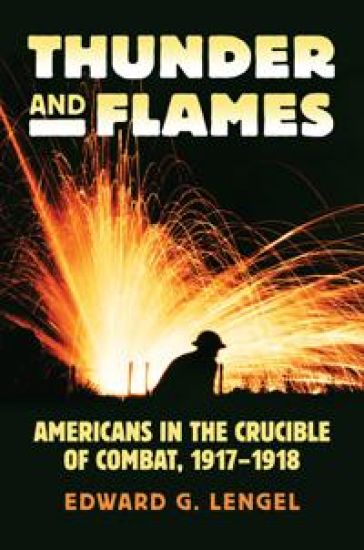
Thunder and Flames

Thunder and Flames

Edward G. Lengel

University Press of Kansas
2023
nidottu
Army Historical Foundation Distinguished Book Award. Master Corporal Jan Stanislaw Jakobczak Memorial Book Award. November 1917. The American troops were poorly trained, deficient in military equipment and doctrine, not remotely ready for armed conflict on a large scale—and they'd arrived on the Western front to help the French push back the Germans. The story of what happened next—the American Expeditionary Force's trial by fire on the brutal battlefields of France—is told in full for the first time in Thunder and Flames. Where history has given us some perspective on the individual battles of the period—at Cantigny, Chateau Thierry, Belleau Wood, the Marne River, Soissons, and little-known Fismette—they appear here as part of a larger series of interconnected operations, all conducted by Americans new to the lethal killing fields of World War I and guided by the battle-tested French. Following the AEF from their initial landing to their emergence as an independent army in late September 1918, this book presents a complex picture of how, learning warfare on the fly, sometimes with devastating consequences, the American force played a critical role in blunting and then rolling back the German army's drive toward Paris. The picture that emerges is at once sweeping in scope and rich in detail, with firsthand testimony conjuring the real mud and blood of the combat that Edward Lengel so vividly describes. Official reports and documents provide the strategic and historical context for these ground-level accounts, from the perspective of the Germans as well as the Americans and French. Battle by battle, Thunder and Flames reveals the cost of the inadequacies in U. S. training, equipment, logistics, intelligence, and command, along with the rifts in the Franco-American military marriage. But it also shows how, by trial and error, through luck and ingenuity, the AEF swiftly became the independent fighting force of General John ""Blackjack"" Pershing's long-held dream—its divisions ultimately among the most combat-effective military forces to see the war through.
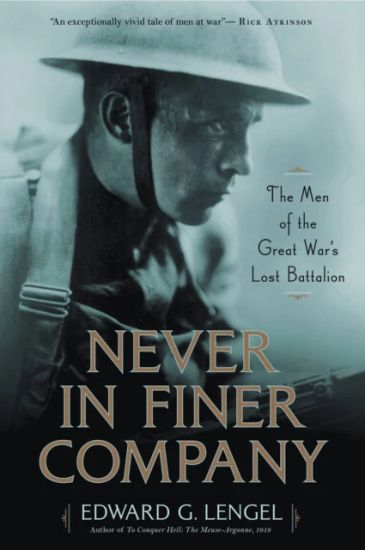
Never in Finer Company: The Men of the Great War's Lost Battalion

Never in Finer Company: The Men of the Great War's Lost Battalion

Edward G. Lengel

Grand Central Publishing
2021
nidottu

Halvin toimitettuna 20,90 €

Uncover the larger-than-life story of World War I's "Lost Battalion" and the men who survived the ordeal, triumphed in battle, and fought the demons that lingered. In the first week of October, 1918, six hundred men attacked into Europe's forbidding Argonne Forest. Against all odds, they surged through enemy lines--alone. They were soon surrounded and besieged. As they ran out of ammunition, water, and food, the doughboys withstood constant bombardment and relentless enemy assaults. Seven days later, only 194 soldiers from the original unit walked out of the forest. The stand of the US Army's "Lost Battalion" remains an unprecedented display of heroism under fire. Never in Finer Company tells the stories of four men whose lives were forever changed by the ordeal: Major Charles Whittlesey, a lawyer dedicated to serving his men at any cost; Captain George McMurtry, a New York stockbroker who becomes a tower of strength under fire; Corporal Alvin York, a country farmer whose famous exploits help rescue his beleaguered comrades; and Damon Runyon, an intrepid newspaper man who interviews the survivors and weaves their experiences into the American epic. Emerging from the patriotic frenzy that sent young men "over there," each of these four men trod a unique path to the October days that engulfed them--and continued to haunt them as they struggled to find peace. Uplifting and compelling, Never in Finer Company is a deeply moving and dramatic story on an epic scale.
The Battles of Connecticut Farms and Springfield, 1780

The Battles of Connecticut Farms and Springfield, 1780

Edward G. Lengel

Westholme Publishing
2020
sidottu
Featured in Ken Burns The American Revolution on PBS(R) By the spring of 1780, American fortunes were at a low point. Charleston, South Carolina, fell to British forces on May 12. At Morristown, New Jersey, George Washington's army struggled to recover from the worst winter of the entire war. The national economy failing, his troops short of supplies and on the verge of mutiny, Washington prepared for an all-out assault on British-occupied New York City with the support of approaching French naval and land forces under General Rochambeau. The planned attack was a gamble born of desperation. Washington felt he had to risk it, or face certain defeat. In New York City, German General Wilhelm von Knyphausen sensed opportunity. Commanding there in the absence of British General Henry Clinton, who was on his way back from Charleston, Knyphausen hoped that a quick strike into New Jersey could deliver a staggering blow to Washington's weakened army. The June 7-8 Battle of Connecticut Farms, however, found American militia and Continentals--mostly soldiers of General William Maxwell's New Jersey Brigade--to be shockingly stalwart. In a series of sharp engagements, fought hard on both sides, the Americans convinced Knyphausen to turn back. Clinton, fresh from his victory in the South, tried again on June 23 to end the war. His advance into New Jersey, intended to draw Washington into the open and perhaps capture Morristown, culminated in the Battle of Springfield. Once again, though, Washington's hardened soldiers, led by men like Colonel Israel Angell, Colonel Elias Dayton, and Major "Light Horse Harry" Lee, fought Clinton's forces to a standstill. The Battles for Connecticut Farms and Springfield, 1780, by distinguished historian Edward G. Lengel, chronicles these two important battles that marked a turning of the tide in the Revolutionary War. Drawing on newly available primary sources, the author presents a fresh and engaging interpretation of these events, which exposed King George III's declining military fortunes in North America even as they revealed the resilience of George Washington's army. The Small Battles Series: Military History as Local History Mark Edward Lender and James Kirby Martin, Series Editors Small Battles offers a fresh and important new perspective on the story of America's early conflicts. It was the small battles, not the clash of major armies, that truly defined the fighting during the colonial wars, the American Revolution, the War of 1812, and the hostilities on the frontiers. This is dramatic military history as seen through the prism of local history--history with a depth of detail, a feeling for place, people, and the impact of battle and its consequences that the story of major battles often cannot convey. The Small Battles Series focuses on America's military conflicts at their most intimate and revealing level.
Papers of George Washington, Volume 24

Papers of George Washington, Volume 24

Edward G. Lengel

University of Virginia Press
2016
sidottu
With volume 24 of the Revolutionary War Series, the conflict enters a new decade. New Year's Day 1780 finds Washington in winter quarters at Morristown, N. J., having established his headquarters at the Ford mansion there one month earlier. During the weeks covered by this volume, the Continental army experienced the harshest winter of the war. But the severity of the winter did not prevent Washington from mounting an offensive against British forces. Ice had formed a natural bridge to Staten Island, and Washington decided to use the situation to launch a major attack on the enemy's forts there. He assigned Major General Stirling to command the strike and assigned him 2,600 troops. Stirling launched the assault as planned in the early morning of 15 January, but the next day he had to report to Washington that the operation had failed. Although the attack was fruitless, it provides evidence of Washington's aggressive generalship: a major winter attack designed to cut off and capture enemy garrisons. Washington's enemy was not idle either. In addition to several raids on New Jersey towns and surprise attacks on outlying detachments, the British launched one operation with a far more ambitious goal: to seize Washington at the Ford mansion and carry him into New York City as a prisoner. The attack failed, but it was the deep snow--and not American bullets--that stopped the cavalry force sent to capture Washington. Enemy operations, however, were not the greatest threat to the survival of Washington's army. The harshness of the winter, the precarious state of Continental finances, and the resulting lack of provisions threatened his forces with starvation. To feed his troops, Washington implemented an emergency ""requisition"" of provisions throughout New Jersey. As usual, administration of the army consumed much of Washington's time. In addition to obtaining supplies, he had to oversee recruiting the army, obtaining clothing for his men, negotiating for the exchange of prisoners, and conducting inspections, as well as attending to the professionalism and discipline of the army. His burden became so heavy that in February he felt it would be ""impossible"" for him to execute the duties of commander in chief unless he received more support from his senior officers. Several letters to or from well-known figures of the Revolution appear in this volume, including Benedict Arnold, Benjamin Franklin, and Robert Morris. Washington's letter to Morris gives rare insight into the general's personal life. The commander in chief expressed his inclination to accept Morris's invitation to spend some of the winter with him, but he lamented that ""public duty"" necessitated remaining with the army at Morristown. He would, he explained to Morris, have to forgo such ""social enjoyments"" until the end of the war.
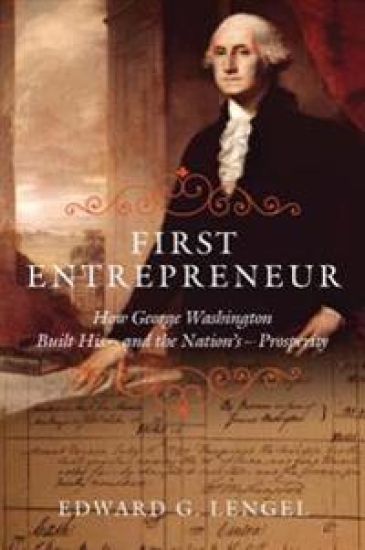
First Entrepreneur: How George Washington Built His -- And the Nation's -- Prosperity
The United States was conceived in business, founded on business, and operated as a business -- all because of the entrepreneurial mind of the greatest American businessman of any generation: George Washington. Using Washington's extensive but often overlooked financial papers, Edward G. Lengel chronicles the fascinating and inspiring story of how this self-educated man built the Mount Vernon estate into a vast multilayered enterprise and prudently managed meager resources to win the war of independence. Later, as president, he helped establish the national economy on a solid footing and favorably positioned the nation for the Industrial Revolution. Washington's steadfast commitment to the core economic principles of probity, transparency, careful management, and calculated boldness are timeless lessons that should inspire and instruct investors even today. First Entrepreneur will transform how ordinary Americans think about George Washington and how his success in commercial enterprise influenced and guided the emerging nation.
Thunder and Flames

Thunder and Flames

Edward G. Lengel

University Press of Kansas
2015
sidottu
November 1917. The American troops were poorly trained, deficient in military equipment and doctrine, not remotely ready for armed conflict on a large scale—and they’d arrived on the Western front to help the French push back the Germans. The story of what happened next—the American Expeditionary Force’s trial by fire on the brutal battlefields of France—is told in full for the first time in Thunder and Flames. Where history has given us some perspective on the individual battles of the period—at Cantigny, Chateau Thierry, Belleau Wood, the Marne River, Soissons, and little-known Fismette—they appear here as part of a larger series of interconnected operations, all conducted by Americans new to the lethal killing fields of World War I and guided by the battle-tested French. Following the AEF from their initial landing to their emergence as an independent army in late September 1918, this book presents a complex picture of how, learning warfare on the fly, sometimes with devastating consequences, the American force played a critical role in blunting and then rolling back the German army’s drive toward Paris. The picture that emerges is at once sweeping in scope and rich in detail, with firsthand testimony conjuring the real mud and blood of the combat that Edward Lengel so vividly describes. Official reports and documents provide the strategic and historical context for these ground-level accounts, from the perspective of the Germans as well as the Americans and French. Battle by battle, Thunder and Flames reveals the cost of the inadequacies in U. S. training, equipment, logistics, intelligence, and command, along with the rifts in the Franco-American military marriage. But it also shows how, by trial and error, through luck and ingenuity, the AEF swiftly became the independent fighting force of General John “Blackjack” Pershing’s long-held dream—its divisions ultimately among the most combat-effective military forces to see the war through.
General George Washington: A Military Life

General George Washington: A Military Life

Edward G. Lengel

Random House Trade
2007
nidottu
A definitive military portrait of America's first president traces Washington's wartime experiences from the 1750s to the 1790s, assessing the characteristics, successes, and failures of George Washington as a military strategist, tactician, administrator, and leader of men and explaining how he unified and shaped the military forces that won the American Revolution. Reprint. 20,000 first printing.
World War I Memories

World War I Memories

Edward G. Lengel

Scarecrow Press
2004
nidottu
This comprehensive annotated bibliography includes over 1,400 references to memoirs, diaries, and letters by soldiers and civilians from all belligerent nations during World War I. Key features include: Incisive commentary on each entry's value to historians, enthusiasts, and collectors, Includes well-known and overlooked titles, Organization by country, Introduction provides a reader's guide to the best World War I literature, Indexes by title and subject allow searching by units, fronts, personal perspectives, and battles This reference source is a necessary addition to the collections of World War I enthusiasts, military historians, and academic and public libraries.