Kirjojen hintavertailu – 12 859 828 kirjaa ja 27 kauppaa

Kirjailija

Edward Gibbon

Kirjat ja teokset yhdessä paikassa: 580 kirjaa, julkaisuja vuosilta 1984–2026, suosituimpiin kuuluu The History of the Decline and Fall of the Roman Empire. By Edward Gibbon, Esq; Volume the First. The Fourth Edition. of 1; Volume 1. Vertaile teosten hintoja ja tarkista saatavuus suomalaisista kirjakaupoista.

580 kirjaa

Kirjojen julkaisuvuodet: 1984–2026.

The History of the Decline and Fall of the Roman Empire

The History of the Decline and Fall of the Roman Empire

Edward Gibbon

Penguin Classics
2000
pokkari

Halvin toimitettuna 18,70 €

Spanning thirteen centuries from the age of Trajan to the taking of Constantinople by the Turks, DECLINE & FALL is one of the greatest narratives in European Literature. David Womersley's masterly selection and bridging commentary enables the readerto acquire a general sense of the progress and argument of the whole work and displays the full variety of Gibbon's achievement.
The Decline and Fall of the Roman Empire

The Decline and Fall of the Roman Empire

Edward Gibbon

Wordsworth Editions Ltd
1998
nidottu

Halvin toimitettuna 11,90 €

Gibbon's Decline and Fall of the Roman Empire, published between 1776 and 1788, is the undisputed masterpiece of English historical writing which can only perish with the language itself. Its length alone is a measure of its monumental quality: seventy-one chapters, of which twenty-eight appear in full in this edition. With style, learning and wit, Gibbon takes the reader through the history of Europe from the second century AD to the fall of Constantinople in 1453 - an enthralling account by 'the greatest of the historians of the Enlightenment'. This edition includes Gibbon's footnotes and quotations, here translated for the first time, together with brief explanatory comments, a precis of the chapters not included, 16 maps, a glossary, and a list of emperors.
Gibbon's History of the Decline and Fall of the Roman Empire
Few books of scholarship have held up so well to public attention over the last two hundred years. At a time when the materials for this history were scant, a mind as great as Gibbon's was able to absorb everything known on the subject and dominate it with his historical erudition and inimitable literary style. The first volume, highly acclaimed on publication, was quickly reprinted in spite of an ambitious first print-run of 1000 copies. Careless proofreading meant numerous errors had to be rectified in later editions. It was not until the third edition, reprinted here, that the layout was improved and the footnotes appeared at the foot of each page and chapter numbers were placed in the margins.
The History of the Decline and Fall of the Roman Empire
Edward Gibbon's six-volume History of the Decline and Fall of the Roman Empire (1776-88) is among the most magnificent and ambitious narratives in European literature. Its subject is the fate of one of the world's greatest civilizations over thirteen centuries - its rulers, wars and society, and the events that led to its disastrous collapse. Here, in volumes one and two, Gibbon charts the vast extent and constitution of the Empire from the reign of Augustus to 395 ad. And in a controversial critique, he examines the early Church, with fascinating accounts of the first Christian and last pagan emperors, Constantine and Julian.
The History of the Decline and Fall of the Roman Empire
Edward Gibbon's six-volume History of the Decline and Fall of the Roman Empire (1776-88) is among the most magnificent and ambitious narratives in European literature. Its subject is the fate of one of the world's greatest civilizations over thirteen centuries - its rulers, wars and society, and the events that led to its disastrous collapse. Here, in volumes three and four, Gibbon vividly recounts the waves of barbarian invaders under commanders such as Alaric and Attila, who overran and eventually destroyed the West. He then turns his gaze to events in the East, where even the achievements of the Byzantine emperor Justinian and the campaigns of the brilliant military leader Belisarius could not conceal the fundamental weaknesses of their empire.
Decline and Fall of the Roman Empire: Vols 4-6

Decline and Fall of the Roman Empire: Vols 4-6

Edward Gibbon

Everyman's Library
1994
sidottu

Halvin toimitettuna 52,20 €

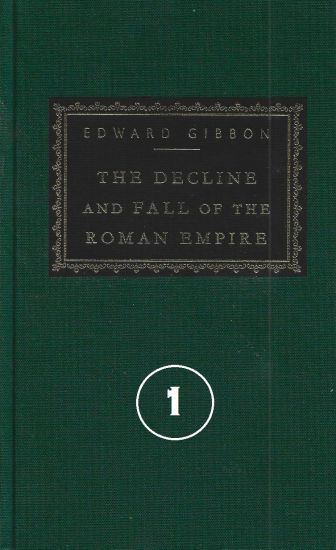
The first three volumes of Gibbon's DECLINE AND FALL (the western empire) were published by Everyman in 1993. Volumes 4-6 complete the set which is now available for the first time in many years. This year is the bicentenary of Gibbon's death, which has been widely noticed in the press, but even after two hundred years his book is still an authoritative work on Roman history. What is more, it remains wonderfully readable: witty, elegant and intriguing, full of the author's own personality. The six-volume Everyman edition - the only complete one now available-prints the entire text of the book with all Gibbon's own notes, later editorial commentaries, maps, tables, descriptive tables of contents, indices, appendices and two magisterial essays on the author and his work by Hugh Trevor-Roper.
Decline and Fall of the Roman Empire: Vols 1-3

Decline and Fall of the Roman Empire: Vols 1-3

Edward Gibbon

Everyman's Library
1993
sidottu

Halvin toimitettuna 52,20 €

Easily the most celebrated historical work in English, Gibbon's account of the Roman empire was in its time a landmark in classical and historical scholarship and remains a remarkable fresh and powerful contribution to the interpretation of Roman history more than two hundred years after its first appearance. Its fame, however, rests more on the exceptional clarity, scope and force of its argument, and the brilliance of its style, which is still a delight to read. Furthermore, both argument and style embody the Enlightenment values of rationality, lucidity and order to which Gibbon so passionately subscribed and to which his HISTORY is such a magnificent monument.
On Christianity

On Christianity

Edward Gibbon

Prometheus Books
1991
pokkari
Written originally as the 15th and 16th chapters of his great work, "The Decline and Fall of the Roman Empire (1776-1788)", "On Christianity" joined the growing number of revisionist histories whose authors rejected the view that popular support of Christianity was miraculously preordained. Gibbon interprets the ascendancy of Christianity in terms of natural social causes, laying bare the paucity of evidence for the supernatural guidance of church actions.
The Saracens

The Saracens

Edward Gibbon; Simon Ockley

Darf Publishers Ltd
1985
sidottu
The foreword to this work, first published over a century ago, provides the following recommendation: 'The narrative of Simon Ockley, which Edward Gibbon characterised as instructive, and his translation of Arabic MSS as 'learned and spirited', make his 'History of the Saracens' a fitting sequel to what has been offered in this volume from Gibbon's great work.' The combined essence of the writings of these two historians on Saracenic history, is here combined in a single volume of unsurpassed scholarship. Its republication will be welcomed by a wide readership. Simon Ockley (1678-1720) was born in Exeter and educated at Cambridge where, in 1711, he became Professor of Arabic at the University. His great work on the Saracens, published between 1708 and 1757, was the result of years of study in the Bodleian Library in Oxford. The second part of the present volume is an abridgement of this work. Edward Gibbon (1737-1794) is best known for his monumental history 'The Decline and Fall of the Roman Empire'. He was an admirer of Ockley's early translations from Arabic sources. Gibbon's own work forms the first part of the present work.

Memoirs of My Life

Memoirs of My Life

Edward Gibbon

Penguin Books Ltd
1984
pokkari
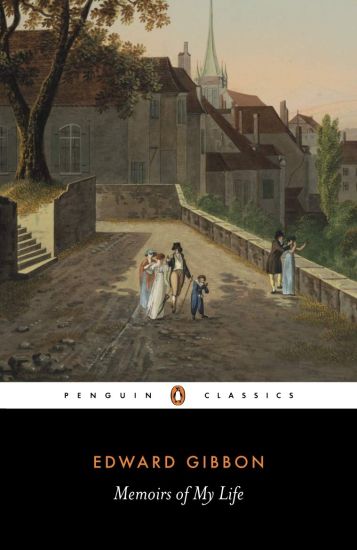
Edward Gibbon was one of the world's greatest historians and a towering figure of his age. When he died in 1794 he left behind the unfinished drafts of his memoirs, which were posthumously edited by his friend Lord Sheffield. Recounting Gibbon's sickly childhood in London, he distils his genius for history into a remarkable gift for autobiography.