Kirjojen hintavertailu – 12 903 725 kirjaa ja 27 kauppaa

Kirjailija

Edward J. Nell

Kirjat ja teokset yhdessä paikassa: 5 kirjaa, julkaisuja vuosilta 1991–2013, suosituimpiin kuuluu Rational Econometric Man. Vertaile teosten hintoja ja tarkista saatavuus suomalaisista kirjakaupoista.

5 kirjaa

Kirjojen julkaisuvuodet: 1991–2013.

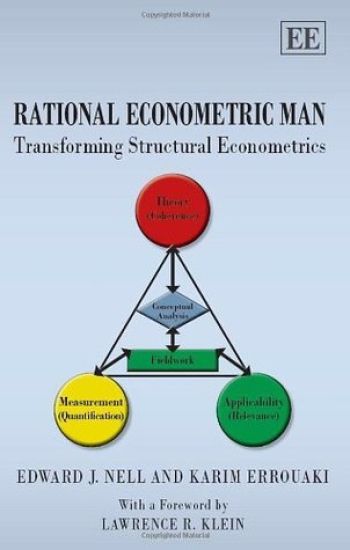
Rational Econometric Man

Rational Econometric Man

Edward J. Nell; Karim Errouaki

Edward Elgar Publishing Ltd
2013
sidottu
This challenging and original book takes a fresh, innovative look at econometrics, and re-examines the scientific standing of structural econometrics as developed by the founders (Frisch and Tinbergen) and extended by Haavelmo and the Cowles modellers (particularly Klein) during the period 1930-1960. The authors begin by rethinking the scientific foundations of structural econometrics, offering a way around the problem of induction that also justifies the assumption of a data generating mechanism', and of ways to model this. They go on to explain how current critiques of the methodological foundations of structural econometrics are direct consequences of implicitly accepted but seriously flawed elements in neoclassical thinking. In the final part they present their distinctive methodological contribution: a blend of fieldwork and conceptual analysis designed to ensure that their models are well grounded in reality, and at the same time, conceptually coherent as well as statistically adequate. In so doing, they outline a number of elements that will be needed to develop a 'good' macroeconometric model of an advanced economy. Rational Econometric Man will prove a stimulating and thought-provoking read for scholars and researchers in the field of economics, and, more specifically, heterodox economics. Contents: Foreword by Lawrence R. Klein Introduction Part I: From Rational Economic Man to Rational Econometric Man 1. Re-reading Hollis and Nell 2. Haavelmo Reconsidered as Rational Econometric Man 3. Induction and the Empiricist Account of General Laws 4. Variables, Laws and Induction I: Are There Laws of Nature? 5. Variables, Laws and Induction II: Scientific Variables and Scientific Laws in Economics 6. The Concept of the 'Model' and the Methodology of Model Building Part II: The Critiques and the Foundations 7. Debating the Foundations: A New Perspective? 8. Scientific Issues in Structural Econometrics 9. Haavelmo and Beyond: Probability, Uncertainty, Specification and Stochasticism Part III: Structural Econometrics in its Place: Mapping New Directions 10. Conceptual Analysis, Fieldwork and the Methodology of Model Building 11. Working with Open Models: Lawlike Relations and an Uncertain Future Conclusion References Index
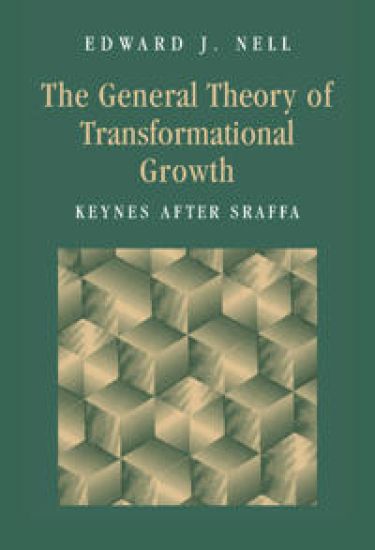
The General Theory of Transformational Growth

The General Theory of Transformational Growth

Edward J. Nell

Cambridge University Press
1998
sidottu
For the last century, economic analysis has been wedded to the idea of equilibrium, in spite of the evident fact that most economic relationships are in flux. The theory of transformational growth in this work replaces equilibrium with history. The role of the market is not to allocate resources, but to generate innovations, which are 'selected' by competition in an evolutionary process. These innovations in turn change the way markets work and how they adjust, thus creating new problems and new kinds of pressures to innovate. Different historical periods can be distinguished with a new one perhaps on the horizon. In each a distinctive style of technology prevails, associated with corresponding institutions and patterns of market behavior. The core relationships provide the foundations for a theory of monetary circulation, which makes possible a revised Keynesian approach, based on Classical foundations.
Transformational Growth and Effective Demand

Transformational Growth and Effective Demand

Edward J. Nell

New York University Press
1992
sidottu
This collection of essays develops Edward Nell's influential theory of transformational growth. Nell sets established concepts such as the classical notion of prices of production and the wage-profit frontier within a significant new framework that illustrates their role in the dynamic evoution of the industrial system from its beginnings in feudalism through the early capitalism of the family firms to the modern system of effective demands and multiplier adjustments. The essays present the method and its relation to the capital critique before developing the main ideas of transformational growth through a series of historical studies culminating in a revised theory of the multiplier. Outlining policies which strongly affirm an expansionist approach, Nell porposes a reconstruction of macroeconimics.