Kirjojen hintavertailu – 12 903 724 kirjaa ja 27 kauppaa

Kirjailija

Edward S. Corwin

Kirjat ja teokset yhdessä paikassa: 18 kirjaa, julkaisuja vuosilta 1978–2018, suosituimpiin kuuluu John Marshall and the Constitution. Vertaile teosten hintoja ja tarkista saatavuus suomalaisista kirjakaupoista.

Nimi esiintyy myös muodoissa: Edward S Corwin

18 kirjaa

Kirjojen julkaisuvuodet: 1978–2018.

The Doctrine of Judicial Review

The Doctrine of Judicial Review

Edward S. Corwin

Routledge
2017
sidottu
This book, first published in 1914, contains five historical essays. Three of them are on the concept of judicial review, which is defined as the power of a court to review and invalidate unlawful acts by the legislative and executive branches of government. One chapter addresses the historical controversy over states' rights. Another concerns the Pelatiah Webster Myth the notion that the US Constitution was the work of a single person. In "Marbury v. Madison and the Doctrine of Judicial Review," Edward S. Corwin analyzes the legal source of the power of the Supreme Court to review acts of Congress. "We, the People" examines the rights of states in relation to secession and nullification. "The Pelatiah Webster Myth" demolishes Hannis Taylor's thesis that Webster was the "secret" author of the constitution. "The Dred Scott Decision" considers Chief Justice Taney's argument concerning Scott's title to citizenship under the Constitution. "Some Possibilities in the Way of Treaty-Making" discusses how the US Constitution relates to international treaties. Matthew J. Franck's new introduction to this centennial edition situates Corwin's career in the history of judicial review both as a concept and as a political reality.
The Doctrine of Judicial Review

The Doctrine of Judicial Review

Edward S. Corwin

AldineTransaction
2014
nidottu
This book, first published in 1914, contains five historical essays. Three of them are on the concept of judicial review, which is defined as the power of a court to review and invalidate unlawful acts by the legislative and executive branches of government. One chapter addresses the historical controversy over states' rights. Another concerns the Pelatiah Webster Myth—the notion that the US Constitution was the work of a single person. In "Marbury v. Madison and the Doctrine of Judicial Review," Edward S. Corwin analyzes the legal source of the power of the Supreme Court to review acts of Congress. "We, the People" examines the rights of states in relation to secession and nullification. "The Pelatiah Webster Myth" demolishes Hannis Taylor's thesis that Webster was the "secret" author of the constitution. "The Dred Scott Decision" considers Chief Justice Taney's argument concerning Scott's title to citizenship under the Constitution. "Some Possibilities in the Way of Treaty-Making" discusses how the US Constitution relates to international treaties. Matthew J. Franck's new introduction to this centennial edition situates Corwin's career in the history of judicial review both as a concept and as a political reality.
Higher Law Background of American Constitutional Law
Having written extensively on various aspects of the American constitutional order, Edward S Corwin is considered a leading constitutional scholar of the twentieth century. Alpheus Mason described Corwin's writings as "sources of learning and understanding -- hallmarks to emulate and revere." "The Higher Law Background of American Constitutional Law" is of unique value in connecting the Western European experience -- from the classical world, the Middle Ages, and the seventeenth-century thought of Coke and Locke -- to the American founding. This renowned work provides a bold and accurate outline of the tradition behind the 'higher law' of the United States and places in historical context the political philosophy underlying the US Declaration of Independence and Constitution. This volume addresses questions such as: Where did the idea of a 'higher law' originate? How has it been able to survive and in what transformations? What special forms of it are of particular interest for historians and political theorists? and; How was it brought to America and wrought into the American system of government? As Clinton Rossiter notes in his prefatory note, "No one can come away from reading (Higher Law) without realizing how much we in America are part of Western civilization. The men we meet in the pages of this essay -- Demosthenes, Sophocles, Aristotle, Cicero, Seneca, Ulpian, Gaius, John of Salisbury, Isidore of Seville, St. Thomas Aquinas, Bracton, Fortescue, Coke, Grotius, Newton, Hooker, Pufendorf, Locke, Blackstone -- all insisted that the laws by which men live can and should be the 'embodiment of essential and unchanging justice', and we may salute them respectfully as founding fathers of our experiment in ordered liberty." In this volume Corwin demonstrates how the concept of a higher law developed and was understood by the leading thinkers of the American Revolutionary period as well as how the ideal of the higher law impacted the creation of the American Constitution. Students, scholars, and general interested readers of constitutional law and political theory will find inspiration in the pages of THE 'HIGHER LAW' BACKGROUND OF AMERICAN CONSTITUTIONAL LAW.

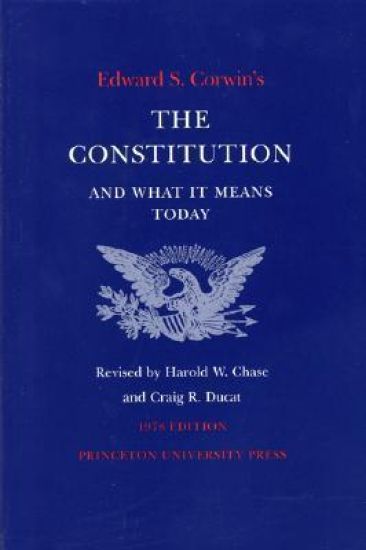
Edward S. Corwin's Constitution and What It Means Today

Edward S. Corwin's Constitution and What It Means Today

Edward S. Corwin

Princeton University Press
1978
pokkari
For over seventy-five years Edward S. Corwin's text has been a basic reference in the study of U. S. Constitutional Law. The 14th edition, the first new edition since 1973, brings the volume up to date through 1977. In this classic work, historian Edward Corwin presented the text of the U. S. Constitution along with his own commentary on its articles, sections, clauses, and amendments. Corwin was a renowned authority on constitutional law and jurisprudence, and was hired at Princeton University by Woodrow Wilson in 1905. Far from being an impersonal textbook, Corwin's edition was full of opinion. Not afraid to express his own strong views of the development of American law, Corwin offered piquant descriptions of the debates about the meaning of clauses, placing recent decisions of the court "in the familiar setting of his own views." The favor of his style is evident in his comments on judicial review ("American democracy's way of covering its bet") and the cabinet ("an administrative anachronism" that should be replaced by a legislative council "whose daily salt does not come from the Presidential table"). Corwin periodically revised the book for nearly forty years, incorporating into each new edition his views of new Supreme Court rulings and other changes in American law. Although Corwin intended his book for the general public, his interpretations always gained the attention of legal scholars and practitioners. The prefaces he wrote to the revised editions were often controversial for the views he offered on the latest developments of constitutional law, and the book only grew in stature and recognition. After his death in 1963, other scholars prepared subsequent editions, fourteen in all.