
Kirjojen hintavertailu – 12 903 725 kirjaa ja 27 kauppaa

Kirjailija

Ehab Ellobody

Kirjat ja teokset yhdessä paikassa: 4 kirjaa, julkaisuja vuosilta 2013–2026, suosituimpiin kuuluu Thin-Walled Structural Members Under Web Crippling Loadings. Vertaile teosten hintoja ja tarkista saatavuus suomalaisista kirjakaupoista.

4 kirjaa

Kirjojen julkaisuvuodet: 2013–2026.

Thin-Walled Structural Members Under Web Crippling Loadings

Thin-Walled Structural Members Under Web Crippling Loadings

Ehab Ellobody

Elsevier - Health Sciences Division
2026
nidottu
Thin-Walled Structural Members Under Web Crippling Loadings: Finite Element Analysis, Design, and Integrated Testing addresses a critical and specialized area in structural engineering focused on the behavior, analysis, and design of thin-walled steel members subjected to web crippling loadings. This reference integrates experimental testing, advanced numerical modeling, and international design codes to improve understanding and practical design of cold-formed steel structures worldwide. The book offers in-depth coverage of experimental testing procedures and finite element analysis, including practical guidance on software tools, model verification, and validation best practices. It includes design examples that demonstrate real-world applications across multiple international codes. The book also presents integrated comparisons of experimental, numerical, and design results, discusses failure modes, and incorporates reliability analyses and parametric studies. This book serves as a valuable resource for researchers, structural and design engineers, graduate and PhD students, as well as manufacturers and industry professionals, with advanced methodologies to enhance the safety, performance, and innovation of thin-walled structural members under web crippling loadings.
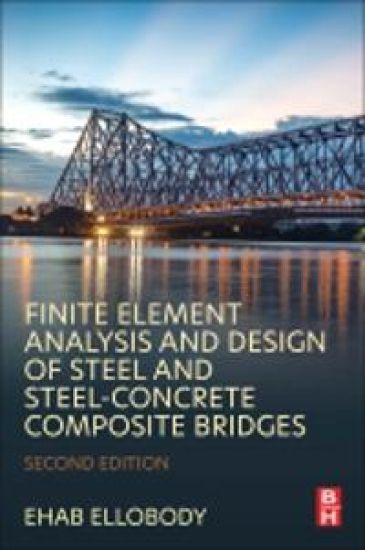
Finite Element Analysis and Design of Steel and Steel–Concrete Composite Bridges
This second edition of Finite Element Analysis and Design of Steel and Steel-Concrete Composite Bridges is brought fully up-to-date and provides structural engineers, academics, practitioners, and researchers with a detailed, robust, and comprehensive combined finite modeling and design approach. The book’s eight chapters begin with an overview of the various forms of modern steel and steel-concrete composite bridges, current design codes (American, British, and Eurocodes), nonlinear material behavior of the bridge components, and applied loads and stability of steel and steel-concrete composite bridges. This is followed by self-contained chapters concerning design examples of steel and steel-concrete composite bridge components as well as finite element modeling of the bridges and their components. The final chapter focuses on finite element analysis and the design of composite highway bridges with profiled steel sheeting. This volume will serve as a valuable reference source addressing the issues, problems, challenges, and questions on how to enhance the design of steel and steel-concrete composite bridges, including highway bridges with profiled steel sheeting, using finite element modeling techniques.
Finite Element Analysis and Design of Steel and Steel–Concrete Composite Bridges
In recent years, bridge engineers and researchers are increasingly turning to the finite element method for the design of Steel and Steel-Concrete Composite Bridges. However, the complexity of the method has made the transition slow. Based on twenty years of experience, Finite Element Analysis and Design of Steel and Steel-Concrete Composite Bridges provides structural engineers and researchers with detailed modeling techniques for creating robust design models. The book’s seven chapters begin with an overview of the various forms of modern steel and steel–concrete composite bridges as well as current design codes. This is followed by self-contained chapters concerning: nonlinear material behavior of the bridge components, applied loads and stability of steel and steel–concrete composite bridges, and design of steel and steel–concrete composite bridge components.
Finite Element Analysis and Design of Metal Structures

Finite Element Analysis and Design of Metal Structures

Ehab Ellobody; Ran Feng; Ben Young

Butterworth-Heinemann Inc
2013
sidottu
Traditionally, engineers have used laboratory testing to investigate the behavior of metal structures and systems. These numerical models must be carefully developed, calibrated and validated against the available physical test results. They are commonly complex and very expensive. From concept to assembly, Finite Element Analysis and Design of Metal Structures provides civil and structural engineers with the concepts and procedures needed to build accurate numerical models without using expensive laboratory testing methods. Professionals and researchers will find Finite Element Analysis and Design of Metal Structures a valuable guide to finite elements in terms of its applications.