Kirjojen hintavertailu – 12 859 828 kirjaa ja 27 kauppaa

Kirjailija

Eilidh Garrett

Kirjat ja teokset yhdessä paikassa: 4 kirjaa, julkaisuja vuosilta 2001–2022, suosituimpiin kuuluu Infant Mortality: A Continuing Social Problem. Vertaile teosten hintoja ja tarkista saatavuus suomalaisista kirjakaupoista.

4 kirjaa

Kirjojen julkaisuvuodet: 2001–2022.

Infant Mortality: A Continuing Social Problem

Infant Mortality: A Continuing Social Problem

Eilidh Garrett; Chris Galley; Nicola Shelton; Robert Woods

TAYLOR FRANCIS LTD
2022
nidottu
In 1906, Sir George Newman's 'Infant Mortality: A Social Problem', one of the most important health studies of the twentieth century, was published. To commemorate this anniversary, this volume brings together an interdisciplinary team of leading academics to evaluate Newman's critical contribution, to review current understandings of the history of infant and early childhood mortality, especially in Britain, and to discuss modern approaches to infant health as a continuing social problem. The volume argues that, even after 100 years of health programmes, scientific advances and medical interventions, early childhood mortality is still a significant social problem and it also proposes new ways of defining and tracking the problem of persistent mortality differentials.
Infant Mortality: A Continuing Social Problem

Infant Mortality: A Continuing Social Problem

Eilidh Garrett; Chris Galley; Nicola Shelton; Robert Woods

CRC Press Inc
2017
sidottu
In 1906, Sir George Newman's 'Infant Mortality: A Social Problem', one of the most important health studies of the twentieth century, was published. To commemorate this anniversary, this volume brings together an interdisciplinary team of leading academics to evaluate Newman's critical contribution, to review current understandings of the history of infant and early childhood mortality, especially in Britain, and to discuss modern approaches to infant health as a continuing social problem. The volume argues that, even after 100 years of health programmes, scientific advances and medical interventions, early childhood mortality is still a significant social problem and it also proposes new ways of defining and tracking the problem of persistent mortality differentials.
Changing Family Size in England and Wales

Changing Family Size in England and Wales

Eilidh Garrett; Alice Reid; Kevin Schürer; Simon Szreter

Cambridge University Press
2006
pokkari
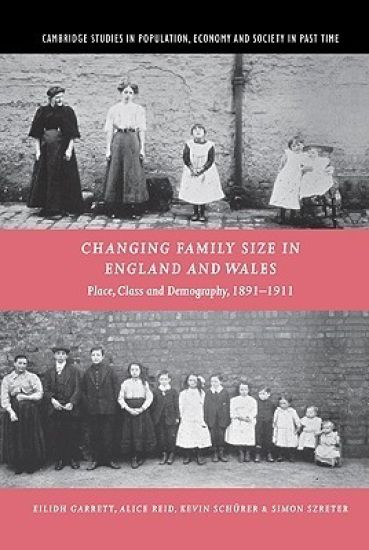
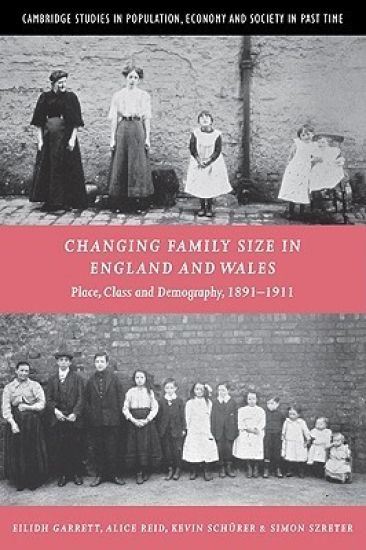
This volume is an important study in demographic history. It draws on the individual returns from the 1891, 1901 and 1911 censuses of England and Wales, to which Garrett, Reid, Schürer and Szreter were permitted access ahead of scheduled release dates. Using the responses of the inhabitants of thirteen communities to the special questions included in the 1911 'fertility' census, they consider the interactions between the social, economic and physical environments in which people lived and their family-building experience and behaviour. Techniques and approaches based in demography, history and geography enable the authors to re-examine the declines in infant mortality and marital fertility which occurred at the turn of the twentieth century. Comparisons are drawn within and between white-collar, agricultural and industrial communities, and the analyses, conducted at both local and national level, lead to conclusions which challenge both contemporary and current orthodoxies.
Changing Family Size in England and Wales

Changing Family Size in England and Wales

Eilidh Garrett; Alice Reid; Kevin Schürer; Simon Szreter

Cambridge University Press
2001
sidottu
This volume is an important study in demographic history. It draws on the individual returns from the 1891, 1901 and 1911 censuses of England and Wales, to which Garrett, Reid, Schürer and Szreter were permitted access ahead of scheduled release dates. Using the responses of the inhabitants of thirteen communities to the special questions included in the 1911 'fertility' census, they consider the interactions between the social, economic and physical environments in which people lived and their family-building experience and behaviour. Techniques and approaches based in demography, history and geography enable the authors to re-examine the declines in infant mortality and marital fertility which occurred at the turn of the twentieth century. Comparisons are drawn within and between white-collar, agricultural and industrial communities, and the analyses, conducted at both local and national level, lead to conclusions which challenge both contemporary and current orthodoxies.